




BlackRock analysts have highlighted the transformation of the financial system under the influence of cryptocurrencies and the rising US national debt. According to the company’s report, stablecoins have become a bridge between digital and traditional economies.
Experts emphasized that stablecoins are no longer merely tools for crypto trading. By November 2025, the market volume exceeded $250 billion. The asset is increasingly used for cross-border transfers and everyday payments.


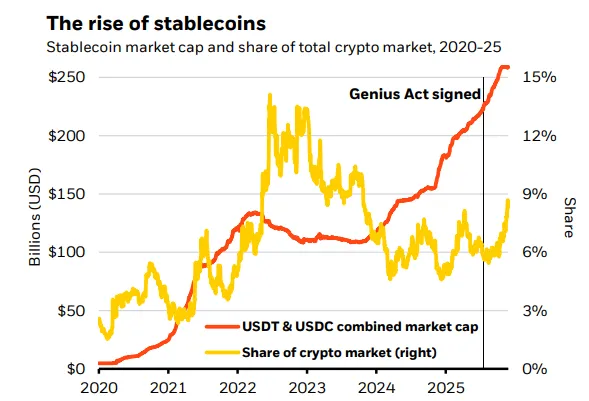
The report mentions the adoption of the GENIUS Act in the US, which established the first regulatory framework for payment stablecoins. Issuers were allowed to use marketing incentives, making them competitors to bank deposits and money market funds.
The mass shift of capital into digital assets could alter the mechanisms of economic lending, according to BlackRock. Banks risk losing some liquidity.
Furthermore, in developing countries, stablecoins are replacing weak national currencies. This expands access to the dollar but complicates the monetary policy of local central banks.
BlackRock also identified other key trends:
- AI and Energy. The development of artificial intelligence is hitting physical limits. By 2030, data centers could consume up to 25% of all electricity in the US.
- Politics. The world has entered a “third world order” after World War II. US-China relations define the global agenda, while Europe is increasing defense spending.
- Investments. The company maintains a positive outlook on US stocks amid AI development.
The report also noted the issue of US national debt. BlackRock analysts no longer consider long-term Treasury bonds a reliable safe asset for portfolios. Investors are advised to seek alternative hedging instruments amid growing budget deficits.
Larry Fink and Bitcoin
BlackRock CEO Larry Fink explained his dramatic shift in views on cryptocurrencies. Speaking at the NYT DealBook summit, he commented on his journey from harsh criticism of the industry to launching the largest spot bitcoin ETF.
Fink acknowledged that his transition from associating digital assets with money laundering to managing billion-dollar assets in digital gold has become a “vivid public example” of changing beliefs. According to the BlackRock CEO, “his thought process is constantly evolving.”
Fink described bitcoin as a “fear asset.” The top executive noted that the first cryptocurrency’s prices decline when markets gain certainty, for instance, amid news of US-China trade deals or easing political tensions.
The expert also warned short-term investors about the risks. Fink stressed that bitcoin remains an extremely volatile instrument. Successful trading requires a perfect sense of the market, which, in the opinion of the BlackRock head, most people do not possess.
Back in November, the head of the investment firm’s crypto division, Robert Mitchnick, stated that most clients of the world’s largest asset managers do not consider digital gold as a means of payment.