



Block Shares Surge 20% Following Major Layoffs for AI Transition
Jack Dorsey announced layoffs at Block for AI transition, boosting shares by 20%.
Jack Dorsey, CEO of Block, announced the layoff of nearly 4,000 employees. The decision is part of the company’s shift to a “more compact, flat, and AI-focused” structure.
we’re making @blocks smaller today. here’s my note to the company.
####
today we’re making one of the hardest decisions in the history of our company: we’re reducing our organization by nearly half, from over 10,000 people to just under 6,000. that means over 4,000 of you are…
— jack (@jack) February 26, 2026
Earlier in February, Bloomberg reported that the company was preparing to lay off up to 10% of its staff.
According to Dorsey, artificial intelligence and its associated tools are fundamentally changing operational principles. Despite financial stability and gross profit growth, Block is compelled to restructure for long-term development.
“A decision of this magnitude carries risks, but inaction is also risky. We conducted a thorough analysis to determine the roles and people necessary for reliable development,” he wrote.
Instead of gradual changes, Dorsey opted for an immediate reduction to avoid prolonged uncertainty. Laid-off employees will receive severance pay equivalent to 20 weeks of salary plus one week for each year of service.
In 2024, Block had already conducted significant layoffs of over 1,000 people.
After closing the main session at $54.53, the company’s shares surged more than 20% in after-hours trading. Its market capitalization is estimated at $31 billion.
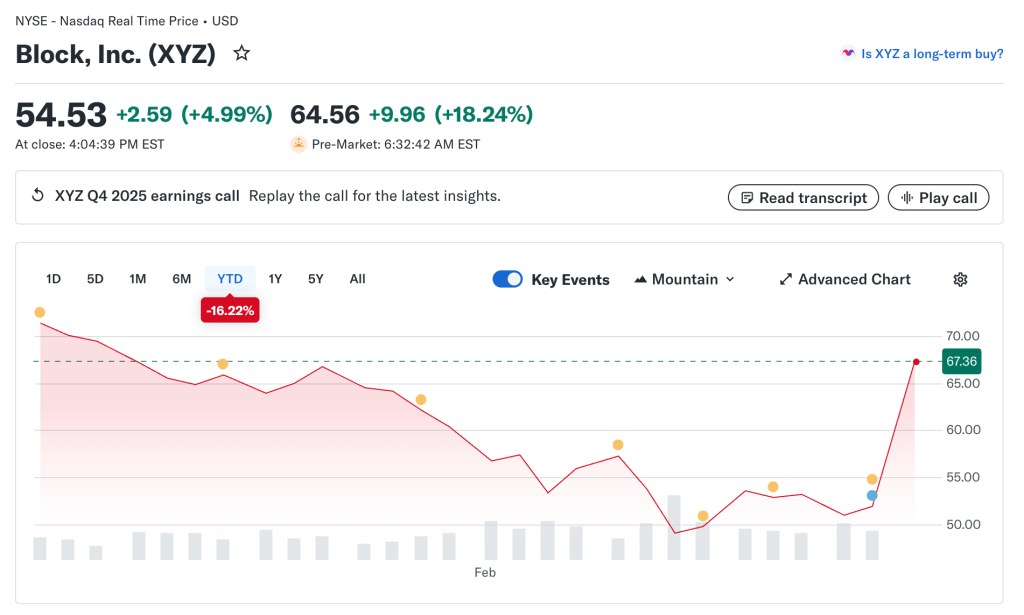
“We will build a company centered on intelligence. […] Our customers will also feel the shift, and we will help them adapt: striving for a future where they can create their own functions directly using our capabilities and interfaces,” Dorsey concluded.
AI Becomes Mandatory
Silicon Valley IT corporations have moved from recommending AI adoption to enforcing policies that require employees to use neural networks in their work, according to WSJ.
“We use both carrot and stick. The only way to thrive is for all employees to have a high level of AI proficiency,” noted Conductor startup CEO Seth Besmertnik.
According to a survey by consulting firm Section, 42% of tech sector specialists reported that their managers expect them to apply artificial intelligence in daily tasks. Eight months ago, only 32% of respondents reported this.
Nearly half of IT firms are already seeing positive returns from investments in generative AI. In comparison, the average across other industries is 35%.
Sector giants are actively implementing systems to assess employees’ AI skills:
- Amazon Web Services tracks work with AI tools through special dashboards. This data is considered in promotion decisions;
- Google has used neural networks for the first time to evaluate the performance of software engineers;
- Meta launched a system to monitor the volume of code written using algorithms. It also provides developers with analytics for self-assessment;
- Microsoft included questions about the use of neural networks in performance discussions—employees must quantify their use of AI tools;
- Salesforce added an AI proficiency tracker to the corporate management dashboard. The company’s stance is clear: refusal to work with new technologies is seen as inefficiency.
Some firms do not consider candidates without skills in working with neural networks. Potential employees undergo testing to solve tasks using AI and must explain their choice of tools and prompts used.
Back in February, OpenAI CEO Sam Altman stated that some companies use artificial intelligence as a pretext for layoffs.
Рассылки ForkLog: держите руку на пульсе биткоин-индустрии!