



In early December, the total TVL in DeFi protocols exceeded $256 billion. More than 65% of these funds are in Ethereum, with the remainder in Binance Smart Chain (6.53%), Avalanche (4.79%), Solana (4.76%) and other networks.
The project Symbiosis Finance is developing the eponymous protocol to consolidate liquidity across several blockchains in a single interface. We explain how the protocol works and why users need SIS tokens.
What problems does Symbiosis Finance solve
In October, testing of Symbiosis Finance began on Ethereum Rinkeby, Binance Testnet, Polygon Mumbai, Avalanche Fuji, Huobi Eco Chain Testnet and OEC Testnet. By the end of December, the developers will add a Solana testnet. Deployment of the protocol on main networks is planned for January 2022.
The project team consists of 30 people, 22 of whom are developers.
«Symbiosis Finance — this is a solution to the problem of liquidity fragmentation across networks. The user experience when working with DEX across different blockchains looks like a nightmare. We want to fix this», — says the co-founder and chief marketing officer of the project, Nik Avramov.
After the mainnet launch, Symbiosis Finance will swap wrapped tokens between the blockchains Ethereum, Binance Smart Chain, Avalanche, Solana, Huobi Eco Chain (HECO), OEC and Polygon. In the future, developers will add support for other networks and L2 solutions.
The SIS token and the Symbiosis Finance DAO
SIS is an ERC-20 token with a supply of 100 million. Its holders can earn via staking and bring to a vote DAO proposals to change the protocol.
Token listings were conducted by Bybit and Gate.io. It is currently also traded on platforms ZT and Uniswap.
In October Symbiosis Finance sold 10 mln SIS for $2 mln in a seed funding round. Participants included Blockchain.com Ventures, Wave Financial, BTC Inc, KuCoin Labs, Injective Labs, DAO Maker, Primitive Ventures, Kairon Labs, Gate.io and Avalanche.


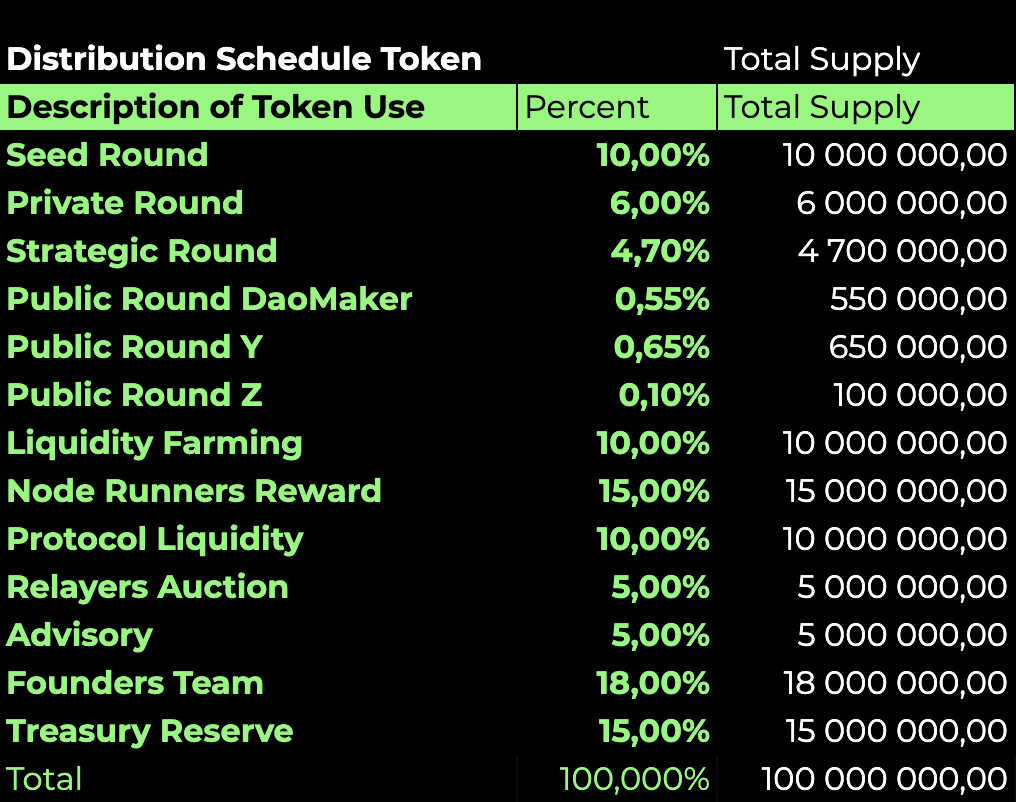
Another 40 mln SIS will go to farming, providing liquidity to the protocol, an auction for relay-network slots, and staking.
The remaining tokens will be allocated to participants of a private sale and several public token sales, as well as the project’s advisors and the Symbiosis Finance developers.
Protocol architecture
Symbiosis Finance conducts swaps using synthetic tokens (Synthetic Token, sToken).
The protocol locks the cryptocurrency in the original blockchain and issues tokens in the other network at a 1:1 ratio. When the cryptocurrency is returned to the original blockchain, Symbiosis Finance burns the sToken.
The protocol consists of three modules:
- Frontend — a web interface with information on assets across networks. It enables users to sign and submit transactions to blockchains;
- Cross-chain liquidity mechanism — a set of smart contracts for swaps between networks. The Symbiosis Finance team deploys them when a blockchain is added to the protocol;
- Relayer network — a P2P network of relayer nodes that monitor events in blockchains, then sign and send transactions to the corresponding networks.
The cross-chain liquidity mechanism Symbiosis Finance includes four groups of smart contracts:
- AMM swap tokens;
- Mint/Burn create and burn tokens;
- Bridge handle interaction between Synthesis smart contracts and the relayer network;
- Metarouter invoke contracts on behalf of the user during cross-chain swaps.
To protect the relayer network, the protocol uses:
- Multi-party Computation (MPC) — cryptographic protocol that allows several network participants to perform a joint computation without revealing their input data;
- Threshold Signature Scheme (TSS) — cryptographic method of distributed key generation and signing a transaction;
- Proof-of-Bond — a mechanism whereby only nodes that have staked SIS tokens may participate in signing transactions.
Symbiosis Finance will distribute 15 million SIS among relayers. The developers will reveal further information about launching such nodes in the near future.
Conclusion
Symbiosis Finance is a multi-chain liquidity protocol in a testing phase. Nevertheless, the project’s token is already trading on two centralized exchanges among the top-20 by trading volume in CoinMarketCap’s rankings.
In January 2022, the Symbiosis Finance mainnet launch is planned. If user interest in the DeFi sector remains, it could become one of the leading protocols for cross-chain swaps.
Subscribe to ForkLog news on VK!