




The Gemini cryptocurrency exchange, founded by the Winklevoss twins, has embarked on a business transformation amid a market downturn. This restructuring demands time, resources, and leaves little room for error, according to Bloomberg.
In September 2025, the platform went public on Nasdaq through an IPO. Gemini issued 15.18 million Class A shares at $28 each, exceeding the planned range of $24-26, raising $425 million.
At its peak, the company’s market capitalization approached $4 billion. By the time of writing, it had plummeted to $661.5 million, a drop of nearly 85%. GEMI’s stock consistently closed lower each month.


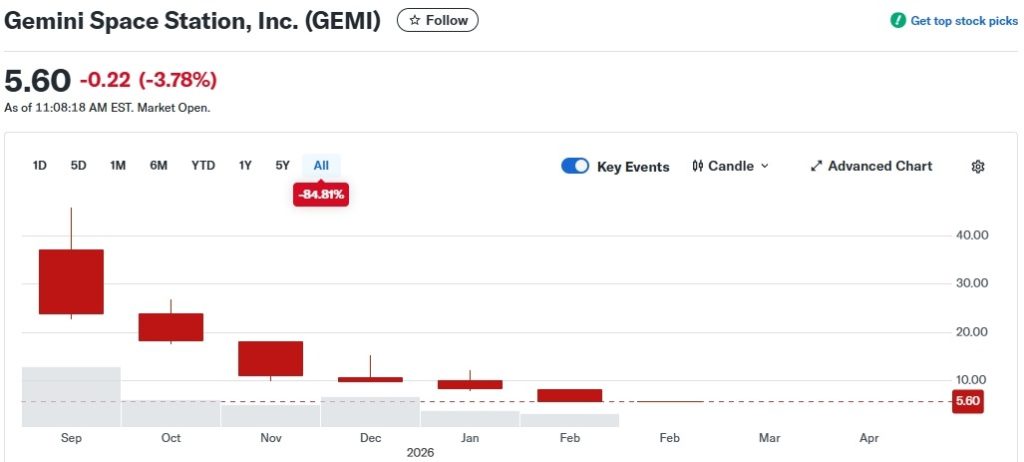
In early February, Gemini announced it was laying off 25% of its workforce and exiting the UK, EU, and Australian markets. Later, the company parted ways with three top executives: CIO Marshall Beard, CFO Dan Chen, and General Counsel Tyler Mead.
According to Bloomberg, the exchange also quietly reduced its US staff.
“The main issue is that Gemini’s management bet heavily on the continued growth of the cryptocurrency market until 2027, but instead, digital asset prices collapsed,” stated Truist Securities analysts Matthew Coad, Lucas Ramadan, and Cameron Macleod.
The exchange has never been among the market leaders, and its lag has only worsened. In January, its share of the spot crypto trading market was 0.1%, down from an already modest 0.6% in June 2025.
“Their strategy needs to change,” emphasized Coad.
New Strategy
Amid declining cryptocurrency trading revenues, Gemini co-founders Cameron and Tyler Winklevoss signaled a shift in business focus.
The company plans to concentrate on developing a platform for prediction markets, custodial services, and issuing credit cards. In trading, the priority jurisdictions are the US and Singapore.
Gemini has decided not to hire a new chief operating officer, with Cameron Winklevoss taking on some of the responsibilities.
In a statement, the brothers acknowledged that succeeding in foreign markets proved more challenging than expected. The company became “overburdened by increased organizational and operational complexity,” leading to higher costs.
Despite the difficulties, Tyler Winklevoss noted in a post on platform X:
“The sentiment in the cryptocurrency market is so bad right now that, honestly, I’m quite optimistic.”
Then why has the Arkham tagged @winklevosscap wallet been selling off bitcoin nonstop for a year straight? pic.twitter.com/0SFaYs3yul
— Pledditor (@Pledditor) February 23, 2026
In response, a commenter pointed out that this statement does not align with the continuous bitcoin sell-off by the Winklevoss Capital wallet. Over the past year, the balance of the address, which Arkham attributes to the Winklevoss family office, has decreased from ~23,000 BTC to ~11,000 BTC.
At its peak in 2014, the volume of stored cryptocurrency was around 108,000 BTC.
Will Winklevoss Bitcoins Fuel the Restructuring?
For 2025, Gemini reported expected net revenue of $175 million against total operating expenses of $530 million.
At this rate of “burning” funds, the $425 million raised during the IPO does not appear to be a substantial reserve.
The company’s public listing paradoxically complicates raising additional funding. Shareholders, dissatisfied with the company’s stock decline, fear dilution of their stakes, Bloomberg noted.
“Given that the brothers will continue to be involved in the business, the possibility of cash injections [from their side] to keep operations going is quite likely,” Coad believes.
However, he acknowledged that Gemini’s investors have reasons to be concerned about its solvency.
Back in January, the US Securities and Exchange Commission reached a settlement with the company over a lawsuit filed two years ago. The claims were related to the now-defunct Gemini Earn product.