




Senior commodity strategist at Bloomberg Intelligence, Mike McGlone, anticipates that by 2026, the leading cryptocurrency will decline by approximately 60% from its historical peak above $126,000.


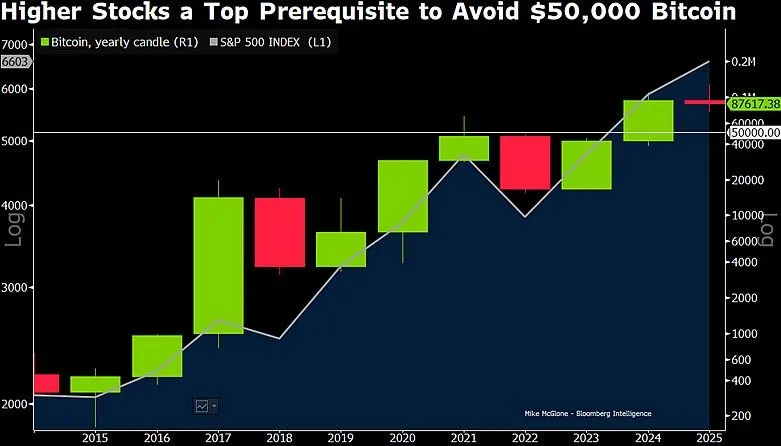
“Will Bitcoin be worth $50,000 or $150,000 in 2026? I lean towards $50,000. Especially if the S&P 500 falls for the third consecutive year since 2008,” the expert wrote.
According to McGlone, a combination of a rapid increase in gold prices and a drop in oil prices, along with stock market volatility, will drive investors away from risky products like cryptocurrencies. These factors could lead to a sell-off with an “unlimited supply,” he emphasized.
On November 21, Friday, Bitcoin plummeted to levels around $82,000 — the lowest since April. Following a subsequent rebound, the price peaked at ~$87,900. At the time of writing, the asset is trading near $86,400.
Bitcoin May End the Year with Another Decline
BitMEX co-founder Arthur Hayes believes that the leading cryptocurrency is set for another dip to $80,000 soon. However, he clarified that this price level will hold.
minor improvements in $ liq:
— fed qt stops dec 1, this wed will prob be last fall in b/s
— us banks increased lending in novwe chop below $90k, maybe one more stab down into low $80k’s but i think $80k holds. might start nibbling, but leave the bazooka until the new year
— Arthur Hayes (@CryptoHayes) November 24, 2025
Hayes considers the cessation of the US Federal Reserve’s quantitative tightening policy from December 1 and the increase in lending volumes by American banks in November as positive factors for the price of digital gold. However, he noted that this liquidity influx will only impact the market by the end of the year.
Citigroup noted that after the October cryptocurrency crash, investors’ risk appetite sharply declined, reports CoinDesk.
Long-term coin holders are increasingly concerned about the second weak year for the asset following the last halving, which contradicts historical cycles.
In their base scenario, bank analysts expected inflows into BTC-ETFs to reach $7.5 billion by the end of the year. Investment bitcoin products have lost $4.92 billion since the beginning of November.
Citigroup experts estimate that their bearish forecast of $82,000 will materialize by early 2026. The key level for ETF investors is $80,000.
Positive factors such as a recovery in capital inflows into exchange-traded funds and a breakthrough in industry regulation in the US could raise Bitcoin’s price to $181,000 within the next 12 months.
Previously, CIO of Bitwise, Matt Hougan, stated that Bitcoin likely hit bottom in the previous downturn, but acknowledged the possibility of another dip closer to $70,000.
The head of the company’s European research department, Andre Dragos, confirmed the investment director’s opinion.
“In the short term, Bitcoin may trade lower until a clear bullish catalyst emerges. But these will be ‘fire sale’ valuations and very attractive entry points for increasing asset holdings,” he said in an interview with DL News.
Dragos expects strong support for the cryptocurrency’s rate in the range of $81,000 to $73,000 — the base value of coins in BlackRock’s ETF and Strategy’s treasury. Below these marks, Bitcoin will be intensively bought, the analyst is confident.
He noted that the current correction “corresponds to previous bull markets in both depth and duration.” A trend reversal could occur at any moment with the emergence of a clear catalyst, such as the continuation of the Fed’s quantitative easing or bond market volatility, which would force the regulator to intervene.
“We still expect the continuation of Bitcoin’s bull cycle in 2026 due to the easing of monetary policy worldwide, which typically affects global growth conditions and risk appetite with a significant lag,” Dragos concluded.
Uncertainty Takes Its Toll
GSR analyst Carlos Guzman highlighted three factors negatively impacting the current market positions of digital gold.
Expectations that the Fed will lower the key rate following the December 10 meeting jumped to 77%, although a week ago the figure was 42%. However, uncertainty remains regarding the regulator’s decision, as a number of crucial economic data were not published due to the prolonged government shutdown.
Concerns are growing about a bubble in the AI segment. After Nvidia’s positive quarterly report, the stock of one of the industry’s flagships jumped 5%, but then corrected by 3.1%.
“This volatility has affected the crypto market, which typically moves in tandem with tech company stocks,” Guzman stated.
As the third factor putting pressure on digital assets, he cited “persistent weakness and pessimism, as well as reduced liquidity” resulting from the October crash.
Analyst Crypto Dan concluded that Bitcoin stabilizing below $80,000 significantly increases the risk of a deeper decline.