



Brazil is no longer merely “the country of the future”, as it was dubbed in the 20th century. By 2025–26 it has cemented itself as the Southern Hemisphere’s digital economy leader. While neighbours use crypto to survive, Brazil is building a new financial system with it.
ForkLog examines how Brazilians’ technological awareness works, why the central bank is bringing every stablecoin under its control, and why local banks tokenise everything — from real estate to footballers.
Country profile: Demography and economic context
Before diving into blockchain thickets, it is worth understanding who lives in the country and how they make a living. Brazil is a vast market that dominates the continent by population (at the time of writing around 213m people) and territory.
Historical note:
Brazil’s economic history is a chronicle of fighting inflation. From 1980 to 1994 the country endured hyperinflation that reached thousands of percent a year. Those scars shaped the nation’s financial DNA: Brazilians have long shunned keeping cash “under the mattress” in the local currency and always look for alternatives.
Population profile:
- age: Brazil is young. The median age is 35. This is a generation that has never known life without the internet but remembers parents’ tales of savings going up in smoke;
- average income: varies widely by region (the south is richer than the north). Wages typically hover around 3,000–4,000 reais (about $577–770 on 10 February 2026). Despite modest figures, purchasing power in the digital sector is high thanks to accessible credit and instalments;
- digitalisation: Brazilians spend more time on their smartphones than any other nation (over nine hours a day online).
The phenomenon of technological awareness
The key concept in understanding the country’s situation is technological awareness: society’s and business’s ability not merely to consume innovation but to adapt it to fix structural problems.
The main catalyst was PIX, an instant payments system launched by the central bank in 2020. It taught even the most conservative citizens to use QR codes and move money in seconds. That success primed mass crypto adoption. People realised money can be fully digital.
A corporate success story is Nubank. After receiving conditional approval from the U.S. Office of the Comptroller of the Currency to establish a national bank, the platform proved Brazilian fintech can compete globally. That, in turn, boosted trust in digital finance at home.
Crypto market in numbers: Fifth in the world
According to a report by Chainalysis, in 2025 Brazil ranked fifth globally in the crypto adoption index and first in Latin America. From July 2024 to June 2025 the country received $318.8bn in crypto assets — nearly a third of the region’s total.
The market is maturing. Once dominated by speculative interest in bitcoin, now 90% of transaction volume is generated in dollar-pegged stablecoins (mostly USDT).
For Brazilian businesses, stablecoins have become a tool of foreign trade. Importers use USDT to pay for goods in China and elsewhere, sidestepping cumbersome currency controls and high taxes.
One notable 2025 trend was a surge in popularity of tokenised gold (Pax Gold, XAUT). As the price of the physical metal rallied, trading volumes in “digital gold” jumped 300%. Investors see it as diversification: protecting capital by “blockchainising” traditional assets. According to Mercado Bitcoin, the average ticket in this segment almost doubled.
Regulation in 2026: The end of the Wild West
February 2026 is set to be a turning point. Brazil’s central bank is introducing tough new rules for VASP, based on the 2022 Virtual Assets Law.
The new rules of the game (Resolutions 519, 520, 521):
- licensing: all exchanges and custodians must obtain authorisation and become SPSAV. Foreign players must open a local branch;
- capital and controls: minimum capital requirements are set (up to 37.2m reais) along with mandatory segregation of client and exchange funds;
- anti-money-laundering: implementation of the Travel Rule and strict KYC mechanisms.
In addition, the Finance Ministry has set its sights on taxing cross-border crypto payments. Previously, the use of stablecoins allowed users to avoid the tax on financial operations (IOF) applied to traditional foreign-exchange transfers.
Officials estimate that using digital assets to pay for imports costs the budget up to $30bn a year. Now, any exchange operations with stablecoins and international transfers of crypto assets will be classified as foreign-exchange transactions. That means automatic IOF levies and tighter oversight by the Federal Revenue Service.
The Supreme Court is also considering lifting the ban on using cryptocurrencies to finance election campaigns. Current rules prohibit such donations because of traceability challenges, but growing blockchain transparency is prompting judges to revisit the stance. A decision is expected in March 2026, ahead of general elections.
RWA: Real assets on-chain
While retail investors trade meme coins, institutions are getting on with it. Brazil has become a global centre for tokenising real-world assets (RWA).
Local banks (for example, Itaú) and fintechs actively use blockchain to issue corporate promissory notes and other instruments. Notable is the case of Liqi Digital Assets, which together with the XDC Network surpassed $100m in tokenised assets.
The central bank is developing Drex (the digital real), which will be not merely a CBDC for payments, but a smart-contract platform encoding property rights in cars, real estate, and securities. This is technological awareness at the state level: blockchain is seen not as a threat but as a more efficient database.
Comparison with neighbours: Why Brazil wins
To grasp Brazil’s scale as a digital-economy leader, compare it with its regional peers:


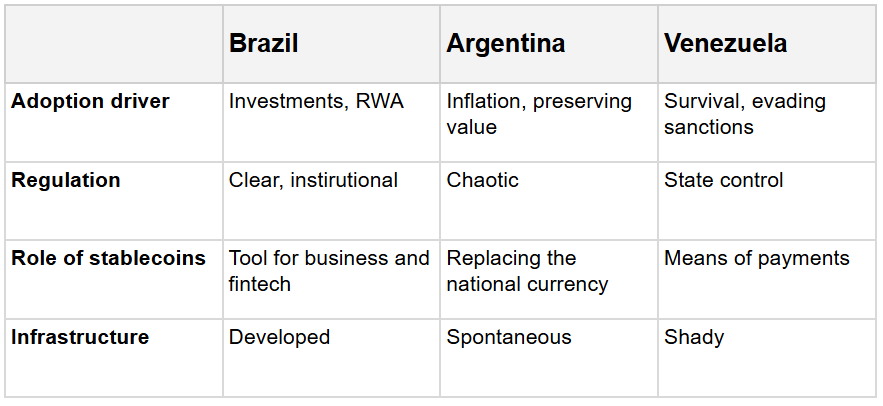
Brazil wins on balance. There is none of Argentina’s uncertainty, nor the despair of Venezuela. There is a market backed by clear rules of the game.
The Brazilian phenomenon
Brazil’s case is unique in busting the stereotype of crypto as a toy for geeks and criminals. In Brazil, digital assets have become boring. That is the highest compliment a technology can get.
When stablecoins pay for imported machine tools and banks tokenise $100m of debt, the paradigm shifts. Brazil shows that mass adoption arrives not via monkey pictures but through integration into familiar financial gateways.
Even so, the new taxes and 2026 rulebook will be a serious stress test. Plugging loopholes may cool the ardour of small firms that used USDT for cheap cross-border transfers. Consolidation looms: minor exchanges will exit; giants able to afford compliance and lawyers will remain.
Brazil is turning into a “crypto Switzerland” for emerging markets, albeit with tropical flair and tight control over every digital cent. If the Drex and VASP-regulation experiments succeed, Brazil’s model could become the gold standard for India, Indonesia, and Nigeria.