


Can Ethereum outpace Solana? Inside MegaETH, an ambitious new rollup
In June 2024, Ethereum co-founder Vitalik Buterin, together with venture giant Dragonfly Capital and other backers, invested in an Ethereum-based start-up, MegaETH.
It is a layer-2 (L2) solution that claims instant transaction finality and throughput of 100,000 TPS. These are the kinds of figures the Ethereum Foundation (EF) ultimately wants to see at the base layer (L1).
Ahead of the launch of the MegaETH testnet on 10 March 2025, ForkLog explains how the “breakthrough” rollup works and what its developers are prepared to trade off in the race to beat Solana, Sui and Monad.
Innovation on layer two
Throughout 2024 the EF faced criticism on several fronts, including a perceived tilt towards centralisation and a ‘bias’ in favour of L2 solutions, periodic sales of ETH reserves and losing ground to Solana.
After digesting a barrage of feedback from the community and investors, the organisation regrouped, reasserted its values and set out its priorities.
On 28 February 2025 the EF announced the Silviculture Society, an independent group that will provide informal recommendations on key issues for the ecosystem. External expert counsel is meant to help the foundation take decisions while staying true to the network’s original ideals.
On 2 March the EF announced leadership changes. Xiao-Wei Wang and Tomasz Stanczak became the new executive directors.
On the technical side, decision-making has become more concrete and energetic. In November 2024, at Devcon, Buterin reiterated the original vision of the ecosystem as a global, distributed computer.
In his telling, Ethereum is a world computer that is regularly upgraded and improved, and L2s are the graphics processors. L1 holds the system together and is the reason rollups can trust each other.
“The first layer is not meant to be super-fast and do a million transactions per second. L1 is, above all, decentralisation and reliability.”, Buterin stressed.
He highlighted the following priorities:
- stronger decentralisation, censorship resistance and post-quantum security;
- better scaling;
- achieving throughput of more than 100,000 TPS via L2s;
- the growth of dapps such as social networks and payments.
Many of these directions and goals are reflected in the white paper of the forthcoming MegaETH. Given that Buterin rarely backs projects “without evolutionary value”, his angel support has heightened interest in the start-up.
Participants in the July 2024 seed round included Ethereum co-founder Joe Lubin, the funds Dragonfly Capital and Robot Ventures, EigenLayer founder Sreeram Kannan, Mert Mumtaz of Solana infrastructure firm Helius, influencer Cobie and others.
In all, MegaLabs raised $20m in the first push. At an ICO held on 13 December, the team pulled in another $10m in just three minutes. A third phase via the sale of the Fluffle NFT collection brought roughly $28m.
How the MegaETH blockchain works
The idea took shape in 2022 with Stanford graduate and computer scientist Yilong Li, inspired by Buterin’s work on a hypothetical network delivering 10,000 TPS that could remain trusted and censorship-resistant even with centralised block production.
Li teamed up with future CTO Lei Yan, a researcher of consensus, networking and a former EigenLayer employee.
Business operations are led by Shuyao Kong, formerly head of global business development at ConsenSys.
MegaETH is a modular rollup with parallel transaction execution and a distinctive architecture that decentralises a single sequencer while using EigenDA as an external data-availability (DA) layer.
As it prepares for a public testnet in the coming weeks, the network reached 15,000 TPS in private testing. It consumed 60 times more gas (1.5 gigagas) than existing Ethereum rollups such as Base. The team says this should double after activating a proprietary parallelisation mechanism. The targets: 100,000 TPS and 10 gigagas.
MegaETH claims sub-10ms transaction execution—far below the 250ms of the fastest rollup today, Arbitrum.

The team aims to minimise latency by offering compute performance close to centralised Web2 servers. A key novelty is storing the entire state in RAM. This lets MegaETH answer requests faster than traditional designs constrained by SSD speeds.
Further acceleration comes from JIT compilation, which turns smart contracts into machine code on the fly, improving the efficiency of heavy computations.
Analysts at Nansen highlight MegaETH’s key differentiators:
- a new state-tree structure. A memory- and I/O-efficient data structure that scales to a terabyte without extra overhead, even on nodes with limited RAM;
- optimised storage. An improved storage architecture that boosts write speed while keeping predictable read speed, enabling massive state-update throughput;
- parallel execution. Separate strategies for block building and verification avoid state conflicts and maximise speed;
- efficient state sync. An optimised peer-to-peer protocol that rapidly synchronises nodes under constrained bandwidth;
- streaming transaction processing (Streaming EVM). A real-time block-processing mechanism that targets a 1ms block time.
The “first real-time blockchain” features four main roles: sequencers, prover nodes, full nodes and replication nodes.
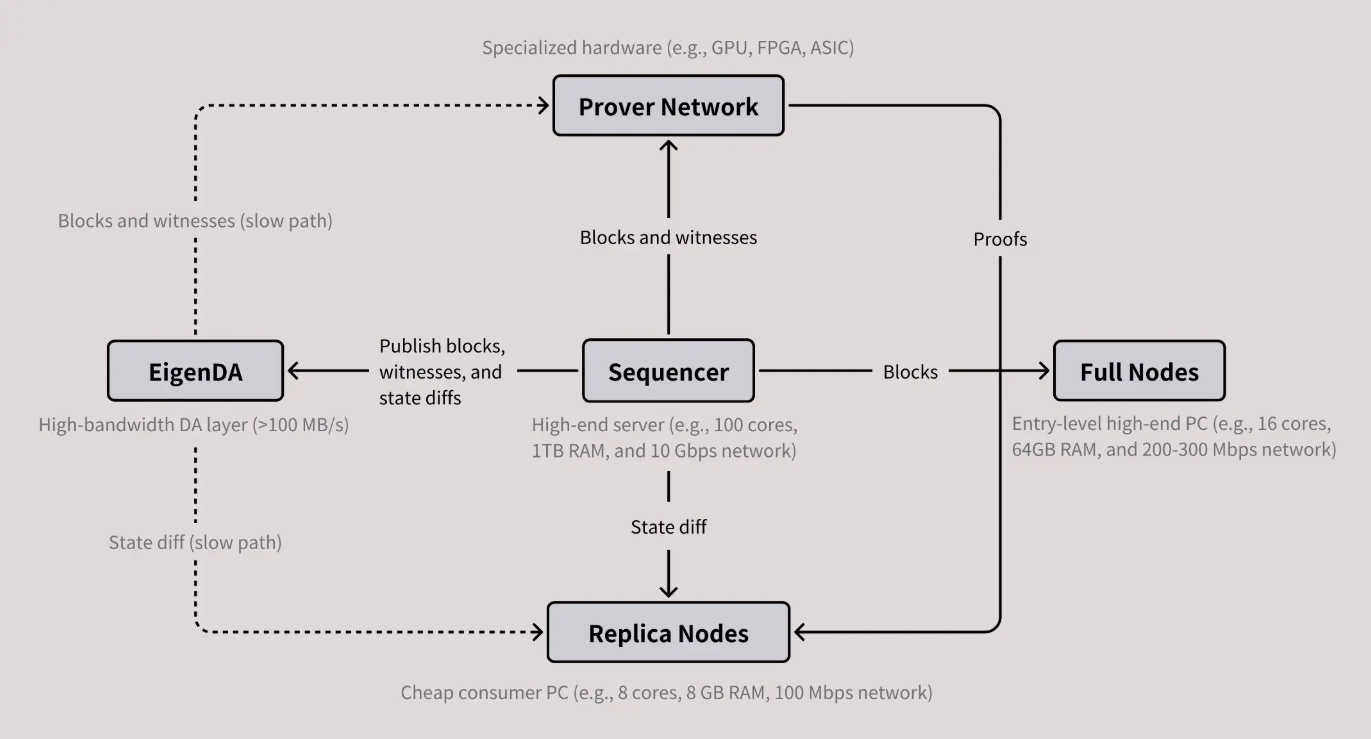
The sequencer orders and executes user transactions. There is only one sequencer, reducing the need for consensus.
Prover nodes verify blocks in a flexible order without storing transaction state.
Replication nodes receive updates from the sequencer and apply the changes to update their local state. They do not re-execute transactions; instead, they verify blocks using proofs supplied by prover nodes.
Full nodes check every transaction to reconcile blocks. These nodes are especially important for bridge operators and market-makers who need rapid finality, and therefore more powerful hardware to keep up with the sequencer.
Storing data outside Ethereum
Architecturally, rollups are constrained by Ethereum’s BLOB storage and aim to decentralise their sequencers.
In January 2025 Buterin confirmed that Ethereum would continue to scale through L2s. He voiced concern about the current limit on blob space and floated a fix.
“With the release for March [of the update] Pectra we expect to double this to six blobs per slot.”, he continued.
Throughput would then rise another two- to three-fold after the PeerDAS protocol lands, the main objective of the next upgrade, Fusaka. In the near future, solutions already in development could take the network to 128 blobs per slot.
MegaETH’s developers took another route from the outset, opting for EigenLayer’s EigenDA as an alternative data-availability solution. Though its safety assumptions have yet to face real stress tests, it allows blocks to be published with throughput above 100MB/s, accelerating both processing and user-requested delivery.
Ethereum developers Justin Drake and Dankrad Feist voiced concern about a mechanism similar to MegaETH’s. They argued that L1-native DA should be scaled instead of alternatives such as EigenLayer’s restaking platform, which they called “a big threat”.
MegaETH’s public face and head of growth, known as Bread, told Cointelegraph that Ethereum’s focus on decentralisation had become excessive. In his view it left L2 leaders such as Base’s Jesse Pollak in a desperate spot, forced to push harder on scaling.
“He is literally begging Ethereum developers and saying: guys, we’re just getting wrecked here, Solana is destroying us,” Bread said, noting that Solana’s priority on scalability significantly influenced MegaETH’s design.
While some see external data storage and the lack of multi-sequencer consensus as problematic, the chain relies on decentralised second-order nodes. The trio of P2P node types distributes transaction verification and lowers hardware requirements for node operators.
The “innovative” rollup’s testnet is slated to launch on 10 March 2025.
A quick $28m and the MegaMafia
The third funding round came via an SBT sale of 5,000 NFTs at 1 ETH apiece. Five percent of the future token supply is earmarked for 10,000 NFT holders. Based on the latest valuation, the project is worth at least $540m.

In total the team will issue 10,000 SBTs across two rounds for allowlisted active users. Holders can unlock customisable items to personalise their rabbits.
Each NFT will progress through several stages, evolving with the owner’s activity on MegaETH. The higher the stage, the greater the reward.
To attract developers and entrepreneurs, the team is running the MegaMafia programme. The initiative includes support from MegaLabs and participation in the project’s meetups and hackathons.
Thanks to MegaETH’s EVM compatibility, dapps such as Uniswap and Aave can be ported easily. The core plan, however, is to grow the ecosystem with new applications that fully exploit high speed and throughput.
MegaMafia is working on several projects, including GTE, a high-speed decentralised exchange, and derivatives platforms from Valhalla.
One of the more novel apps is Euphoria, which turns trading into a game by letting users click on the chart to bet against its movement.
Sweep also looks intriguing—a Twitch-like streaming platform where users can bet on various events. Another is Autonomous World Engine, a Roblox-style 3D world where players can earn coins.
Early testnet integration will let users gauge the project’s prospects and experience the speed, convenience and intuitive design first-hand.
Рассылки ForkLog: держите руку на пульсе биткоин-индустрии!