



A planned economy and a socialist order are associated with the absence of private property, state monopolies, and tight regulation. That is how the model of society looked in the USSR.
However, in the mid-20th century China took a different path — globalisation of the economy while preserving the core characteristics of communist ideology. So today you can buy shares in large Chinese companies on the stock markets.
Deng Xiaoping’s ‘Policy of Reform and Opening Up’ spurred private enterprise in China. As a result, many local companies have achieved success and carved out their niches in the global market.
ForkLog investigates who stands behind the development of the AI industry in China and what influence these players exert on domestic and international markets.
- Economically, Chinese tech giants lag behind their American rivals.
- Stringent regulation by Chinese authorities has created monopolistic conditions for local companies.
- Tech giants invest around 10% of revenue in promising R&D.
- The US–China confrontation affects corporations on both sides of the Pacific.
The Chinese Three and TikTok
In China, the tech giants are traditionally identified as three companies: Baidu, Alibaba and Tencent. They are among the pillars of digital life in China.
ByteDance is also considered a tech giant, which, in less than a decade, has achieved a stunning milestone and caught up with the industry leaders in market capitalization.


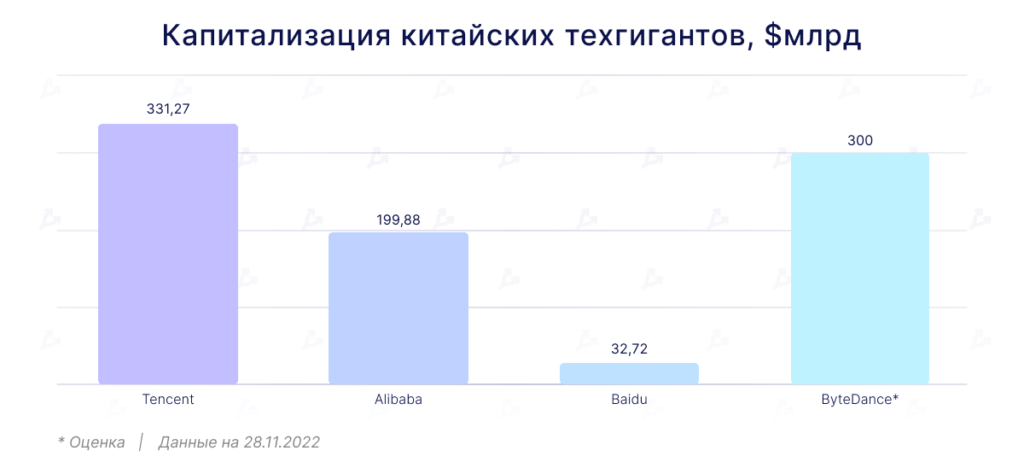
The aggregate market capitalization of the four aforementioned firms is minuscule next to that of American players: $863.87 billion vs $7,829.33 billion. Still, Chinese corporations that primarily serve the domestic market influence technology development.
Baidu
Baidu is the most popular search engine in China. The company is often contrasted with Google, whose products are not available in the country.
Like its American counterpart, Baidu develops a range of services:
- search engine;
- video hosting;
- maps service;
- translator;
- blog platform
- web browser
- social network;
- online encyclopedia.
On Baidu приходится 59.59% of the market share in China. It also входит among the top-6 search engines in the world.
Like Google, Baidu earns revenue from advertising. Besides, the company actively develops the self-driving platform Apollo Go, which is already operating in several Chinese cities.
Alibaba
Alibaba Group was founded in 1999 as an e-commerce company. However, the corporation diversified its business and now also operates in the following areas:
- entertainment;
- online payments;
- cloud computing;
- artificial intelligence technologies.
The company’s best-known products are the Taobao marketplace and the Alipay payment system.
Alibaba accounts for eight out of ten online sales in China.
The tech giant’s main revenue comes from advertising and promoting products in search results. To optimise results, the company actively uses recommendation systems.
Alibaba operates seven AI, ML, NLP and cybersecurity research labs. The company uses these technologies to optimise the supply chain, personalise, and create products.
The corporation also provides cloud services designed to make AI accessible to all developers.
Tencent
Tencent was founded in 1998. The majority of Chinese users first encountered the company through its first product—the QQ messaging platform.
Over two decades Tencent has developed many other lines of business, including social platforms, entertainment, e-commerce, online payments, information services, and AI.
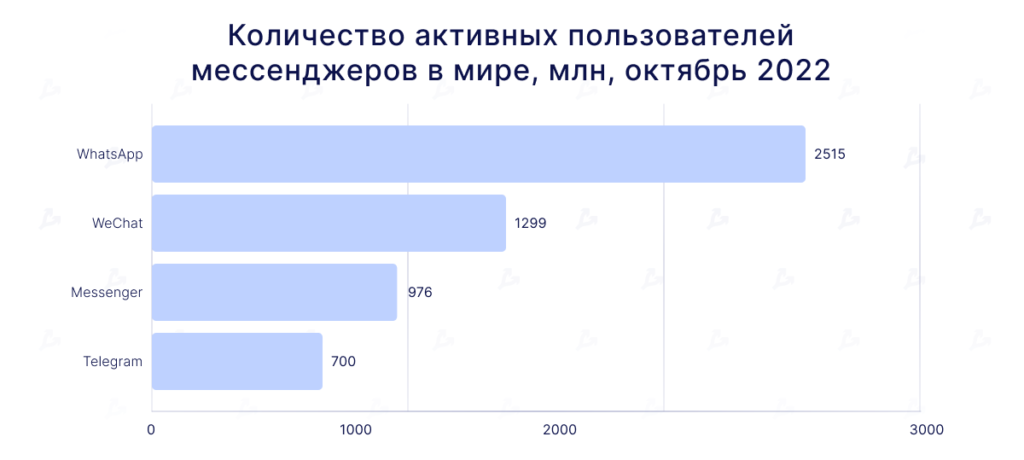
Tencent owns one of the world’s most popular messengers—WeChat. In 2022 it ranked second in terms of users—over 1.2 billion people. The app trails only WhatsApp.


Also Tencent Entertainment holds the top spot in the global online gaming industry, followed by Sony.
The company provides AI services for corporate clients in healthcare, agriculture, heavy industry and manufacturing.
In Tencent’s offices around the world, thousands of engineers and scientists work. Key research areas include machine learning, natural language processing, computer vision and speech recognition.
ByteDance
ByteDance was founded in 2012. In China, the company released several entertainment services, but to Western users it is best known for TikTok.
In 2020 the app became the world’s most popular, overtaking Facebook and Instagram. To surpass the one-billion-download mark, the service took less than three years.
A distinctive feature of TikTok is its advanced recommendations, which analyse vast amounts of data to curate content relevant to the user.
The service also uses voice synthesis, facial recognition, and other AI algorithms.
ByteDance plans to conduct an IPO by the end of 2022. In September, the company carried out a share buyback at a price that valued the business at $300 billion.
Investments in R&D
Like Western tech giants, Chinese companies invest significant resources in R&D.


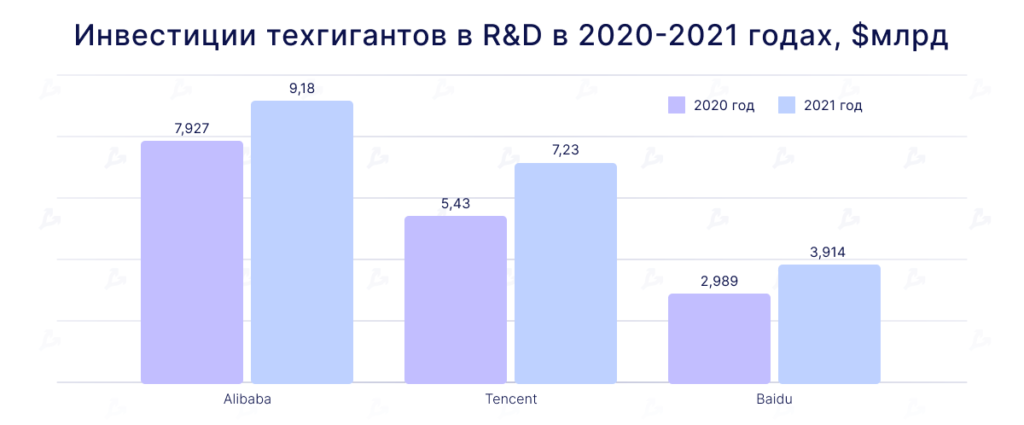
In 2021, Baidu allocated $3.9 billion to R&D, which amounts to 20% of annual turnover. The company actively develops cloud AI computing and autonomous driving technologies.
According to Baidu’s CEO Robin Li, in Q3 2022 each Apollo Go robotaxi made on average more than 15 trips per day in Beijing, Shanghai and Guangzhou. This roughly matches the average trips of a regular taxi.
In the same period Alibaba invested $9.18 billion in R&D, or 7% of revenue. The main areas of research are cloud AI computing and IoT devices for smart homes and cities.
Tencent invested $7.23 billion in R&D. One of the company’s promising areas is the metaverse. In June 2022 the tech giant set up a unit to develop augmented-reality technologies.
Because ByteDance is a private company, there is no data on investments in research. According to some media, the company is actively developing its own AI chip.
Tech giants guarding the Communist system
The Chinese authorities actively back local firms. The government has effectively eliminated competition from American players.
At the same time, Chinese companies are obliged to comply with local laws that impose strict internet censorship. At the first request from the authorities they remove forbidden information, rely only on approved sources for media, and filter keywords for search engines.
The authorities regulate AI algorithms tightly. In August 2021 the Cyberspace Administration of China (CAC) presented a draft of rules of 30 points on the use of AI by technology companies. The norms took effect on March 1, 2022.
The proposed measures ban ‘encouraging dependence and high consumption,’ as well as any actions that threaten national security or disrupt social and economic order.
It is expected that applying the rules will reduce content consumption by users. This is likely to reduce tech giants’ revenues.
In April the CAC launched an assessment of companies’ recommendation algorithms. The regulator intends to determine how social networks serve ads and content to attract users.
This is part of a package of measures aimed at curbing the growing influence of China’s biggest corporations, whose platforms control the realms of public discourse and entertainment. By 2025 the authorities intend to enact a suite of acts targeting technology sectors, national security, data governance, the environment, antitrust in markets and health care.
Media have also reported cases where data handed by corporations were used for dubious purposes.
In December 2020, Alibaba admitted that its cloud AI services were used for facial recognition of Uyghurs in Xinjiang. Various organisations have repeatedly drawn attention to numerous human-rights violations by China, but authorities deny any accusations.
To avoid sanctions, Alibaba promised it would no longer provide such services for cloud-product users.
In 2021, under government pressure, Tencent agreed as part of a government plan to reduce underage gaming to implement child facial recognition.
In 2022, social-media users reported that Chinese authorities utilised anti-COVID infrastructure to deter a shareholder protest at a major bank. The system assigned them a red code in the health app, limiting their movement across the country.
According to members of a WeChat group chat, about 200 people faced a similar problem. They share the common trait of openly expressing protest sentiments on social networks and messaging apps.
China–US competition
The standoff between the two largest economies directly affects the activities of the tech giants.
The hard regulation by the CPC and support for local business has allowed the corporations to assume a dominant position. In China you won’t be able to ‘Google’ a weather forecast or order a travel kit on Amazon. The authorities have long established the Great Firewall of China, cutting Western tech companies off from a multi-billion market.
The US approach to curbing Chinese technologies is different. Alibaba operates successfully around the world, Tencent attracts Western investment, and TikTok enjoys enormous popularity in the entertainment sector.
Nevertheless, Chinese tech giants regularly suffer from sanctions. One of the most high-profile cases concerns Huawei. Until recently this company was the world’s largest supplier of telecommunications equipment and mobile phones. Huawei has made a huge contribution to the development of modern technologies and communications, taking part in the development of 4G and 5G networks.
But in 2019 the administration of U.S. President Donald Trump accused the company of spying for the PRC. It was barred from operating in the United States, and from cooperating with American companies.
As a result, the company lost contracts to build 4G and 5G networks in the United States and Western Europe, and its devices lost access to Google services.
Huawei adapted to the sanctions fairly quickly. The Chinese authorities backed the manufacturer and ordered it to roll out 5G networks. The company rapidly developed its own mobile OS to avoid interrupting the smartphone production cycle.
Under the Biden administration, the confrontation intensified. Throughout 2022, the U.S. government introduced several measures aimed at curbing China’s technological dominance.
In autumn the White House restricted exports to China of semiconductors intended for building supercomputers and AI workloads. Specifically, Nvidia and AMD products were placed under export controls.
Some experts say the sanctions will help local companies develop analogues of Western products. Others, by contrast, are convinced that technology development in China will slow down in the future.
The latter concerns are not unfounded. The Chinese chipmaker Biren Technology unveiled an AI accelerator akin to Nvidia’s H100. However the Taiwanese firm TSMC declined to manufacture it, fearing U.S. sanctions. It is possible the trend will persist, as China still lags behind Western countries in high-tech chips.
***
Over the past two decades, relatively young Chinese tech giants have achieved significant success. They can compete with world leaders and set trends.
Tencent pours billions into the gaming industry, Alibaba enables shopping around the world, and ByteDance in record time has left Instagram and YouTube far behind.
Many of the companies’ achievements have been driven by cutting-edge technologies, including AI, and state support.
However the United States, above all, fears the dominance of Chinese tech giants. The Chinese system is not very democratic; the CPC tightly regulates technology and uses it for social control. At the same time, the Chinese government formally positions itself in opposition to the Western world.
Likely the accusations by American and European politicians of tech giants spying for the CPC are not unfounded. It is possible that, due to similar concerns, authorities in China keep companies like Google and Facebook out of the market.
Nevertheless, law-enforcement agencies in the US, Europe and other developed democracies are not far behind their Chinese counterparts. They can also access personal data both by court order and without one.
That said, one should not expect softer rhetoric on either side in the near future. Countries continue to compete with one another, including in the technology sector. That will undoubtedly leave its mark on the tech giants’ activities.
At the same time, the trend toward growing digital data and AI development may indicate that the sides have chosen the right course.
Subscribe to ForkLog news on Telegram: ForkLog AI — all the news from the AI world!