


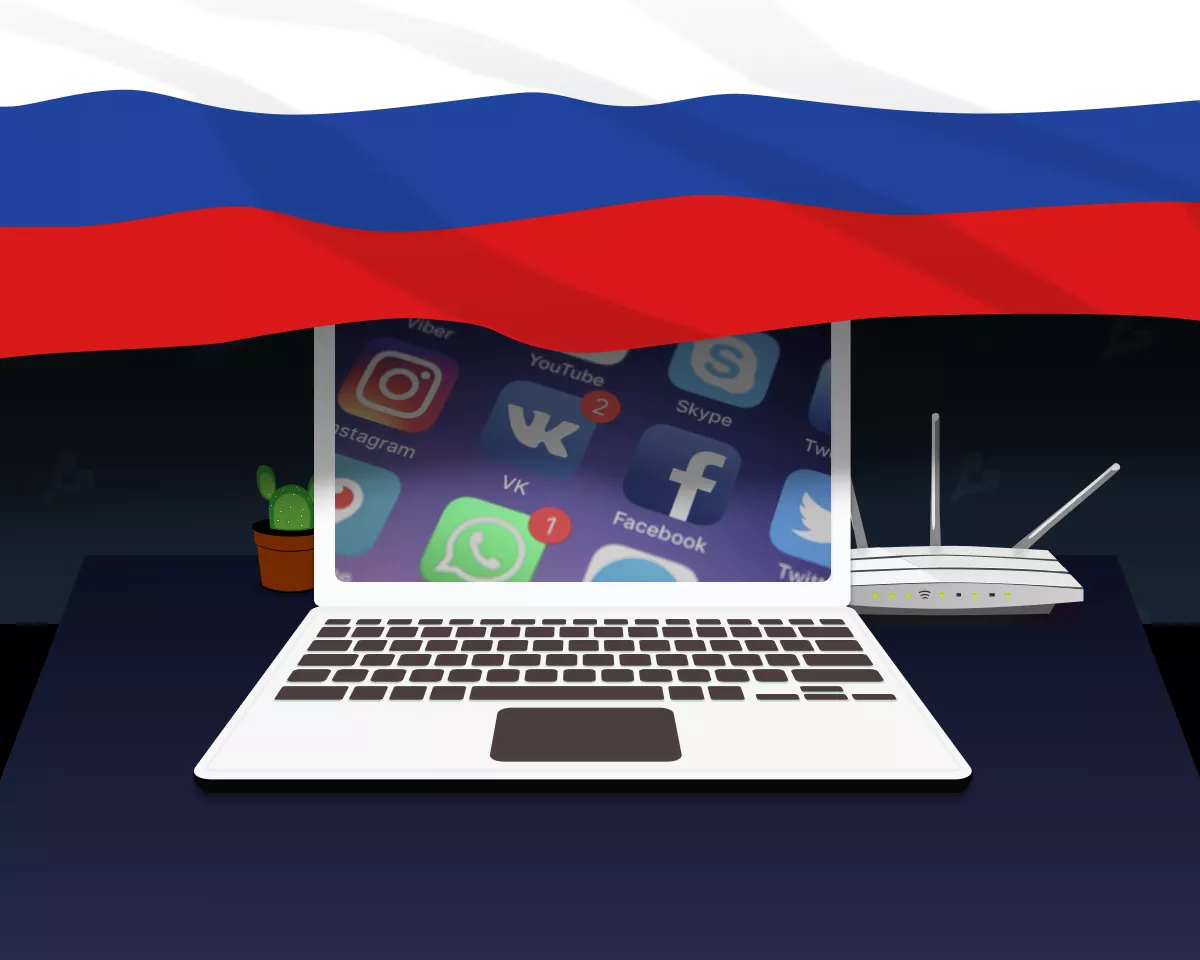
Catch-22 for Russia’s social networks as authorities fight censorship with censorship measures
On 1 February took effect amendments to Russia’s legislation regulating the dissemination of information on social networks. They obligate the owners of such networks to monitor user content and effectively engage in censorship.
For companies, this means colossal costs for moderation tools, but even if they are prepared to bear them, the risk of infringing the ambiguously defined rules will remain, experts say.
For ForkLog, Mikhail Tretyak, partner at the Digital Rights Center, and lawyer Nikita Istomin explained the new Russian realities.
- The Russian authorities are trying to legally obligate social networks to block unwanted content. Implementation of the requirements will impose colossal costs on the owners of these companies — it is unclear whether they are willing to undertake them for the Russian market.
- At the same time, authorities are attempting to prohibit social networks from blocking “publicly significant information”, but the legislation does not define such a concept. This opens regulators up to broad interpretation of the norm.
- The tangled requirements also complicate life for domestic IT companies.
The latest phase of state internet regulation in Russia is two-pronged.
On the one hand, Roskomnadzor is demanding the unblocking of accounts that publish political content on Instagram, as well as accounts of Russian media and their video materials on YouTube.
On the other hand, as of March 10 Roskomnadzor began throttling Twitter for non-compliance with the requirements of amendments to Federal Law No. 149-FZ “On Information, Information Technologies and Information Protection”, recently in force.
This refers to the introduction by Federal Law No. 530-FZ of December 30, 2020 №530-FZ “On amendments to the Federal Law “On Information, Information Technologies and Information Protection” to Article 10.6 “Features of information dissemination on social networks”, which came into force on February 1, 2021.
That article contains a definition of a social network, which Twitter, unsurprisingly, fully fits.
If this definition is abbreviated, then any online service meeting the following criteria falls under it:
- have features for creating user pages and sharing information;
- are available in the state language and in the languages of the peoples of the Russian Federation;
- advertising targeted at consumers in the Russian Federation can be disseminated via the service;
- access to each such service from the territory of the Russian Federation is by more than 500,000 users within 24 hours.
Owners of social networks de jure and de facto are obliged to exercise full control over information disseminated by users. Article 10.6 sets out in broad terms the obligation of the owner (and in practice the operator) of a social network not to allow its use for the purpose of:
- committing crimes;
- disclosing information protected by law;
- disseminating information with public calls to terrorism or its justification, extremist materials, propaganda of pornography, cult of violence and cruelty, as well as containing obscene language.
By the information protected by law we mean state, commercial, professional and other secrets, as well as those kinds of information, dissemination of which was restricted by other federal laws long before the introduction of this article.
A more detailed list is contained in the List of confidential information (approved by the President of the Russian Federation by Decree No. 188 dated 6 March 1997). It also includes information about persons under state protection.
However, from January 10, 2021, the Federal Law No. 515-FZ of December 30, 2020 will allow the government to restrict information about civil servants, their relatives, and their property not only in cases of threats to life or health but simply due to their status. This restriction naturally covers not only information about civil servants themselves, but also Internet publications of journalistic investigations into cases of their corruption.
Moreover, general obligations to observe prohibitions and restrictions, established by legislation on referenda and elections, are introduced.
Obviously, such a provision was included in the text of the article because Roskomnadzor’s facts of political advertising on Google, YouTube and Facebook on the eve of the 2019 elections (breach of the day of silence) led to this.
And with a broad formulation, there is an obligation to “observe the rights and legitimate interests of citizens and organisations, including honour, dignity and business reputation of citizens, and business reputation of organisations” — a provision that will surely be interpreted as broadly as possible.
In addition to the general duties not to allow the use of social networks for certain purposes, Article 10.6 obliges owners of social networks to effectively become “censors,” independently monitor social networks and restrict access to a specific list of information. This information includes:
- obvious illegal information (for example, child pornography involving minors, methods of suicide and calls to suicide, ways and methods of manufacturing drugs);
- information that is quite controversial, but which increasingly becomes the subject of criminal proceedings in cases of extremism, mass disorder (including calls to such activity) or administrative cases (involvement in unauthorized protests, insult of authorities, dissemination of “fake” news).
With these restrictions and amendments to Federal Law No. 482-FZ of December 30, 2020 “On amendments to the Federal Law…” owners of social networks are placed in a difficult position.
This is because a platform owner can now be deemed involved in violations of fundamental rights and freedoms when they restrict public-interest information on the territory of the Russian Federation (including messages and/or materials of registered media).
The main difficulty is fulfilling two requirements at once: restricting certain types of information, while not restricting access to information of public significance.
The current law does not define “public significance information” (i.e., it could be any information), and the list of restricted information sometimes lacks specificity.
A paradox is that deleting or banning content “just in case” to avoid Roskomnadzor’s complaints may have the opposite effect and invite such complaints.
There is also uncertainty and inconsistent enforcement: there is a risk that, for example, materials from some media outlets that formally fall under restricted information will be selectively removed or access to them restricted by Roskomnadzor, while materials from other outlets on the same topics, but presented differently, will not.
Additionally, social networks will have to interact more often with the state regulator and revisit their moderation and pre-moderation processes.
Ideally, content would pass through automated pre-moderation via software filters, after which any “controversial” content could be approved for publication by a human moderator. However, building and refining such automated pre-moderation systems, as well as hiring additional moderators, requires colossal costs.
There is a practice of internet services blocking access for users from certain states, including to reduce regulatory risks related to data-protection rules. In the case of social networks, they could simply set IP filters to block users from certain jurisdictions from accessing their platforms.
Finally, some American internet companies do not provide services to people residing in Crimea due to sanctions. This means that measures must be taken to block their resources across the entire territory of the Russian Federation.
The amendments, as currently drafted, are a double-edged sword. They oblige social networks to engage in censorship, yet simultaneously prohibit censorship of undefined “information of public significance.”
It would be wrong to say they help balance freedom of expression with public safety. These amendments undoubtedly complicate further compliance with Russian law, primarily for domestic IT-sector players whom the state has been trying to support for two years without success.
Follow ForkLog’s bitcoin news on our Telegram — cryptocurrency news, prices and analysis.
Рассылки ForkLog: держите руку на пульсе биткоин-индустрии!