




The mathematically limited supply of the first cryptocurrency makes it a more refined scarce asset than gold, according to Cathie Wood, founder and CEO of Ark Invest.
Years of pressure have not broken the US economy, but have wound it tight. In a New Year’s letter, @CathieDWood shares her coiled spring theory and 2026 outlook, including insights on inflation, productivity, AI, bitcoin, gold, the dollar, and valuations.https://t.co/B7PFLGpqFG
— ARK Invest (@ARKInvest) January 15, 2026
The expert views bitcoin as a new class of scarce asset in a portfolio, whose value is determined not by fear of inflation, but by a fundamental mismatch between growing global capital and limited supply.
She analyzed the divergence in the dynamics of the two assets: in 2025, the precious metal rose by 65%, while bitcoin fell by 6%.
However, since October 2022, the cryptocurrency has surged by 360%, compared to gold’s 166% increase. Wood attributed this to “global wealth creation,” which outpaces the modest annual increase in the precious metal’s supply of about 1.8%.
“Additional demand for gold may exceed the growth of its supply. Gold miners, by increasing production, can do what cannot be done with bitcoin,” noted Wood.
Key Difference and Decorrelation
The supply of the first cryptocurrency is mathematically programmed to grow by about 0.82% over the next two years, after which the rate will slow to 0.41%.
The “inelastic” schedule means that any surge in demand—such as from spot ETF—will have a stronger impact on the asset’s price.
“If the demand for bitcoin continues to grow, the leading crypto asset will gain more advantages than gold due to its nature,” Wood believes.
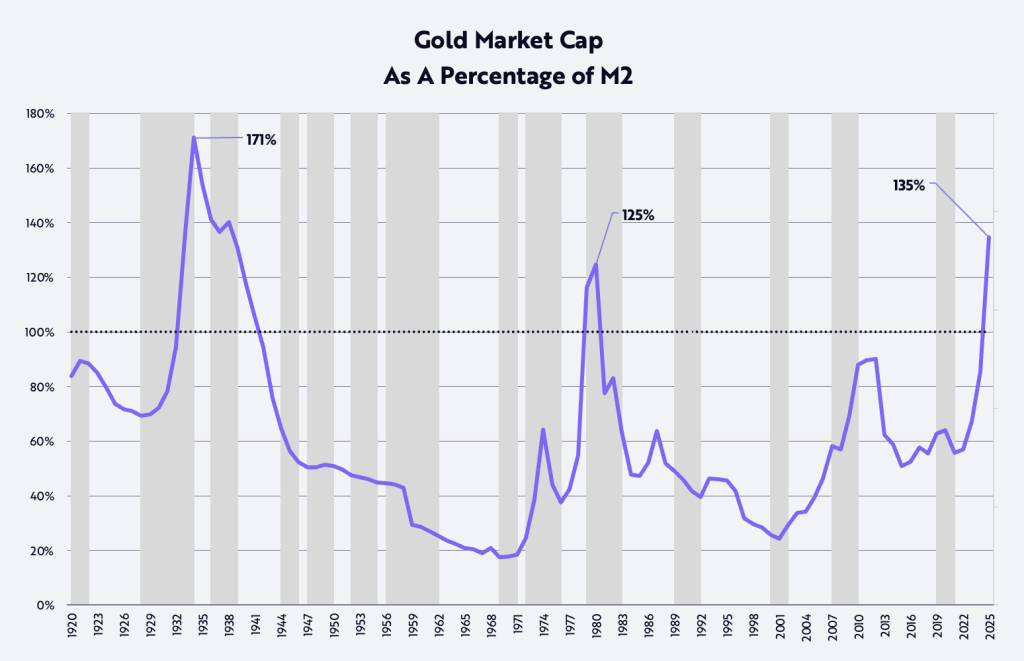
She also emphasized that the recent gold rally reached historically extreme levels. The ratio of its capitalization to the M2 money supply returned to levels seen in the early 1930s and 1980s, which historically preceded high stock market returns after corrections.


As the main advantage of bitcoin, the Ark Invest founder highlighted its diversification potential. The correlation between the cryptocurrency and the precious metal was found to be lower than that between stocks (S&P 500) and bonds.
In mid-January, for the first time since mid-2022, the 52-week ratio of bitcoin to gold dropped to zero.
This allows the asset to be considered an effective tool for increasing returns per unit of risk in investment portfolios in the coming years.
Quantum Threat
Jefferies investment bank strategist and author of the popular “Greed & Fear” concept, Christopher Wood, has completely removed bitcoin from his flagship portfolio, reports Bloomberg. He replaced the first cryptocurrency with physical gold and shares of gold mining companies.
The reason was growing concerns that advances in quantum computing could threaten the long-term security of the coin.
Wood added that concerns about these risks are growing among many long-term investors. According to him, some asset managers are questioning the thesis of bitcoin’s value as a safe-haven asset if the timeline for the advent of quantum computers shortens.
Back in December, Castle Island Ventures partner Nic Carter criticized developers for ignoring the quantum computing threat. In his view, the reluctance to acknowledge the risks is already weighing on the price of the first cryptocurrency.
Meanwhile, Blockstream co-founder and cypherpunk Adam Back believes that systems capable of breaking bitcoin’s cryptography will not appear for another 20-40 years.