



Charles Hoskinson finds Trump’s impact on crypto underwhelming
Hoskinson says Trump’s crypto impact is underwhelming and adds volatility.
President Donald Trump’s administration has proved “a little unhelpful” for the crypto industry, despite early hopes of a “magic net positive”. So said Cardano co-founder Charles Hoskinson.
🇺🇸 NEW: Cardano co-founder Charles Hoskinson (@IOHK_Charles) explains at the @MidnightNtwrk Summit 2025 why many expected the Trump administration to be a “magic net positive” for the crypto ecosystem — even if it has been “a little unhelpful” so far. pic.twitter.com/sEdhjSU6Df
— CoinDesk (@CoinDesk) November 17, 2025
Speaking at the Midnight Summit, he acknowledged that many in the community, himself included, had expected an unambiguously positive impact from the Trump administration. On the campaign trail, the politician made cryptocurrencies one of the main planks of his platform.
“But sometimes, when someone big and strong hugs you, they can do it too hard — so hard they just break your ribs. Just like in The Goonies,” Hoskinson noted.
In his view, irrational optimism and meddling with the usual four-year market cycle have created extra complications for the industry. The Cardano co-founder stressed that the community now has to “deal with all this”, adapting to a new regulatory reality.
The real impact of Trump’s policy on the crypto market
Donald Trump’s pledges to make crypto a priority for the American economy have turned into an unexpected stress factor for the market.
According to The Kobeissi Letter, over 41 days the industry has shed $1.1 trillion in market capitalisation — an average decline of roughly $27 billion per day.
What is happening in crypto?
Over the last 41 days, crypto has erased -$1.1 trillion in market cap, or -$27 billion PER DAY.
Crypto market cap is now ~10% BELOW levels seen during the record -$19 billion liquidation on October 10th.
This is a structural move. Let us explain. pic.twitter.com/5JXKFSCPXV
— The Kobeissi Letter (@KobeissiLetter) November 16, 2025
Total market size is now 10% below levels seen after the October 10–11 crash. According to CoinGecko, at the time of writing it stands at $3.2 trillion.
One trigger for the extended correction was Trump’s announcement of 100% tariffs on Chinese imports. Against that backdrop, bitcoin slumped to $111,000, and daily liquidations reached $19.3 billion.
The political rhetoric that once inspired hope has instead become a source of additional volatility.
Unexpected structural shifts
Yet the basic indicators remain resilient, making events paradoxical. Despite White House rhetoric in support of the crypto sector, the market keeps falling.
Analysts explain the reaction with structural factors:
- institutional outflows reached $1.2 billion in early November;
- excess leverage amplified the sell-off — 20–100x positions created a domino effect on minimal price moves;
- over 16 days there were three sessions with liquidations above $1 billion.
All this has heightened market hypersensitivity. The Fear and Greed Index fell to 10 (an “extreme fear” zone), even though since the April low the price of the leading cryptocurrency has risen by 25%.
Correlations with traditional assets have also broken down — gold has outpaced bitcoin by 25 points since early October, while Ethereum is down 35% amid a broader rise in risk assets.
Experts see a “structural bear phase”, in which the fundamental value of cryptocurrencies is improving but market dynamics are dictated by mechanical factors.
Even so, The Kobeissi Letter expects a near-term bottom, citing a record global M2 ($137 trillion), stimulus in Japan ($110 billion) and forthcoming “tariff dividends” in the US.
All this could restore balance, but for stability the market must first overcome its structural leverage issues, the analysts concluded.
An October signal
Amid the deteriorating structure, analysts have also observed changes in behavioural dynamics.
In October, Placeholder partner Chris Burniske warned that the sharp drop “broke crypto for a while,” making it difficult to quickly rebuild sustained demand.
Increasingly convinced last Friday’s massacre broke crypto for a while — hard to quickly develop a sustained bid, after such a meltdown. This cycle has been disappointing for most, which can paralyze action as people hope for bluer skies, or former ATHs. It’s easy to get caught… pic.twitter.com/2dEU9rSaLV
— Chris Burniske (@cburniske) October 17, 2025
This cycle has disappointed many investors — paralysing activity and prompting them to wait for a return to previous highs, the expert said.
He also pointed to worrying signals from gold, credit markets and Strategy. Burniske stressed that the stock market “will get the message last”.
He allowed for a weak bounce but said he had shifted his strategy towards “more cash”. He will consider re-entering around $75,000 in bitcoin or lower, while the key level to watch now is $100,000.
At the time of writing the leading cryptocurrency is trading around $91,500. On 18 November the asset’s price fell to $90,000 for the first time in seven months.
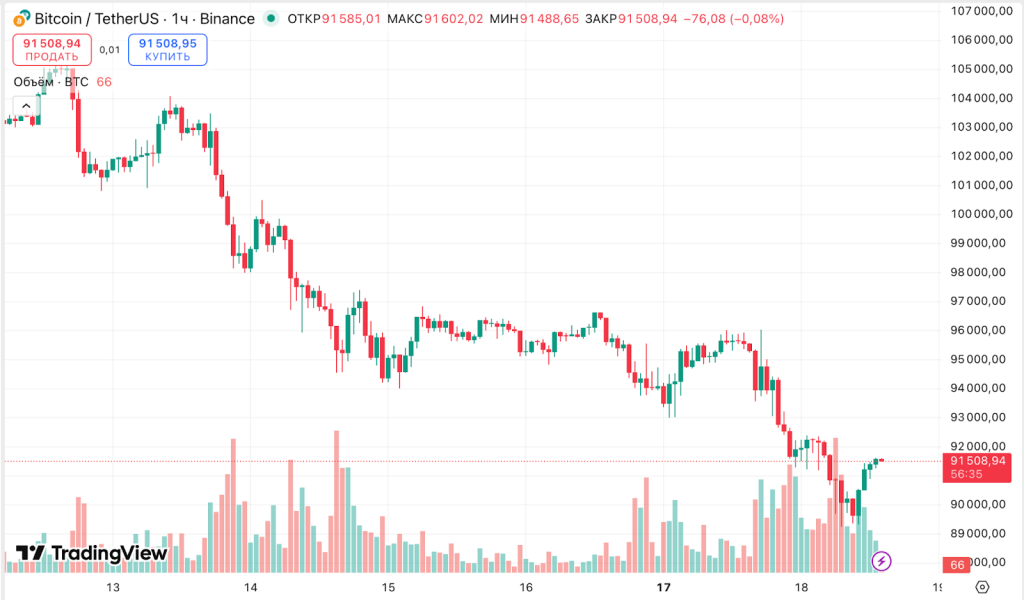
Earlier, Bernstein analysts described the 25% correction in bitcoin as “short-term”.
Рассылки ForkLog: держите руку на пульсе биткоин-индустрии!