




The People’s Bank of China (PBoC) held a meeting with representatives of financial institutions. The regulator banned them from participating in cryptocurrency transactions and ordered to crack down on such activity.
According to a press release, the June 21 meeting was attended by:
- Industrial and Commercial Bank of China;
- Agricultural Bank of China (ABC);
- China Construction Bank;
- Postal Savings Bank of China;
- representatives of the Alipay payment system.
According to the regulator, speculation in the digital-asset market ‘disturbs the normal order’ in the financial sector, creating risks of money laundering and capital outflows abroad.
The PBoC reaffirmed the ban on regulated institutions’ involvement in digital-asset transactions, imposed in 2017. Many Bitcoin exchanges in China have long shifted to crypto-to-crypto trading, but over-the-counter brokers continue to conduct fiat-money transactions.
The regulator asked banks to check whether OTC-brokers use their services to facilitate peer-to-peer exchanges for Chinese traders. Accounts of such users should be blocked, and information about them provided to the regulators.
Credit institutions and payment systems must comply with customer-identification requirements and upgrade their internal monitoring algorithms to better analyse cryptocurrency transactions.
According to Reuters, after the PBoC’s notice was published, all involved parties pledged to comply with the regulator’s order. For example, ABC said it would conduct comprehensive customer checks and will sever ties with violators.
Alipay pledged to create a monitoring system aimed at identifying illegal cryptocurrency transactions. The payment system will also blacklist all merchants involved in such operations.
Bobby Li, founder of the Ballet app and former CEO of BTC China, told Reuters that the PBoC had not changed the law, but had demanded compliance with regulations that have been in effect for several years.
«Essentially, this has taken down all over-the-counter platforms. They circumvented the final ban aimed at suppressing cryptocurrency exchanges. Bitcoin remains a legal digital asset that people may own. Perhaps, in a few years, the final nail in the coffin will be a ban on owning Bitcoin», — added Lee.
Beijing-based Sino Global Capital noted that the PBoC is seeking to limit retail traders’ options for speculative trading.
We believe that the PBOC means to limit the options for the general public to enter the market for speculative trading.
— Sino Global Capital (@sinoglobalcap) June 21, 2021
China’s repressive policy towards cryptocurrencies has driven miners to move capacity abroad. One Guangzhou-based logistics firm reported transporting three tonnes of mining equipment from China to the U.S..
#China logistics firm in Guangzhou confirms to @CNBC it’s airlifting 3,000kg (6,600lbs) #bitcoin mining machines to Maryland, USA. Fenghua International advertises products delivered to door, tax on both ends cleared. Price per kilo: as low as $9.37! #cryptocurrencies pic.twitter.com/8yUjZjhpkk
— Eunice Yoon (@onlyyoontv) June 21, 2021
On June 22, the NYSE-listed mining company BIT Mining Limited also reported the successful delivery of the first batch of mining equipment for cryptocurrency mining in Kazakhstan.
According to Glassnode insights, Bitcoin’s hash rate fell to mid-2020 levels. Coin Metrics puts it at 104 EH/s, BitInfoCharts at around 101 EH/s.


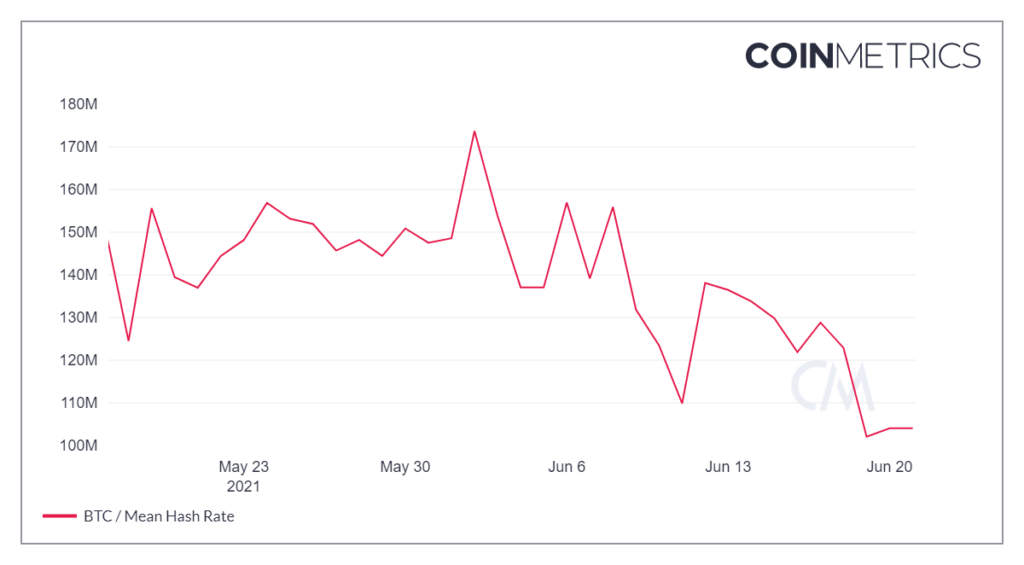
Analysts at Glassnode say that as Chinese miners resolve the logistics of relocating capacity, some may liquidate a portion of their cryptocurrency holdings.
«These sales may represent hedging of risks, freeing up funds to finance logistics, and for some miners — exiting the market», the report says.
In the last week, the price of digital gold fell by almost 20%, according to CoinGecko. Bitcoin was trading at around $32,782 at the time of writing.


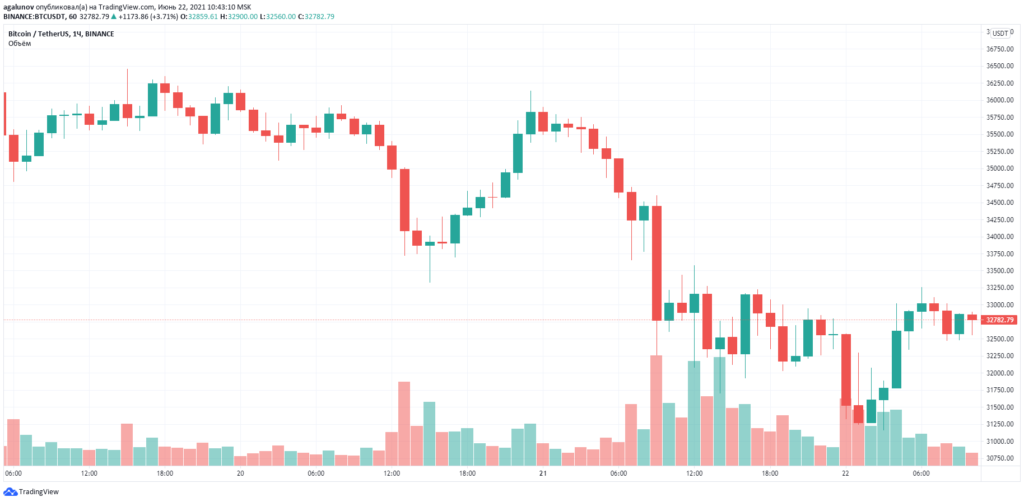
Analyst Michaël van de Poppe noted that Bitcoin is still seeking support around $32,000 with a decisive breakout above $35,500. If the resistance does not hold, the price could fall to $24,000.
#Bitcoin is still acting in support here, with the crucial breaker at $35.5K.
If this support doesn’t hold, I’m seeing $24K as the next area. pic.twitter.com/kk2CJixUyF
— Michaël van de Poppe (@CryptoMichNL) June 22, 2021
In May 2021, three associations under the PBoC issued a joint notice banning companies from supporting cryptocurrency-related business.
In the same month, Vice Premier Liu He said authorities intended to take measures against cryptocurrency mining and Bitcoin trading.
Later, Xinhua News Agency criticised digital gold and its mining methods.
Read ForkLog’s Bitcoin news on our Telegram — cryptocurrency news, prices and analysis.