


Chinese Researchers Develop Exoskeleton for Robot Training
Researchers unveil HumanoidExo, a suit for capturing human movements to train robots.
Researchers from China’s National University of Defense Technology and Midea Group have introduced the HumanoidExo system—a lightweight wearable suit that captures human movements and converts them into structured data for robot training.
Experts aim to tackle one of the most challenging tasks in robotics—teaching humanoid bots to move like humans without the need for thousands of costly demonstrations.
During trials, the humanoid Unitree G1, trained using this new method, was able to perform complex manipulations and even walk after just a few examples.
“A significant bottleneck in robot training is obtaining large and diverse datasets, as collecting reliable real-world information remains challenging and expensive,” the researchers noted.
Humanoid bots often struggle to replicate human movements fully because their training relies on video and simulation data. HumanoidExo addresses this gap by capturing real movements.
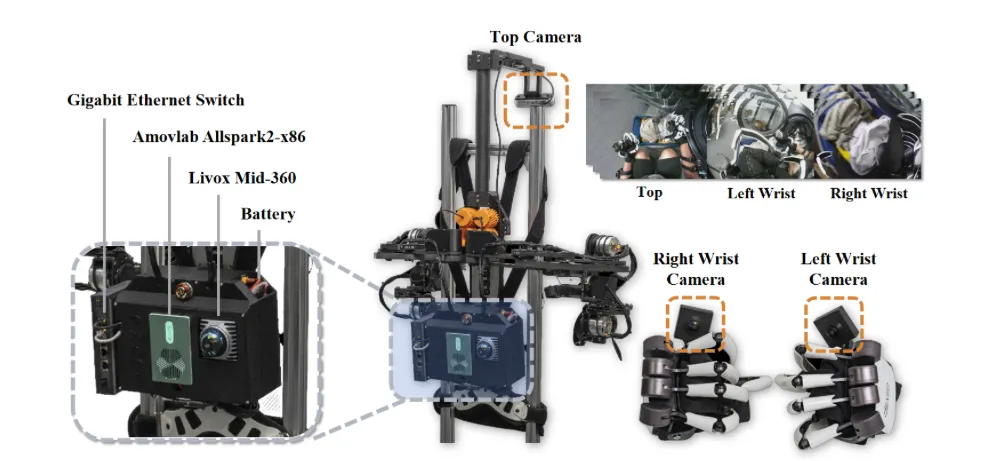
The suit directly maps seven joints of the human arm to the robot’s configuration. It uses inertial sensors on the wrists and a LiDAR module on the back to track the body’s position and height.
The information stream feeds into a two-tier AI system called HumanoidExo-VLA. It includes a Vision-Language-Action model that interprets tasks, and a reinforcement learning controller that ensures balance and stability in movements.
According to the researchers, Unitree G1 was trained on just five teleoperated demonstrations and 195 sessions recorded with the exoskeleton. This hybrid combination increased task success rates for object transfer from 5% to approximately 80%, reaching the level of a model trained on 200 demonstrations.
The exoskeleton recorded a person walking to a table, after which the robot learned to walk, despite the absence of such examples in its training data.
Experts report that the bot successfully completed all movement tasks and continued to work with objects without losing balance.
In one test, researchers physically pushed the robot—it independently returned to its original position and completed the task.
In August, Nvidia launched the Jetson AGX Thor module for robotics at $3,499. The company describes the chip as the “brain of the robot.”
Рассылки ForkLog: держите руку на пульсе биткоин-индустрии!