




The past year proved challenging for the AI industry. The war in Ukraine, the energy crisis, inflation, and tensions between the United States and China—all of which affected the sector directly or indirectly.
But despite unprecedented challenges, 2022 yielded a wealth of breakthrough developments that helped shape the trajectory of technology. Neural networks learned to generate photorealistic images and produce convincing text, and robotaxi services became commonplace in cities such as San Francisco and Beijing.
Here’s a look back at AI in 2022 and what to expect in the coming 12 months.
- Tech firms pulled out of Russia, complicating AI development.
- The United States restricted China’s access to cutting-edge chips, imposing unprecedented export controls.
- Image- and text-generating models became a major trend on social media.
- AI agents mastered a range of sandbox games, advancing reinforcement-learning research.
- Autonomous-vehicle developers launched commercial robotaxi services in major cities in China and the US.
Western Firms Exit Russia
Following Russia’s invasion of Ukraine, many companies, including technology firms, suspended activities in Russia. Volunteers estimate that within nine months of the conflict about 1,000 foreign firms покинули the country or reduced operations there.


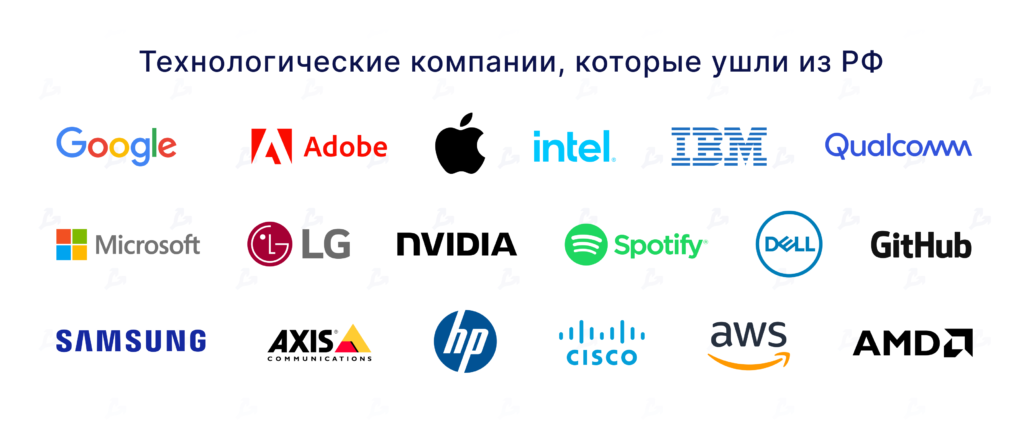
The majority of tech giants paused operations on their own initiative. They include Microsoft, Amazon, Google, Nvidia, Apple and Samsung.
Restrictions affected AI development and deployment in Russia. Russian users can no longer register new accounts on AWS, Azure and Google Cloud. They do not have access to hardware from AMD, Intel and Nvidia.
The U.S. government and its allies did not explicitly ban companies from operating in Russia. However, difficulties arising from sanctions and restrictions on both sides have made their operations in the Russian market more challenging.
Some hope to weather the crisis and return. Others, it would seem, have burned their bridges for good.
Google’s Russian subsidiary formally launched bankruptcy proceedings. Nvidia, HP and IBM closed their offices in Russia and laid off staff. Microsoft intends to wind down its business gradually until there is nothing left.
Restrictions can still be bypassed. Blocked services are accessible via VPNs, and hardware via ‘parallel import’. Yet all this creates difficulties for most users.
The restrictions have also hit ordinary Russian users. Consumer electronics such as smartphones, Spotify and Netflix, and social networks—all are unavailable or operate with difficulty.
Against the backdrop of sanctions and Western firms leaving Russia, domestic services such as «Яндекс.Музыка» and «Кинопоиск» have gained popularity. Local developers have also offered alternatives to several open-source software programs.
Nevertheless, Russian companies cannot replace the full range of Western products—from chips to AI services from cloud providers.
Chinese firms may offer an alternative. However, they risk becoming subject to secondary sanctions. The United States had already in March threatened Chinese firms with restrictive measures over chip shipments to Russia.
Russian tech giants were also hit by sanctions. The Sber group no longer has access to Western technologies and equipment. Яндекс, shortly after the onset of hostilities halted testing of autonomous vehicles in the United States.
According to Reuters, the search giant may исчерпать запасы of semiconductors and other components needed to run its servers by mid-2023. Yandex was forced to sell some of its services and move drone development to Israel.
According to latest reports, the company is considering exiting the Russian market altogether.
The Battle for AI Chips
Over the past year, the standoff between the United States and China intensified. In September the White House restricted exports of chips used for supercomputers and AI to China. Nvidia and AMD were among those affected.
A month later, the U.S. government published new rules affecting 28 Chinese companies. Chip manufacturers now must obtain export licenses. The U.S. government noted that most applications would be denied.
In the United States these measures were described as safeguarding national security. Authorities fear that American technologies could be used by the PRC for military purposes.
Experts say such restrictions have not been imposed on China since the 1990s. They are based on the Foreign Direct Product Rule, under which authorities can halt the sale of products created with American technology at any time.
If successful, these measures could freeze China’s chip-making industry, according to experts.
In the same month, experts stated that Chinese manufacturers would quickly create alternatives to American AI accelerators. For example, Biren Technologies’ BR100 chip, which matches Nvidia’s A100, was cited; however, fearing secondary sanctions, TSMC halted shipments.
In December there were reports that the Chinese government planned to invest 1 trillion yuan ($143 billion) in the semiconductor industry. In addition, China complained to the World Trade Organization about export controls.
At the same time, the U.S. Congress passed a bill to boost domestic chip production. The document would grant tax credits and funding for new plants, with more than $50 billion allocated.
Tech Giants in Crisis
In 2020, amid the pandemic, online content consumption rose sharply and tech giants’ profits grew faster than expected. In response, firms hired more staff to meet demand.
However, as anti-COVID restrictions gradually eased, borders opened and workers returned to offices. Faced with macroeconomic headwinds, by Q3 2022 the tech giants found themselves in a difficult financial position.
This led to mass layoffs affecting almost all firms.
The first to report slower hiring was Google. The company also undertook efficiency measures, such as cutting the Area 120 division and merging the mapping unit with Waze.
Microsoft was among the first to resort to unpopular measures. In October the tech giant quietly laid off 1,000 employees. The company said it was normal, but hiring was paused.
Twitter saw the most high-profile layoffs. After a change of ownership, the company laid off half its staff in one day, including the ethics AI team.
Two weeks later, Elon Musk laid off 80% of contractors worldwide — roughly 4,400–5,500 workers in moderation, marketing, engineering and other roles.
Soon reports emerged of anticipated cuts at Meta. A couple of days later the company confirmed plans to optimise the workforce and announced 11,000 layoffs. The changes also affected the machine-learning researchers team in the hardware stack.
Following Meta, Amazon announced layoffs of 10,000 employees. The cuts affected the Alexa voice-assistant development division and related devices.
With the prospect of a further downturn, layoffs may continue in 2023, including at Google and Apple.
Viral Generators
In 2022 AI algorithms that produce content—primarily images—enjoyed notable popularity. Models such as DALL-E 2, Stable Diffusion and Midjourney operate on a similar principle: users submit a text prompt, and the algorithm returns an image with the requested content.
A hallmark of these generators is their realism. It’s not always possible to tell whether an image was created by a human or a machine. Moreover, DALL-E 2 can generate photorealistic images. That has raised concerns for photographers and artists.



Image repositories, meanwhile, warmly welcomed the technology and allowed selling AI-generated pictures. Among them are Getty Images, Adobe Stock and Shutterstock.
But such services drew criticism over potential copyright breaches. The developers of image-generation algorithms draw on real images, including licensed ones. The question of who owns the rights to AI-generated content and how legally such works can be used in training datasets remains unresolved.
At the end of 2022 OpenAI also introduced the text generator ChatGPT, based on a large language model. According to the developers, it can answer questions, admit mistakes, argue and reject inappropriate requests.
Yet human creativity has not stopped there, and users began experimenting with the algorithm. It turns out it can compose songs, draw simple images and even write code.
Vitalik Buterin volunteered to test ChatGPT’s programming abilities. He said the chatbot can reproduce simple code, but despite the convincing results, it often contains errors and does not run. He concluded that the algorithm will not replace human programmers in the near future.
Similarly, language models are far from achieving general AI. These are algorithms that stitch together fragments of text from training data. Language models do not understand the context they reproduce, as evidenced by non-working code and plagiarised output generated by ChatGPT or Copilot.
Not Just Chess and Go
In 2021, DeepMind said that ‘reinforcement learning is enough to achieve general artificial intelligence’. Since then, the Alphabet-owned outfit has pursued universal AI agents applicable in the real world.
The focus did not stop at chess and Go. In July, DeepMind researchers said they had taught AI to ‘fairly’ distribute wealth in an online economic game. They argue such a model could help people allocate resources more efficiently and earn maximum profits while narrowing the gap between the haves and have-nots.
DeepMind researchers stressed that their work is not a ‘how-to for building AI governance’. They do not plan to develop AI-based tools for politics.
In September, the company demonstrated AI agents that can ‘play football’. The virtual athletes learned from scratch—walking first, then handling the ball. Watching video matches, the system learned the rules and researchers ran some mini-tournaments.



By year-end, researchers showed two algorithms that can play Stratego and Diplomacy on par with humans. Both are built on reinforcement learning.
But DeepMind was not alone in creating and developing AI agents. In November, Meta researchers introduced the Cicero algorithm, which also plays Diplomacy.
The model predicts other participants’ policy for the current move based on the board state and the ongoing dialogue, then formulates its own strategy for the next move.
OpenAI engineers trained AI to play Minecraft. The neural network can run, swim, navigate obstacles, gather resources, craft diamond tools, hunt animals and cook food.
Researchers developed a method of pretraining on video data, enabling the use of large amounts of unlabeled data. They also trained AI to play using mouse-and-keyboard simulators.
Sony unveiled GT Sophy, an AI that beats top players in the racing-simulation game Gran Turismo. The AI surpasses the best chess- and Go-playing algorithms, as well as AlphaStar and OpenAI Five, the developers said.
Researchers say game worlds are ideal testing grounds for AI training. They are complex and full of surprises, so virtual agents can make unusual decisions.
Rise of Robotaxis
The past year has seen an unprecedented rise in autonomous vehicles. Alongside ongoing development by leading carmakers and independent startups, many firms have already begun monetising the technology.
Industry leaders launched commercial robotaxi services in several American cities. Rides are available to residents of San Francisco, Phoenix, Las Vegas and Austin. In China, robotaxi services operate in Beijing, Wuhan, Shanghai and other locations.
In February, Waymo received permission from California regulators to test commercial robotaxi trips. Initially the company’s vehicles could carry only employees. Regulators also imposed restrictions on speed, time of day, and weather conditions.
In November, state authorities allowed Waymo to transport private customers and charge for services across San Francisco and Santa Clara County.
In neighbouring Arizona, Alphabet’s subsidiary likewise expanded its footprint. The company was authorised to operate commercially in central Phoenix, and to transfer passengers from the airport.
GM’s Cruise also competed in both cities. In February, the company received permission to test autonomous vehicles in San Francisco, and by June regulators permitted a commercial launch.
In the autumn, Cruise announced plans to launch robotaxis in Phoenix and Austin by year-end.
The Hyundai-Aptiv joint venture Motional did not contest the above markets. Instead, it launched robotaxi trips in Las Vegas with Uber and Lyft partners.
For 2023, the companies set an ambitious goal to roll out robotaxis in Los Angeles.
Chinese automakers are keen not to lag behind. In February, AutoX announced its lead in the number of robotaxis in the country, with a fleet exceeding 1,000 autonomous vehicles.
In August, Baidu expanded Apollo Go robotaxi service to Wuhan and Chongqing. The drones gained the ability to transport paying passengers in certain districts of megacities.
By November, Baidu reported strong demand for the service. According to CEO Robin Li, in Q3 2022 Apollo Go completed an average of more than 15 rides per day in Beijing, Shanghai and Guangzhou, roughly matching the daily calls of regular taxis.
In April, Pony.ai received a license to commercially operate robotaxis in Guangzhou, with the fleet potentially reaching up to 100 autonomous vehicles in one district.
Not all autonomous-vehicle startups survived 2022. In October Argo AI abruptly ceased to exist. Its largest investors, Volkswagen and Ford, divided the assets of the liquidated firm and took on some of its staff.
Because of Argo AI’s closure, Lyft was hit too, losing $135.7 million. The two sides had been jointly testing robotaxis in Texas and Florida. After Argo AI’s shutdown, trials ended.
Conclusion
2022 proved to be a year of real difficulty, yet it was also rich in notable, transformational events. The world saw a wide range of AI algorithms with practical applications. Generators, robots and automation are being actively embedded in daily life, making it simpler, more productive and more engaging.
Predicting what the next 12 months will bring is hard. Geopolitical tensions are unlikely to ease. A return of Western companies to Russia is unlikely, just as a thaw in U.S.–China relations.
Clearly, the clash between artists and AI generators will intensify. The community faces a considerable task to prove that humans and algorithms can coexist in a single world. Governments will play a key role, tasked with balancing the sides, especially in copyright matters.
Yet the past year showed that human creative potential knows no bounds. The ChatGPT example demonstrates how user ingenuity can reveal new facets of the algorithm. That is further evidence that people remain first in their relationships with machines.