


Chrome Extension Developed to Slow Down Chatbot Responses
Sam Lavigne's SLOW LLM for Chrome slows chatbot responses, questioning AI reliance.
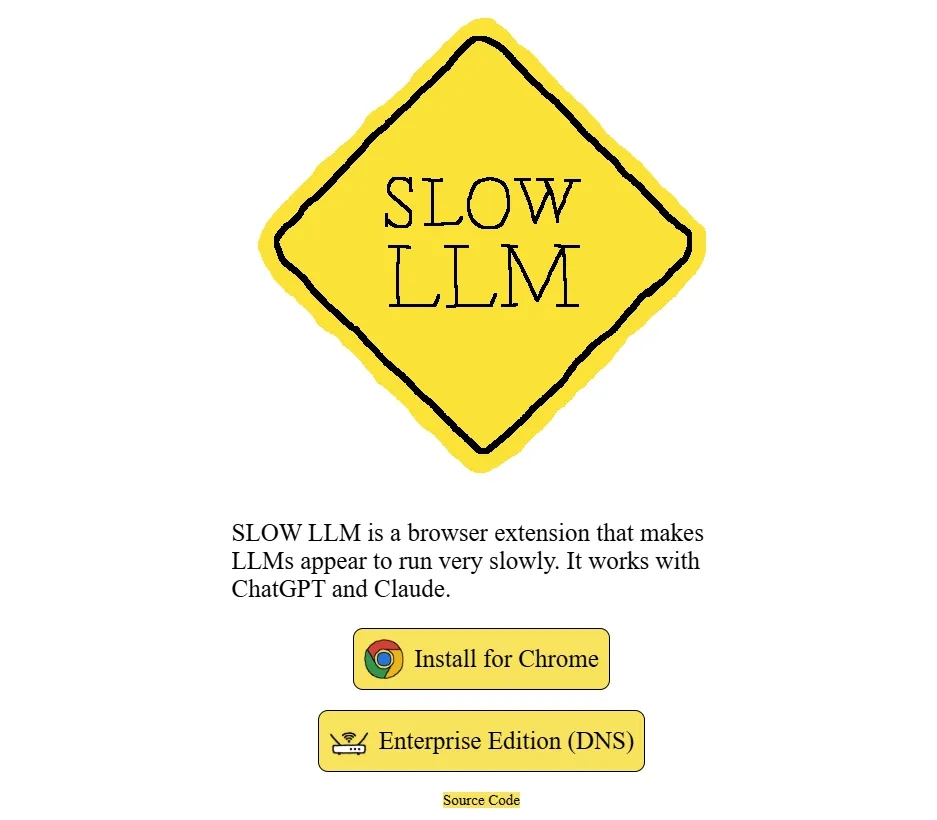
New York artist Sam Lavigne has developed the SLOW LLM extension for the Google Chrome browser, which intentionally slows down responses from popular chatbots.
The idea for the project arose after the plugin developer observed how heavily some of his students and acquaintances rely on generative tools for basic tasks.
This open-source application works with ChatGPT and Claude. A “corporate” version is also available via DNS servers, supporting more models. It allows chatbots to be slowed down on a local network scale, such as in educational and corporate institutions.
SLOW LLM does not interact directly with neural networks. The solution manipulates a feature of the JavaScript language by rewriting the Fetch function, which returns data to the browser. When a user visits a chatbot domain and enters a query, the modification stretches the response over a very long time.
“Many are starting to use AI tools to outsource their cognitive and emotional functions, forgetting all the basic things they were taught. I think that as more people rely on LLM, the trend of skill loss will begin to develop,” Lavigne stated in an interview with 404 Media.
The artist argues that chatbots have taken the idea of “friction” to an extreme. They suggest outsourcing any troubles or difficulties to “thinking machines of Silicon Valley”—even if overcoming these obstacles is part of what makes human creativity meaningful and valuable.
“Anything that removes the friction of solving complex problems hinders your learning and negates already acquired knowledge,” he believes.
Lavigne noted that no one has yet reported successfully deploying SLOW LLM in work or educational networks.
“I haven’t tested the extension on unsuspecting people yet, but I’m considering it. Maybe they’ll just drop out of grad school in anger,” the developer jokes.
The Artist’s Creativity
Previously, the New York artist conducted similar digital performances. During the peak of the COVID-19 pandemic in 2021, he released the Zoom Escaper application for “escaping” video calls, which filled the user’s audio stream with annoying sounds.
In 2018, Lavigne scraped publicly available LinkedIn profiles to create a database of ICE agents. The incident caused a scandal, and the published information about government employees was removed from platforms like GitHub and Medium.
A frequent collaborator of Lavigne, known by the pseudonym Tega Brain, has released several browser tools such as Slop Evader, which remove “junk” generative content by filtering search results after November 2022—the time of ChatGPT’s public launch.
“I conduct small experiments in digital sabotage, trying to create tools that slightly disrupt the operation of computational systems,” Lavigne described his projects.
However, the artist does not consider himself an anti-digitalization maximalist. He admitted to using the Claude chatbot to write the code for SLOW LLM.
In March, analysts at ActivTrak concluded that instead of easing the workload, artificial intelligence currently only accelerates and complicates work processes.
Рассылки ForkLog: держите руку на пульсе биткоин-индустрии!