



Colab learns to code; Meta unveils language models and other AI news
We aim to inform readers not only about events in the Bitcoin industry, but also about developments in related technology spheres — cybersecurity and the world of artificial intelligence (AI).
ForkLog AI has gathered the most important AI news of the past week.
- TikTok challenged Montana’s ban in court.
- Meta trained AI to understand 4,000 living languages.
- Tencent launched palm-recognition technology to pay for rides on the Beijing metro.
- Photoshop added an image generator.
- AI has learned to transform people’s thoughts into videos.
- A writer used ChatGPT and Midjourney to create 97 books.
- The week’s most notable AI deals.
TikTok challenged Montana ban in court
TikTok representatives filed suit against Montana (USA) over the ban on the app in the state. The defendant is Attorney General Austin Knudsen.
We are challenging Montana’s unconstitutional TikTok ban to protect our business and the hundreds of thousands of TikTok users in Montana. We believe our legal challenge will prevail based on an exceedingly strong set of precedents and facts.
— TikTokComms (@TikTokComms) May 22, 2023
According to the complaint, the ban violates the right to free speech guaranteed by the First Amendment to the U.S. Constitution, and a number of other laws.
Code generator to appear in Google Colab
In the coming months, Google will add AI-powered features to Colab for automatic programming.
The cloud environment will use the Codey family of models based on PaLM 2. The algorithms were trained on a large corpus of code fragments with permissive licenses from external sources and tuned for Python.
Among the new features:
- code generation from natural-language prompts;
- auto-completion of code;
- a chat bot for answering programming questions.
Initially, the update will be available to paid Colab subscribers in the US. Later Google will make coding AI features free for a wider audience.
Meta trains AI to understand 4,000 living languages
Meta unveiled the Massively Multilingual Speech (MMS) language AI models. The project’s source code is available on GitHub.
MMS can identify more than 4,000 spoken languages, about 40 times more than existing equivalents. The algorithms also learned to synthesize speech and convert it to text in about 1,100 dialects.
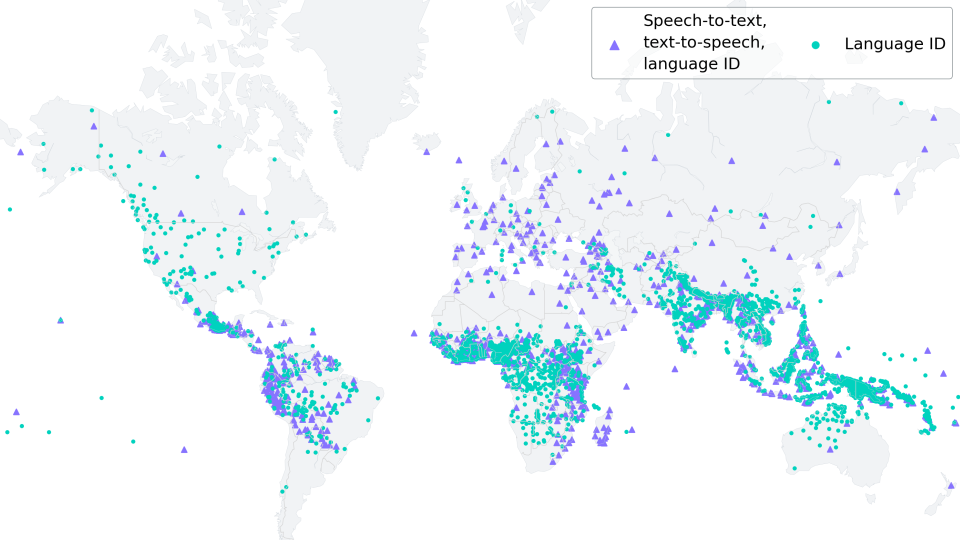
To train the models, developers used the New Testament, on the basis of which they created two datasets. The first contains audio and text in 1,107 languages. The second includes unlabeled speech recordings in 3,809 dialects.
The company warned that MMS may sometimes misinterpret certain words and phrases. They also noted that the Bible contains bias and distortions.
Tencent deploys palm-recognition payment system
Tencent launched palm-recognition technology to pay for Beijing metro rides via WeChat Pay.
The system was developed by YouTu, the company’s AI lab. It identifies not only palms but also veins, and takes into account arm extension during scanning and other characteristics. According to the developers, the technology works under varying lighting conditions.
Users must link their WeChat account to the palm-recognition device and scan their palm at a dedicated auto-mat at the station. Then they can pay for a ride by waving their hand over the scanner at the turnstile.
The company tested the system in Shenzhen. In the future it plans to deploy the technology in offices, campuses, shopping malls, restaurants and other places.
Bard learned to search for images
The Bard chatbot can show images from Google’s search engine.
For example, when asked about the sights of New Orleans (Louisiana, USA), the bot will provide a list of places and their photos. Each image includes a source link.
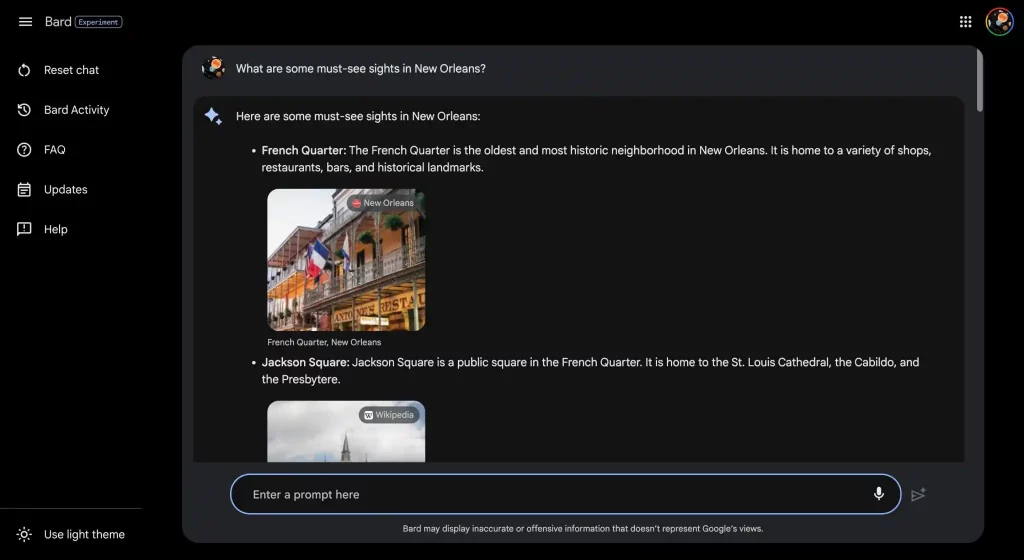
Users can also request images directly from the AI.
Image generator added to Photoshop
Adobe added the Generative Fill AI tool to Photoshop.
The technology is based on Firefly models. It allows, via English-language text prompts, to scale images, as well as to add and remove objects. The tool accounts for perspective, lighting and style.

The company also added a new task panel with a Generative Fill button that appears when selecting objects. It allows quick image edits even without prompts.
Generative Fill is available in Photoshop beta for PC. A full release is planned for the second half of 2023.
YouTube uses AI to describe Shorts videos
YouTube deployed Flamingo, a visual language model, to create descriptions for Shorts.
The DeepMind-developed algorithm analyzes the opening frames of the clip and attempts to understand its content. The model-generated descriptions are stored as metadata for “better video classification and matching search results with viewer queries.”
According to YouTube Shorts product manager Todd Sherman, the AI text meets the platform’s responsibility standards. He added that situations where the technology could cast a video in a bad light are unlikely.
A DeepMind spokesperson said Flamingo has already generated descriptions for many videos, including the most viewed.
Scientists create image-manipulation algorithm
Researchers from the Max Planck Institute for Informatics, MIT and Google developed an AI algorithm Drag GAN for manipulating images.
The technology is similar to Photoshop’s Warp tool. According to the study, it does not simply move pixels but uses AI to recreate the underlying object.
With Drag GAN you can change object sizes and appearance with a couple of mouse clicks. The algorithm also allows rotating objects like 3D models.
Researchers say the approach can not only create occlusions of objects but also deform them according to rigidity, for example when bending a horse’s leg.
Google expands flood forecasting tool to 80 countries
Google expanded the availability of the Flood Hub AI flood-forecasting system.
The platform can be used by governments, aid organizations and residents of 80 countries across the Asia-Pacific region, Africa, Europe, the Americas. It now covers areas with high shares of the population at risk from natural disasters, such as the Netherlands, Vietnam, Laos, Cambodia, and Myanmar.
Flood Hub uses two models to forecast floods caused by river and creek overflows seven days ahead. The system estimates the amount of water entering the flow, the expected flood height, and the areas affected.
AI learns to transform brain activity into video
Singaporean and Chinese researchers developed an AI algorithm MinD-Video for reconstructing video from brain activity data.
The system is a ‘two-module pipeline’ consisting of a trained fMRI encoder and a tuned version of the Stable Diffusion image generator. For training, researchers used a publicly available dataset containing videos and brain activity recordings of participants who watched them.
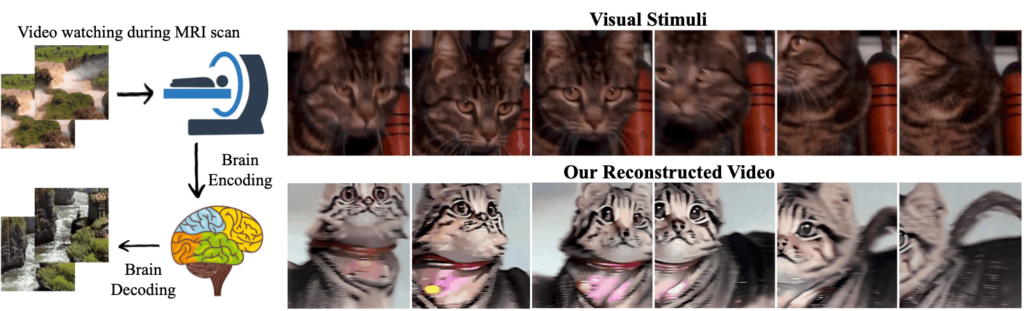
According to the researchers, the algorithm reconstructs video with 85% accuracy. The clips turned out to be ‘quite high-quality,’ as evidenced by motion and scene dynamics, they added.
Writer uses AI to create 97 books
Fiction writer Tim Bushe employed AI to write the AI Lore series.
The author used ChatGPT and Anthropic Claude chatbots, as well as the Midjourney image generator. Each work contains 2,000 to 5,000 words and includes 40 to 140 illustrations.
In nine months, Bushe produced 97 books. He says he earned almost $2,000 from selling 574 copies.
The week’s most important AI deals
From May 21 to 27, AI startups raised more than $969 million. Here are the most notable deals.
- Anthropic raised $450 million to build ‘useful, harmless, and honest AI systems’.
- AI team Tools for Humanity, which includes the Worldcoin developers of Sam Altman, raised $115 million.
- Moonfire, a venture firm that uses AI to scout promising startups, received $115 million.
- Marketing AI platform Insider raised $105 million.
- Figure raised $70 million for humanoid robot.
- FlowX AI raised $35 million to develop technology enabling enterprises to move legacy and modern software to a single place for building and launching apps and services based on it.
- Elementl raised $33 million to support a Dagster-based data orchestration platform.
- Gitai raised $30 million for space robotics manipulators and rovers.
- Datasembly raised $16 million to develop an analytics platform using big data for retailers and manufacturers of consumer goods.
Also on ForkLog:
- G7 leaders agreed to regulate risky AI.
- Digital twins are gaining popularity of deceased people in China.
- On Twitter a deepfake of the explosion at the Pentagon spread.
- Bill Gates predicted the ‘death’ of Google and Amazon because of AI.
- Microsoft unveiled a range of AI innovations at Build 2023.
- Binance warned of the threat of deepfakes.
- OpenAI will exit the EU in case of strict regulation.
- Nvidia reported revenue amid rising AI-chip demand.
- Former Google head called AI an ‘existential threat’.
- Neuralink got approval to test brain implants in humans.
- AI tokens surged following Nvidia’s report.
- Microsoft called deepfakes the biggest AI problem.
What to read this weekend?
ForkLog reviewed the main concepts of ethical AI and tried to determine whether they truly matter for developing safe AI.
Рассылки ForkLog: держите руку на пульсе биткоин-индустрии!