


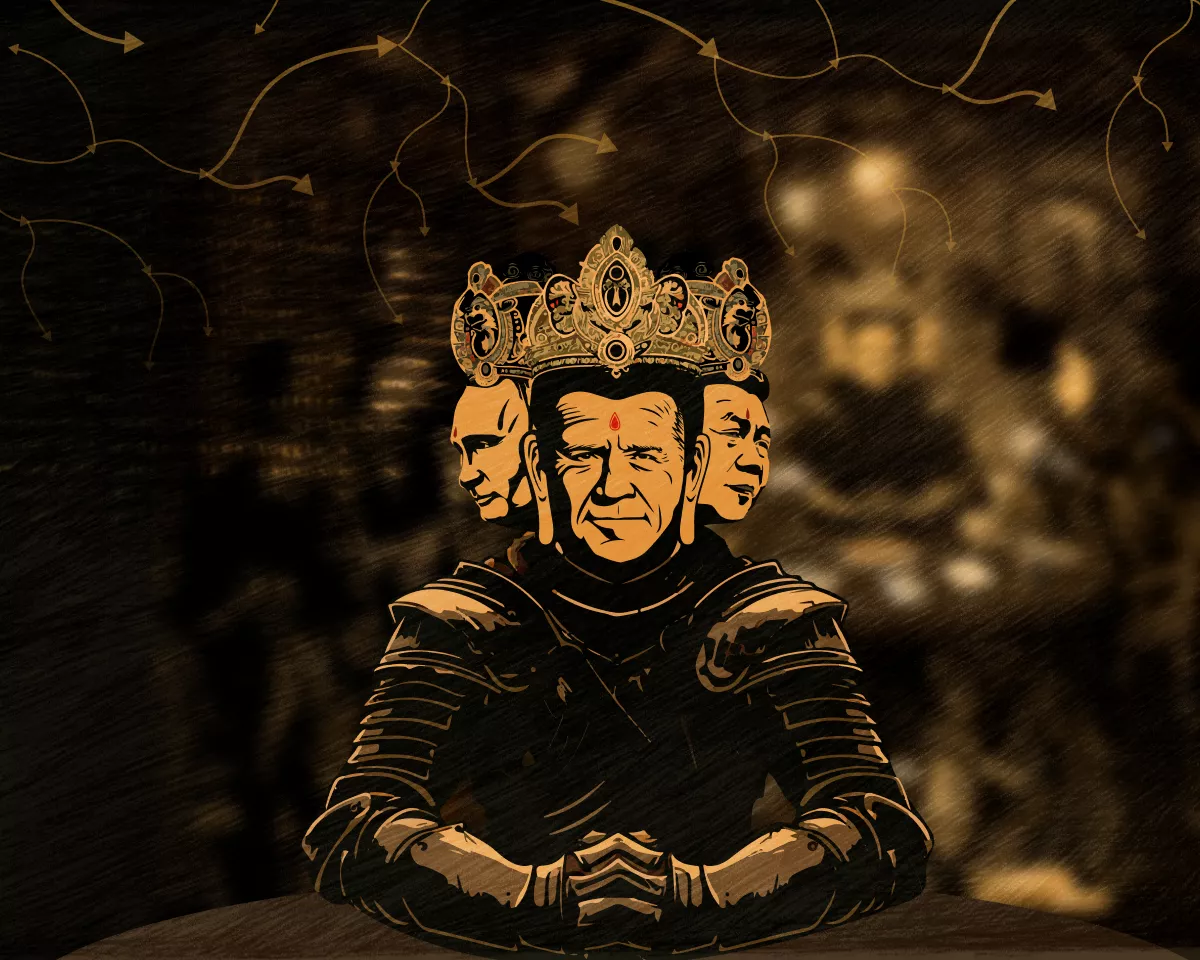
“Community first, then tools”: ATH guests on the problems and prospects for DAOs
Where to begin when building your own DAO, why oligarchs will be the most useful citizens of network states, and whether there will still be room in these structures for good old crypto-anarchism? Guests of the All Time Half (ATH) conference answer these and other pressing questions about social organisation in the Web3 era.
Are DAOs a new form of ownership?
In brief: Yes, but that is only the beginning.
Sergey Mendeleev (exved.com): The concept of a DAO is good not only for business, but also for public administration in cases where we are talking about decentralisation, transparency and control. I am waiting for some UN member state to hold elections on a real blockchain, where you can vote with a token and automatically tally the result with a smart contract.
Andrey Tugarin (GMT Legal): A DAO as a company is too small. I am sure that a decentralised autonomous organisation as a form of public administration is the next stage in humanity’s development. Everyone will get fed up with what is happening now, and everyone will go into what they call DAOs.
Are DAOs about democracy?
In brief: Democracy is only one mode of organisation; DAOs are a field of experiments.
Denis Smirnov (DAO Builders): Unfortunately, democracy has distinct downsides. One of the main ones is the ability to “bribe” the voter through populism. In a fragmented society, where participants are ready to give their vote in exchange for sweeping promises, people will vote for promises rather than results. For DAOs, democracy is not ideal, and the entities that survive use meritocratic models—the one who brings the most benefit earns the most.
Futarchy is one way of governing communities in which the reward comes not for making a decision but for its consequences. If we voted to raise taxes and as a result started living worse, then the value of that decision is low and it should not be rewarded. In the long run this approach will lead to inefficient participants being washed out of the system.
I will get flak for this, but in network states oligarchs will be the most useful members of society. Because as soon as they stop bringing benefit, society will get rid of them at once.
Peter Bel (DAO Builders): Why exactly futarchy and not panarchy? By tossing dice, generating gibberish and making random decisions, panarchy looks a bit more like evolution.
Are DAOs mere form without substance?
In brief: It may seem so, but that is not quite fair.
Alexander Boldachev (philosopher): A DAO is one way of technologically organising activity, adding nothing new to already existing models: co-operatives have always existed; they only lacked a technological platform.
The whole history of DAOs resembles children playing at theatre: they draw tickets, make perforations on a sewing machine so the stub tears off, and the play never takes place. Second, activity is so varied that there simply cannot be a single organising mechanism: somewhere an authoritarian leader is needed, somewhere a co-operative organisation fits.
Decentralisation is not a panacea.
Denis Smirnov: The DeFi sector is an example of DAOs at work. If we look at the capitalisation of existing DAOs, we will see several thousand organisations producing concrete impact; it is just that this is often a specific story tied to DeFi protocols. DAOs work, and all the organisations that have achieved something in DeFi gravitate towards this model of governance.
Peter Bel: DAOs change and must change. This is not a story where we thought up the theatre in advance and started handing out tickets. What I like in the idea of a DAO is that it can be changed from within.
Are DAOs about technology?
In brief: Technology is secondary; community comes first.
Denis Smirnov: Many on the path to DAOs made this mistake: they created infrastructure, issued a token and then expected people to organise. It does not work. When we talk about decentralised organisations, we mean communities. A DAO is not technology; it is an ideology, only it has good tools. Community first, then tools.
Peter Bel: All DAOs are, first and foremost, social constructs. They are about what people have in their heads, about which ideas they want to rally around. Like any social environment, it is hard to predict. It is always an extremely unpredictable story.
Why are DAOs relevant as a political project?
In brief: Nation-states do not answer the new challenges facing humanity.
Denis Smirnov: Today we are observing several global processes that, slightly exaggerating, can be called another Great Migration of Peoples. We have flows of refugees, citizens of states who are not ready to share their countries’ policies, and all this is happening against the backdrop of a general trend towards remote work, accelerated by the coronavirus pandemic and technological development.
Digital nomads are not the funny downshifters from the creative industry as they were once perceived, but a cohort of people who periodically change their location while continuing to create value in different ways. Traditional forms of social governance are simply becoming inconvenient for such a way of life.
Network states are a logical evolutionary option for humanity. This does not mean that traditional states will cease to exist tomorrow, but accumulating small inconveniences push us towards change. The more pronounced these processes are, the more we will move into the digital.
Will new forms of identification and alternatives to KYC take root?
In brief: Yes, but most likely first in decentralised environments.
Andrey Tugarin: When we are talking about volumes like those of large exchanges, even Uniswap, you have to comply. If you do not want to be that large, you can be clever; if you do, you must comply with the rules. One excludes the other.
Denis Smirnov: Decentralised communities already offer a number of solutions that replace standard forms of identity disclosure, giving a person the ability to provide the information about himself that he considers necessary—as bequeathed in the “Crypto Anarchist Manifesto”. A huge number of protocols are appearing that, instead of a government passport, allow you to create a decentralised digital document that reveals not a person’s identity but his actions.
I cannot agree [that this is doomed to exist in sandboxes], because there is the example of El Salvador. It did what it did not because it followed some ideals of crypto-anarchists—it is simply a long-term decision that can bring certain benefits. Given the speed at which new technologies appear, I would not risk saying that this will happen after some prolonged period.
Where should a DAO builder begin?
In brief: With understanding your community.
Denis Smirnov: The main task is to understand what the community’s mission is and whether formalising interaction within it is necessary. A DAO is an internet community of people with a shared bank account.
Peter Bel: The first thing needed at the start is to set a common goal and bring together people who are ready to agree with it at a fundamental level. What is good about the crypto market is that we get platforms and tools with which they can interact. That is the value of funds like Aragon.
Рассылки ForkLog: держите руку на пульсе биткоин-индустрии!