


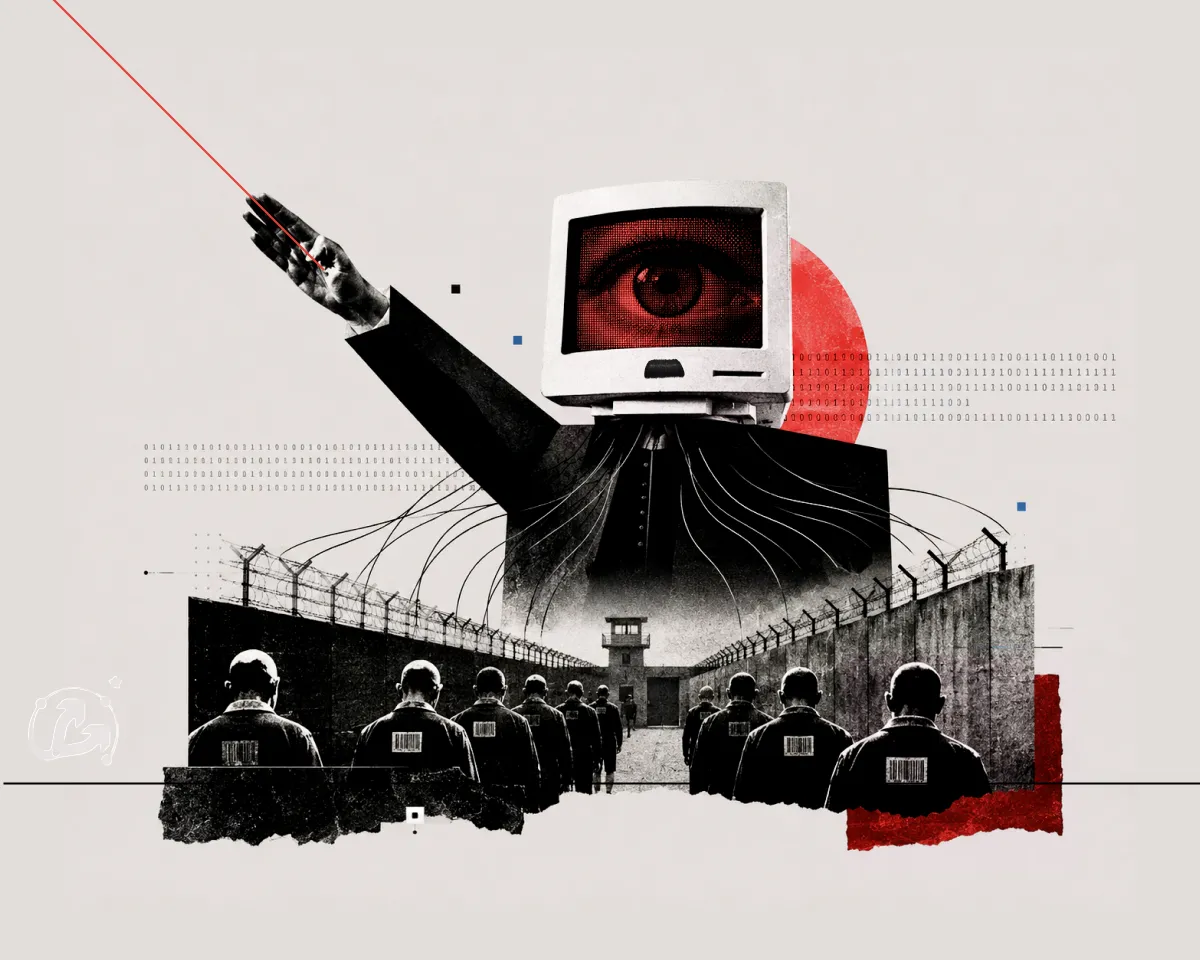
Not long ago, claims that the world was moving toward a global digital dictatorship were confined to people who demand the government reveal its alien contacts and believe tinfoil clothing protects them from electromagnetic radiation. Those halcyon days are gone, and today leading investigative journalists use the phrase “digital gulag” without irony.
At ForkLog’s request, Roman Korolev, author of the Telegram channel “Dark Culturology,” examines this new reality by tracing the roots of conspiracy beliefs about the coming of the Antichrist, an infernal computer and a concentration camp encircling the entire globe.
Religious fear of the machine
Many conspiracists argue humanity is on the final turn toward a total system of suppression and control that uses computer technologies to surveil people and strip them of their freedoms — in short, a “digital concentration camp.” Conspiracy believers inclined toward religiosity often equate this looming cybernetic world of universal unfreedom with the Kingdom of the Antichrist, to be established before the Second Coming.
“Human technophobia is a permanent phenomenon, but it is in the second half of the 20th century that fear of new technologies begins to take on a religious underpinning,” Igor Kuziner, a scholar of religion, told ForkLog.
According to him, scholars of conspiracy theories identify several causes. One is the atom’s entry into human life, including its terrifying military use in Hiroshima and Nagasaki. Another, perhaps the most important, is the growing complexity of technologies to the point where they become a “black box,” hermetically sealed from the average person.
A 19th-century technopessimist could hate a steam engine for threatening his job, but at least he could see how steam moved pistons and grasp the principles behind it. The modern person, who spends much of life in front of a screen, usually can’t fully explain how a computer works. The post-silicon-revolution world is more complex, and complexity inspires fear.
“But computers will become part of everyday life later, in the 1990s. In the 1960s–70s, the main threat conspiracists saw in them was that they would become part of government bureaucracy. In radical American Protestant circles, the idea spread that the government was concentrating financial levers in its hands in order to control the economy and all human life through calculating machines. This coincided with the global fuel crisis, when after another Arab-Israeli war Middle Eastern countries refused to export oil to the US, and prices on everything else rose with the fuel. And despite their marginality, such ideas became quite popular in the US,” Kuziner says.
For someone raised in a Christian culture, the notion that things are moving not toward progress but toward a fatal catastrophe would hardly seem new. After all, that is precisely the scenario foretold in the Bible, which prophesies that before the end times will come the Great Tribulation — a period of immeasurable suffering and unimaginable cruelty. Since the days of Roman persecutions, Christians have seen in the surrounding world signs of that prophecy’s fulfillment.
Anglo-Irish clergyman John Nelson Darby, who in the 19th century had a profound impact on Protestant fundamentalist culture, quite precisely calculated the Great Tribulation to last seven years. Roughly midway, according to Darby’s projections, a totalitarian dictatorship of the Antichrist will be established, with the figure hiding his true nature behind the mask of a charismatic peacemaker until the appointed time. He will gain a plenitude of power humanity has never even imagined and will wield it for persecution, torment and terror on an unprecedented scale.
Dire as that sounds, Darby predicted the suffering would be comparatively short-lived: just three and a half years until Christ returns to earth and routs the Antichrist’s army at Armageddon. The truly righteous, he said, won’t have to suffer at all, because at the start of the Great Tribulation the Lord will “rapture” them to heaven, where they will remain with the Savior until his return to the world.
Authors who extended this line of thought, as noted by American sociologist Michael Barkun in “A Culture of Conspiracy: Apocalyptic Visions in Contemporary America,” tended to equate the Antichrist’s unprecedented managerial abilities, as foreseen by Darby, with the development of information technologies.
Indeed, in the second half of the 20th century what better tool could there be than television for the Son of Perdition to attain worldwide fame and infect minds with sweet lies? It took a few decades to learn the tool truly exists — and it is the internet.
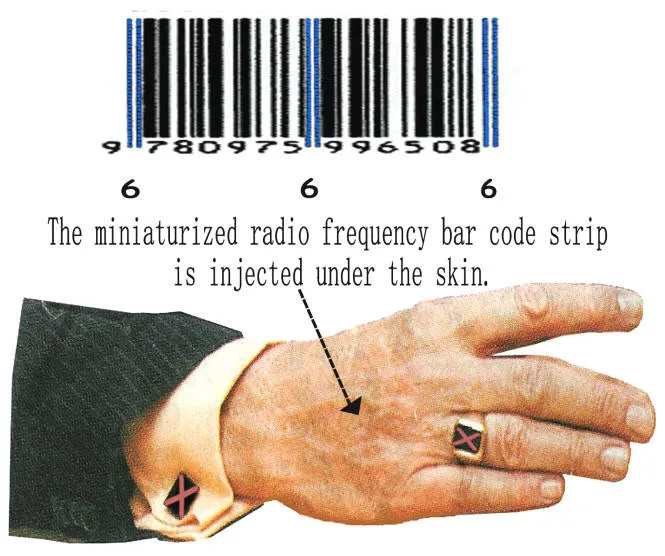
Likewise, street cameras and tracking features embedded in electronic devices will be used by the Antichrist to monitor billions, while barcodes containing the “mark of the beast” will let him seize complete control over their economic lives. He will ultimately abolish cash altogether so every transaction runs on credit cards through a banking system under his sway.
Having realized his plans, the Antichrist will govern the world via a supercomputer capable of analyzing and predicting the behavior of everyone on earth. As Barkun writes, for some conspiracists “Antichrist and computer became virtually interchangeable.” In a more extravagant version, he himself is an ultra-powerful calculating machine to which humanity voluntarily cedes global power.
A generator of evil
To understand how such beliefs spread, we need to introduce another Protestant preacher: American David Wilkerson, who in 1972 produced the pseudo-documentary “Rapture.” It depicts a future in which news anchors report events heralding the Great Tribulation: the sudden disappearance of millions (including people behind the wheel of cars or at aircraft controls), earthquakes, volcanic eruptions and other displays of nature’s fury.
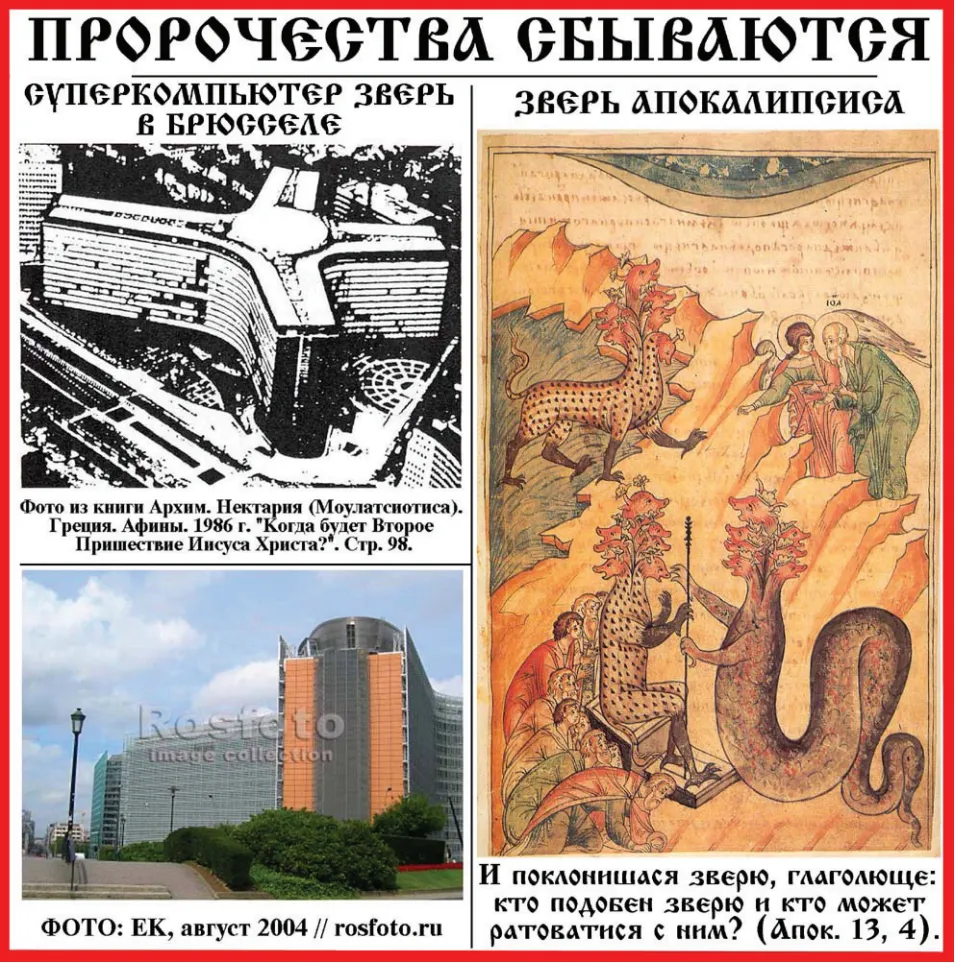
As part of the film’s promotion, Wilkerson published a newspaper, “Signs of the Times,” filled with similar Great Tribulation fantasies. One article is written in the voice of Dr. Hendrik Eldeman — a fictitious “chief analyst of the Confederation of the Common Market.” He describes a supercomputer in Brussels spanning three floors, named “The Beast,” which plans to assign “every citizen of the world a number used for all buying and selling.” The number, invisible to the naked eye, will be laser-etched on the forehead or back of the hand, turning every person into a walking credit card.
Notably, Wilkerson did not hide the fictional nature of these articles. Yet within months, his fellow evangelical Protestants were writing in their outlets about the Beast as established fact. The theory was relayed in that key, for instance, by preacher Mary Stewart Relfe in her 1981 Alabama book “When Your Money Fails: The 666 System in Action.”
As writes Russian anthropologist Alexander Panchenko, “Relfe paid special attention to the development of international payment systems and the spread of plastic debit cards, which, in her view, were to become the main instrument of humanity’s economic subjugation. In Relfe’s book, the story of the Brussels computer and Dr. Eldeman was repeated several times. Moreover, it stated that the ‘little beast’ in Brussels would soon be replaced by another supercomputer located in Luxembourg.”
By 1983, Athonite monk Parthenius included an alarming message about the Beast in his apocalyptic pamphlet “Troubling Signs of the Times,” distributed among Greek laity. Evidently, Relfe’s book was the source that carried the legend of the infernal computer beyond Protestant fundamentalism and into other conservative Christian circles.
Researchers have established that even before the Soviet Union collapsed, the awful truth about the Beast computer spread in Old Believer circles via samizdat. After the USSR’s dissolution, nothing stood in the way of such rumors. Russian monarchist writer Sergei Fomin, a proponent of the Jewish-conspiracy idea, mentioned the Beast in the bestseller “Russia Before the Second Coming,” published in 1993 by the Trinity Lavra of St. Sergius. The demonic computer also drew sharp condemnation from seer Ioann (Veniamin Bereslavsky), founder of the “Center of the Mother of God,” and Maria Devi Christos (Maria Tsvigun), leader of the notorious “White Brotherhood.”
American scholar of Russian religious movements Eugene Clay notes that the Beast-computer legend was used with equal ease in propaganda by American Protestants, Greek and Russian Orthodox, conservative European Catholics and new religious movements. Apparently, in every milieu the beliefs similarly “expressed anxiety over the state of the economy and deep mistrust of computer technologies, state surveillance, globalization and Europeanization.”
On Russian soil, these beliefs soon seeded a movement against taxpayer identification numbers (INN), one of its more prominent figures being the well-known schema-hegumen Sergius, then spiritual father of the Sredneuralsk women’s monastery. In a sermon he foretold the advent of “electronic slavery by devil-like people who will be eternal inhabitants of hell. The inscription is the barcodes on products and things. Everyone has an INN, and it contains three sixes. The seal of the Antichrist will deprive a person of God’s grace. If you consent to the processing of personal data, all information about you is transmitted to the world computer located in Brussels. Its name is BEAST.”


Now schema-hegumen Sergius — too conservative even by Russian Orthodox Church standards — has been defrocked, placed on the federal list of terrorists and extremists, and is serving time in a penal colony. But the concepts he promoted, of course, have not disappeared.
These ideas took root in Russian society amid post-Soviet economic turmoil and expectations of an apocalypse in 2000. As we know, nothing happened. That did not stop many intellectuals in these circles from heralding new doomsdays, pushing the date back year after year.
During the Covid pandemic, such beliefs gained unprecedented traction worldwide, but Russia has long been at the vanguard of “electronic” conspiracism. The country rebelled against INNs, against new passports whose numbers supposedly add up to “666,” and against vaccinations that would somehow “chip” people. All these fears rest on the belief that the Antichrist will mark us, and we will cease to be people with baptismal names, becoming mere numbers in his vast electronic concentration camp.
‘The Beast’ becomes ‘Hitler’
Contemporary Russian conspiracists do not always lean on apocalyptic imagery borrowed from their American “colleagues.” Instead they may speak the language of pop culture — for example, jokingly dubbing the secret world government’s supercomputer “Computer-Hitler,” a figure lifted from a cult album by the thrash-metal band Korrozia Metalla. Or they call it “Rehoboam,” the name a similar computer bore in the series Westworld.
The essence of these beliefs remains the same: evil forces will gather information about every individual into a single electronic system and gain unchallenged power over people by using probability theory to anticipate any possible action.
Looking around, many readers may find these fears not entirely groundless. Governments of all stripes are seeking to limit cash in circulation. The global tech elite have long behaved as though they’ve read the grimmest conspiratorial blueprints and firmly resolved to implement them. Nor does it seem far-fetched that the governance of human society could, in our lifetimes, be handed to neural networks — whose diabolical nature is easy to recognize for anyone who has dealt with them even once.
Does all this mean the fighters against the “digital concentration camp” were right about humanity’s future? There is a caveat. Sociologist Michael Barkun — with whose work we began — linked the explosive spread of beliefs in a totalizing system of digital control to the end of the Cold War.

Although the US emerged victorious, in the eyes of Protestant fundamentalists the world paradoxically did not become safer. Fear of a communist threat from the East gave way to dread of a global, unified system governed from a single center — stripped of any hint of local identity and equally unfree for all. In conspiracist circles this system became known as the “New World Order.” From the vantage point of 2026, however, reality looks far less like a prelude to a globalist utopia than it did at the end of the second millennium.
“Conspiracists are fighting — as if it were inevitable — the idea that our world is developing toward digital globalization, although there are many completely opposite theories: about humanity’s shift to techno-feudalism, techno-nationalism, and so on. It is quite possible we are moving toward global digital fragmentation,” Kuziner concludes.
If both proponents and critics of these projects are right, we may be able to say with confidence that the Antichrist’s plans won’t come to pass. Instead of one digital concentration camp for all, we will get many small autonomous camps, divided by borders and implacably hostile to one another. Reader, take comfort.