




The concept of the metaverse has existed for nearly two decades, but only now have technologies advanced sufficiently for its realization. Bloomberg Intelligence projects that by 2024 the market for virtual worlds will reach $800 billion, and at Epic Games they are counting on trillions.
Metaverse refers to a single virtual space, an alternate world that, however, can be a ‘mirror’ of the real one. In this environment users can influence objects and build social connections, and thanks to a fusion of technologies, the range of such interactions is far greater than in the physical world.
Virtual worlds are being described as the new Internet, and many companies are preparing for a digital transition. Even sports brands and automotive groups are actively developing the field, not to mention technology giants like Meta.
It may sound like a distant future, but metaverses—though constrained and closed—are already here: Ariana Grande and Travis Scott are performing concerts in Fortnite, and children prefer to celebrate birthdays right on the Roblox platform.
- The technologies lying at the heart of metaverses provide users with a wide range of tools for social interaction. Consequently, their impact could be as transformative as the advent of the Internet or mobile phones.
- Virtual worlds will help address certain social issues, but will also pose serious challenges, such as inequality of digital opportunities.
- Blockchain technology is not a mandatory component of metaverses, but it enables linking the virtual economy with the real one, giving users full control over the value they generate.
A Second Layer of the Real World
The prefix ‘meta’—meaning beyond—signifies that the metaverse will allow people to dive into a virtual world unburdened by physical constraints. In this freedom lie fundamental advantages and drawbacks of the new reality, for it can be as destructive as humanity can be.
The de facto forebears of metaverses are MMORPGs. The genre’s heyday ran from 2003 to 2010, and many may recall how often in the media it was discussed how dangerous these online games could be, allegedly causing serious addiction.
Nevertheless, studies have not been able to confirm or refute this thesis. Scientists agree that [1], [2], [3] that ‘pathological’ addiction to such games does exist, but its root cause lies in relationship problems within the family or with peers.
Moreover, authors of some studies argue that MMORPGs can positively affect psychological health. For example, online games help develop and strengthen interpersonal skills, such as the ability to work in groups and social flexibility.
Metaverses offer a wider spectrum of tools for user interaction—this is aided by their technological scaffolding. With mass production of advanced solutions like VR gloves capable of transmitting tactile sensations from digital objects, this effect will only intensify.
How do we touch the virtual world? Our Reality Labs team is working to create the technology to make it possible. Today we shared some progress in researching and developing haptic gloves to bring the sense of touch to the metaverse. Check it out https://t.co/MliVQQdtfs pic.twitter.com/mdOsMwXE5Q
— Meta (@Meta) November 16, 2021
That is why, over the horizon of twenty years, the influence of metaverses on society could be comparable to the emergence of the Internet or mobile phones. A glance at the exponential growth of social media audiences shows how dependent people are on social interaction.
Already the immersion provided by VR devices makes users demonstrate empathy toward each other that resembles that observed in the physical world. It also fosters widespread engagement.
In 2018, a user of the VRChat platform with the nickname DrunkenUnicyclist experienced an epileptic seizure during a session. Because he wore a VR headset that fully tracks body movements, other players saw his seizures and heard the wheezy breathing.
“The main feature of VR is immersion. The way a person seemed to be in agony in front of us made us think we should do something — my instinct yelled at me, but we were powerless”, said Mashable streamer Sam Raisen.
Historically, the incident ended well. After a few minutes the seizure subsided and the player told others who had worried about him that he was OK. Raisen noted that VR projects should incorporate safety protocols allowing admins to access emergency contacts when needed.
Metaverses not only sport social and entertainment components but also enable people to work productively from home. The pandemic pushed many toward remote work, and in the future, against a backdrop of automation and robotics across many processes, the relevance of such a capability will only grow.
Meta’s Horizon family of social services, which includes the Workrooms space, offers users virtual rooms for collaborative work. Owners of Meta’s VR headsets can gather together just as in a real office.
The Meta service is in beta, but some are already using apps like Immersed for the Quest headset to bring their workspace into the virtual world.

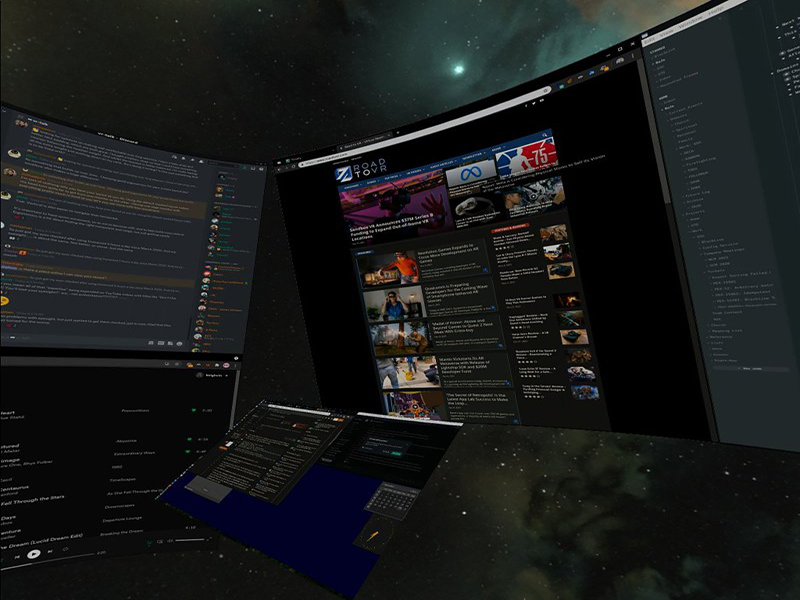

It is not impossible that metaverse users will earn a living through less traditional activities, such as playing games. The Axie Infinity experience — an NFT project based on the Play-to-Earn concept — shows that this is indeed feasible.
Thanks to a broad range of possibilities, people are likely to spend a lot of time in these spaces, and some even believe that in the future a large part of their life will be linked to the metaverse.
This is neither good nor bad — merely a direction of technological progress. Yet such evolution carries a downside nonetheless.
The Dark Side of Progress
To describe the postmodern model of society, French philosopher Jean Baudrillard introduced the term “hyperreality”. In plain language, this is a state in which a person cannot distinguish reality from simulation, because all objects of the physical world are replaced by images and signs — simulacra.
The ideas of Baudrillard may seem radical — something like what we see in the film The Matrix — yet people with unstable mental health can indeed become ‘lost’ in the digital world, forgetting the real one.
Beyond that, social problems of metaverses do not end. Unfortunately, the vices of some members of society often take a very aggressive form — in the digital space their behaviour is unlikely to differ, and the sense of impunity will only worsen the situation.
On the Internet such aggression mainly takes the form of cyberbullying, though harmful to victims’ mental health, it is not as dangerous as physical harm. In virtual worlds, especially with more advanced VR gear, such intrusions can be far more brutal.
In 2018, an attacker hacked the Roblox platform and added animation simulating a sexual act. This allowed two male characters to ‘violate’ the avatar of a young girl.
“I could not believe what I was seeing at first. My daughter’s avatar was subjected to a brutal group rape right on the playground. Toward the end of the act, a woman climbed onto her body. Then all three fled, leaving my daughter’s avatar lying face down in the sandbox,” mother of the victim wrote.
Of course, Roblox is not a VR game. The lack of immersion may prevent players from feeling sufficient empathy for others, so they treat it as a game rather than taking it seriously.
However, such incidents occur all too often in real life, where crime is usually met with proportionate punishment. In virtual worlds without proper controls, true chaos could reign.
Addressing the need for governance and moderation of metaverses is being considered by organisations that develop them. Meta’s chief technology officer Andrew Bosworth noted in an internal memo to staff that the corporation’s virtual world should have “almost Disney-level security.”
This task is not easy, as in virtual reality companies will need to monitor not content but behaviour. That requires developing a wholly new type of moderation systems.
Such control is a double-edged sword. To implement it, operators of digital worlds will collect and process vast amounts of data — the painful experience of the same Meta already showed what this can mean for consumers.
To connect to virtual spaces, users need specialized equipment and access to fast network connectivity. These requirements raise another metaverse issue — the “digital divide”.
Prices for basic VR headsets like the Oculus Quest 2 start at $300. Yet more advanced kits capable of full-body tracking cost significantly more. For example, the new HTC Vive Pro is listed at $1,600. Many simply cannot afford them.
Access to high-speed connectivity is not evenly distributed either. Even in developed countries such as the United States there are sizable “dead zones” where fewer than 10% of people have access to broadband.
In the future these problems will become less conspicuous, as happened with prices for mobile telephony, but that will take time, and there are no guarantees we will reach a world of equal digital opportunity.
Why Blockchain for Metaverses?
According to Nvidia CEO Jensen Huang, augmented reality technologies will become the “backbones” connecting the physical world to the digital one.
“We will enter the virtual world using VR, and its digital objects will cross into our world thanks to AR. It will happen that part of the digital world will temporarily, or perhaps almost permanently, augment our reality. Ultimately, this is a merging of the virtual and physical worlds,” said him.
The metaverse concept presupposes several building blocks without which it is impossible to erase the boundary between worlds. The set of building blocks may vary by design approach, yet some are fundamental:
- Internet. Obviously, interactions among millions of users across continents would be impossible without it.
- Functional compatibility and open source. These standards will enable developers to make virtual worlds seamless, allowing users to “travel” between them.
- Augmented reality technologies. Without AR- and VR-headsets or their equivalents, full immersion cannot be achieved.
- Computing power. The hardware in data centers and at users’ premises must be powerful enough to process large volumes of information.
If the link between physical and digital objects is provided by AR hardware, what will connect the virtual economy to the real one? Some believe that blockchain is a perfect candidate for the role of a financial “backbone”.
Blockchain’s decentralized nature gives users full control over the value earned in the virtual world, which can be represented as cryptocurrency or NFTs. Interoperability between blockchains also makes it easy to transfer this value from one world to another.
An example of this vision in action are projects based on the Play-to-Earn model, whose in-game currencies can be exchanged for fiat.
Blockchain can also address another problem — prevent unjust censorship and instead establish fair rules for moderating behavior. If successful implementations exist for the first issue (decentralized social networks), the second remains to be solved.
An Uncertain Future
According to Gemini co‑founder Cameron Winklevoss, in the future a battle will unfold between decentralized spaces and closed ecosystems (walled gardens). The outcome will largely determine the final realization of the metaverse concept.
Behind centralized solutions stand large corporations with virtually unlimited resources. But that does not guarantee an outright victory.
“In twenty years, technology will let a VR world be created by a single person. Corporations are always a step ahead because they can hire thousands of people and buy licenses for cutting‑edge software. But the idea‑driven spark behind a project is almost always produced by a few people, so when tools become available, the power of one person becomes comparable to that of a corporation,” said Kravenko in an interview with ForkLog, founder of Distributed Lab Pavel Kravchenko.
One thing is certain: metaverses will not only offer numerous opportunities but will also pose serious challenges to humanity. How society copes with them will determine the effect of the pairing of the two worlds.
Follow ForkLog’s bitcoin news on our Telegram — cryptocurrency news, prices and analysis.