



Traditional finance is undergoing restructuring due to the growing corporate interest in tokenization, with the shift of stocks to blockchain altering the very logic of markets. In March, major stock exchanges NYSE and Nasdaq embraced the trend.
IT Director of the crypto company ReserveOne, Sebastian Pedro Bea, believes that the new market is being shaped by two groups of platforms. American platforms like Securitize, Superstate, and Figure are creating infrastructure for issuing Fortune 500 company securities directly on a distributed ledger. This automates and simplifies dividend payments, shareholder voting, and settlements.
Offshore players like Kraken and Ondo offer a different approach. They purchase Apple or Tesla shares through special purpose vehicles and sell tokens backed by them. Formally, these are derivatives, but this structure already allows for instant trade settlements.
Robinhood CEO Vlad Tenev described the tokenization of securities as an “unstoppable train.” The speed of mass adoption of this technology now depends solely on the timeline for regulatory framework development.
SEC’s Readiness for Experiments and Dialogue
SEC Commissioner Hester Peirce stated in an interview with CNBC that the agency is open to collaboration with asset managers implementing blockchain assets in traditional markets and exploring tokenized financial instruments. According to her, as the industry evolves, the regulator insists on direct dialogue with issuers.
“Just come and tell us what you are trying to do. We want to work with you to allow experimentation and determine if such products are needed by the market,” Peirce emphasized.
Addressing the recent tightening of the agency’s control over exchange-traded funds with high leverage, the commissioner noted: the regulator’s task is not to classify products as good or bad. The main goal is to ensure that issuers comply with established limits, explain the structure of funds in terms of securities law, and honestly disclose all risks to investors.
Interest in blockchain is growing, and companies are increasingly approaching the SEC with tokenization initiatives. In response, the agency’s staff has begun developing a special “narrow” exemption for innovations. This initiative will allow for targeted experiments with trading certain tokenized securities within existing rules, without creating broad relaxations and maintaining investor protection mechanisms.
The SEC acknowledges the industry’s arguments that tokenization will speed up settlements and reduce intermediaries, but insists on maintaining oversight standards. According to Peirce, the commission understands that testing these models will inevitably raise new legal, operational, and technical questions, but the regulator is ready to “walk alongside” market participants in finding necessary solutions.
Tokenization in Practice
The backdrop for dialogue with regulators is the rapid growth of the RWA sector. Due to the bear trend in the crypto market, ongoing since autumn 2025, and the sharp increase in raw material prices, exchanges and wallets are massively launching trading in digitized gold and silver. With such instruments, platforms retain liquidity within their ecosystems.


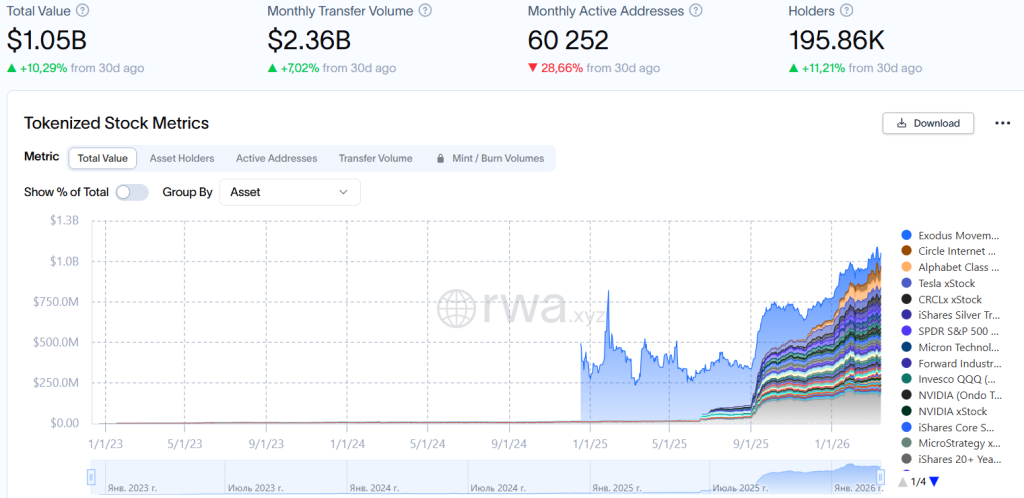
In a comment to ForkLog, TECHNOBIT CEO Alexander Peresichan described precious metals as the most comprehensible class of assets for digitalization:
“The demand for tokenized metals is a consequence of crypto investors seeking safe-haven assets without leaving the ecosystem. Instead of selling digital coins and buying physical gold or ETFs through a broker, they can switch to a token linked to the metal’s price in a few clicks.”
The trend has quickly spread to major platforms. At the end of 2025, Tether Gold (XAUT) tokens were added by OKX, Bybit, KuCoin, MEXC, and Bitget. Pax Gold (PAXG) is traded on Binance and Kraken. The wallet integrated into Telegram has incorporated digital gold, silver, copper, platinum, and palladium.
Traditional financial institutions are not staying on the sidelines. Major Russian banks, among others, are increasingly offering digital financial assets on gold with fixed returns.
BitOK founder and CEO Dmitry Machikhin sees irony in the current situation:
“Bitcoin has been promoted as ‘digital gold’ for a decade and a half. Yet, in the crypto winter, investors are turning to real gold, albeit in token form. Ideology has given way to common sense. But there’s something more important than speculation: crypto exchanges, without realizing it, are becoming universal platforms for RWA. Precious metals are just the first step. The bear market will accelerate this transformation, and the industry is unlikely to return to its previous model.”
In March, the RWA platform International Digital Exchange announced the launch of the LITRO coin, backed by physical oil.