



Crypto Funds See $1.67 Billion Outflow in a Week
Experts linked the outflow to a reassessment of asset management strategies.
Between May 25 and 29, investment products based on digital assets experienced an outflow of $1.67 billion. According to a report by CoinShares, this negative trend has persisted for the third consecutive week.
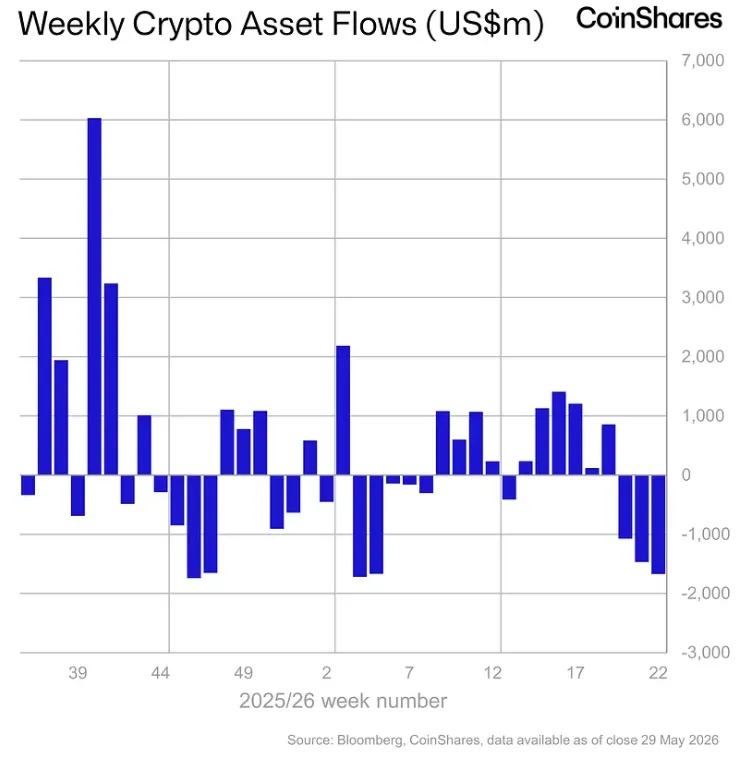
The total amount withdrawn over the past three weeks has reached $4.21 billion. The current outflow is the second largest in 2026. Assets under management fell from $148 billion to $141 billion, marking the lowest level since early April.
The primary impact was on the leading cryptocurrency: investors withdrew $1.43 billion from its instruments. This marks the largest weekly outflow for the coin this year. The annual inflow into Bitcoin products decreased to $1.2 billion from $3.9 billion two weeks earlier.
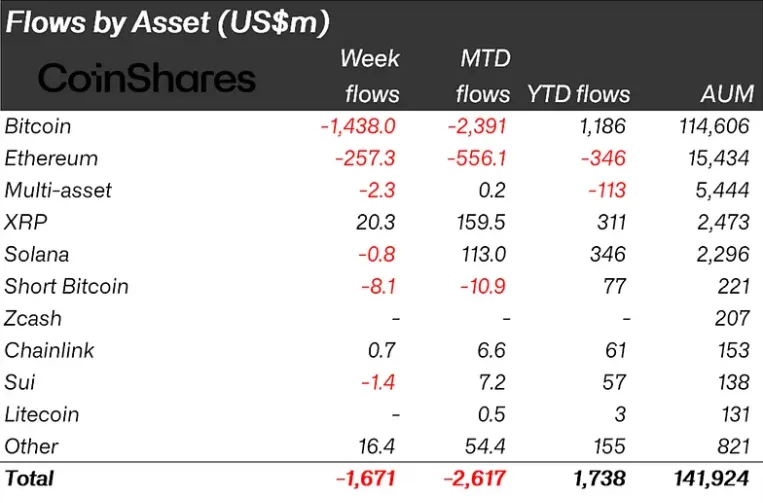
Ethereum funds lost $257 million. Interest in altcoins also declined: only five assets showed inflows of more than $1 million. Among them: XRP ($20.3 million), Hyperliquid ($10.8 million), and NEAR ($7.6 million).
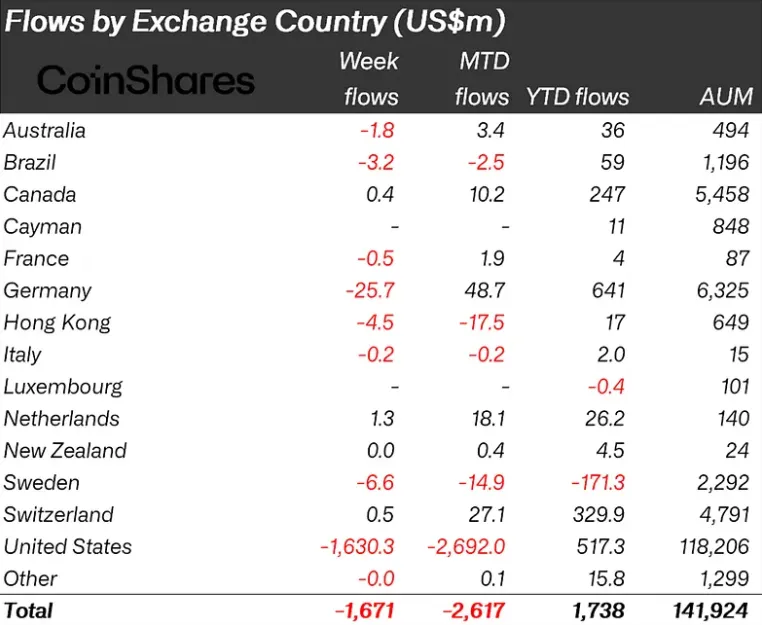
The US was the regional leader in outflows with $1.63 billion. Sales were also recorded in Germany ($25.7 million), Sweden ($6.6 million), and Hong Kong ($4.5 million).
Strategy Shift
In 2026, cryptocurrency hedge funds faced declining returns amid Bitcoin stagnation and reduced activity in the DeFi sector. Experts noted an increasing gap in the market between profitable managers and those unable to adapt to new conditions.
This year, passive holding of major crypto assets ceased to be profitable. Success was achieved only by funds with diversified portfolios. For instance, Digital Asset Capital Management highlighted tokens like Hyperliquid, Morpho, and Zcash as key growth drivers.
Researcher Amir Hadjian from Keyrock emphasized that the crypto industry is undergoing a period of “maturation.” Capital is flowing into projects with real products and revenue, while weaker assets lose support. According to his data, 85% of tokens launched in 2025 are trading below their opening price.
Institutional investors have become more attentive to fund structures, risk management methods, and governance mechanisms. Instead of buying altcoins, they are opting for:
- market-neutral strategies (arbitrage, yield in DeFi);
- on-chain storage and custodial services;
- tokenized treasury products and RWA.
According to Crypto Insights Group, market-neutral strategies have grown by 2.15% since the beginning of the year, while directional funds have lost 5.4%.
The industry anticipates a wave of consolidation. About 78% of crypto funds manage less than $50 million. Without a bullish trend, such structures will not be able to cover operational costs through fees.
Analysts predict that within a year, the number of active funds will decrease, while the average capital under management of the remaining players will increase. Smaller firms will either be absorbed by larger companies or exit the market due to growing competition with ETF.
Earlier in May, crypto-based investment funds recorded an outflow of $1.47 billion.
Рассылки ForkLog: держите руку на пульсе биткоин-индустрии!