



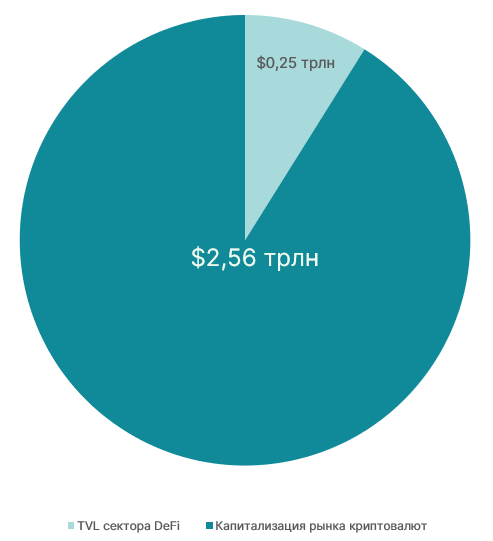
DeFi — a promising and rapidly developing segment of the cryptocurrency market. If at the start of the year its TVL stood at $21.55 billion, by the end of November the figure had reached $253.5 billion.
The total market capitalization of cryptocurrencies exceeds $2.5 trillion. The DeFi sector remains comparatively small — about ten times smaller than the broader market. Yet the growth potential is substantial. new applications appear almost daily, and TVL is growing before our eyes.


Growth prospects attract investors, including players from traditional markets. However navigating the array of protocols isn’t straightforward, especially for newcomers. Investing substantial sums in one or two relatively simple projects carries risks of losing funds.
And DeFi indices come to the rescue. They kill two birds with one stone — freeing investors from the need to perform fundamental analysis of numerous projects and diversifying investments, without worrying about portfolio rebalancing.
- On the backdrop of growth and development in the DeFi segment, decentralized indices are gaining popularity. They include tokens of GameFi and NFT sectors, the “blue chips” of the crypto market, and assets with significant growth potential.
- New instruments allow investors to buy diversified portfolios across various asset sets in a few clicks, without fundamental analysis and periodic rebalancing.
- The DeFi-index segment is still small, but its growth potential is substantial.
What are DeFi indices and why they matter
Decentralized indices are similar to exchange-traded funds (ETFs). However they are not yet regulated by bodies such as the SEC and are not classified as securities.
Total assets under management in traditional ETFs in 2021 reached $10 trillion. The market capitalization of the global stock market exceeds $120 trillion.
As of 26.11.2021, the total market capitalization of the DeFi-index sector amounts to only $428 million. Given the current size of the crypto market, the dynamics and growth potential of the segment, one can safely assume that $1 trillion capitalization for the decentralized indices segment is only a matter of time.
DeFi-index protocols can be compared to asset managers such as ProShares or Vanguard. Index tokens represent a stake in the portfolio of a particular decentralized fund.
Some protocols also have governance tokens that allow investors to vote on the index composition, the shares of various assets in it, and other nuances. Rebalancing of portfolios is performed automatically, via smart contracts.
The index tokens themselves are quite liquid — they can be bought and sold on decentralized exchanges. Moreover, some such assets can be used as collateral in external DeFi protocols and for yield farming.
Beyond diversification, these instruments significantly reduce transaction costs — to form a portfolio of blue chips and other promising sector coins, it is enough to buy a token from one of the index protocols.
Consider the most well-known projects specializing in DeFi-indices.
Index Cooperative (INDEX)
The Index Cooperative project (also known as Index Coop) is one of the segment’s pioneers. It was founded by Set Labs, which created the Set Protocol platform, with the assistance of the DeFi Pulse analytics service.
The project has a governance token INDEX. Its holders vote on various proposals, for example, the inclusion of tokens in indices and changes to the latest parameters, liquidity-mining programs and the launch of new instruments.
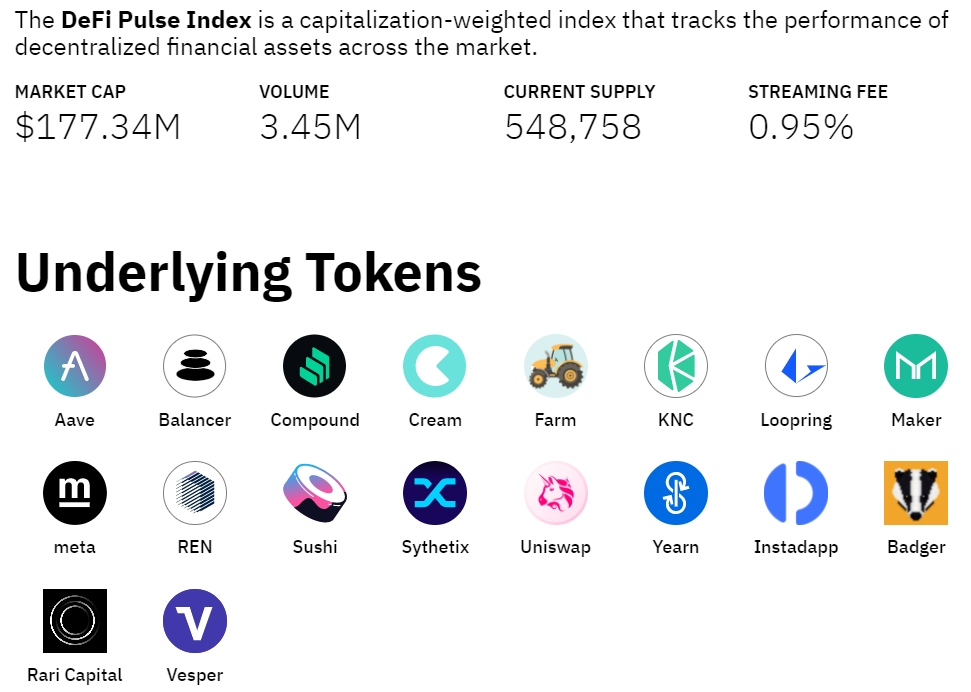
DeFi Pulse Index (DPI) — the oldest and most popular index in the DeFi space. Its market capitalization stands at $177 million (as of 26.11.2021). The token trades on Uniswap (v2 and v3), SushiSwap, KuCoin and Loopring.
According to information on the site, the index is weighted by market capitalization. It includes 18 tokens. The components are rebalanced monthly.


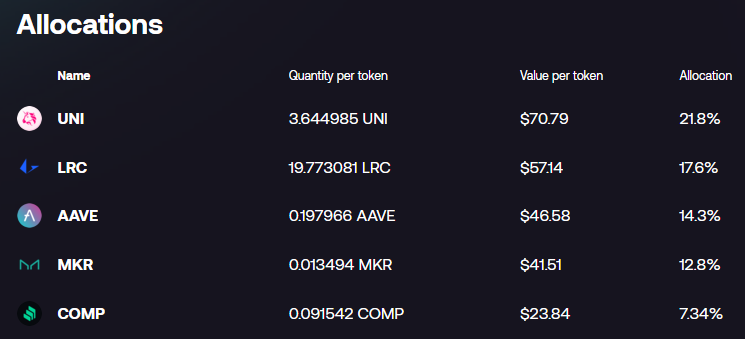
The largest share goes to the UNI token of the Uniswap exchange.


The annual management fee is 0.95%. The founder of The Daily Gwei, Anthony Sassano, is convinced this is not too expensive, given the DPI’s positive momentum.
The fees go to DeFi Pulse and the @indexcoop who manage the index with rebalances and such.
A 0.95% yearly fee for a product that has returned 300%+ since it launched is a fair trade to me 🙂
I imagine that fees will come down over time once the DPI grows though.
— sassal.eth 🦇🔊🐼 (@sassal0x) February 3, 2021
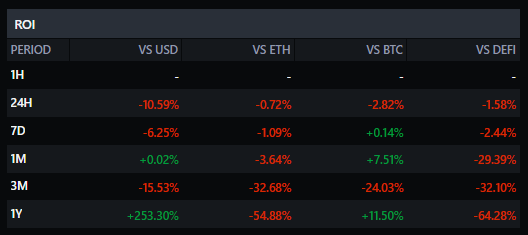
However, by the end of November, Ethereum’s growth and the DeFi sector overall outpaced DPI on various timeframes.


To include assets in the DPI they must meet the following criteria:
- the token is available on the Ethereum blockchain;
- the token is from the DeFi space and
- the token is listed on DeFi Pulse;
- the token is not classified as a security;
- emission is forecastable over the next five years;
- in free circulation not less than 5% of the token supply.
Derivative assets such as wrapped coins (WBTC, WETH), tokenized derivatives and synthetic financial instruments are not included in the index. Also excluded are tokenized claims on other tokens.
Metaverse Index (MVI) — an index based on tokens in the burgeoning GameFi sector.
The screenshot below shows the assets included in the index.


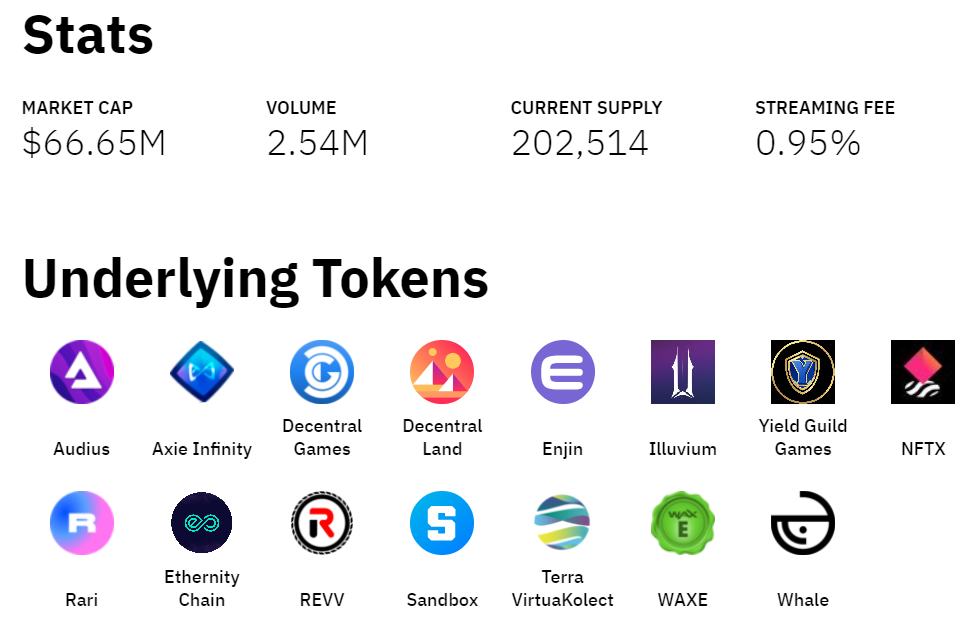
When calculating the shares of MVI components, liquidity metrics are also considered. The main inclusion criteria for MVI are:
- available on the Ethereum blockchain;
- market capitalization above $50 million;
- “reasonable and sustainable” liquidity on Ethereum exchanges.
The price trend of MVI shows an ascending trajectory, significantly outperforming ETH, BTC and the DeFi sector as a whole.


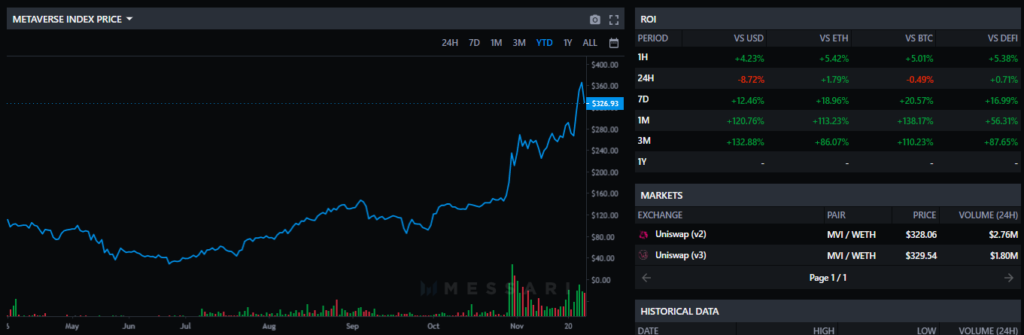
Market capitalization of Metaverse Index stands at $66.8 million (CoinGecko data as of 26.11.2021). You can buy MVI in the Index Coop app or on Uniswap.
Another interesting instrument is the ETH 2x Flexible Leverage Index (ETH2X-FLI). As noted by developer Peter Le’Monade, it allows using leverage to open “super-long” positions on the second-largest cryptocurrency.
According to him, previously users performed a whole sequence of steps. For example:
- deposited ETH in the lending service Compound;
- took out a loan in USDC;
- exchanged the borrowed stablecoin for ETH.
If risk appetite is very high, and the price of ether keeps rising, some users repeated the above algorithm. This approach allows acquiring a significantly larger amount of the asset than, for example, on the spot market. But this strategy carries higher risks and substantial transaction fees.
The developer emphasised that ETH2x-FLI achieves roughly the same effect “in one transaction, because the leveraged position is simply tokenised and traded like any other ERC-20 token.”
«Many people associate leverage with casinos like BitMEX, where there are 25x margin positions. We think of it as the complete opposite», — noted Peter Le’Monade.
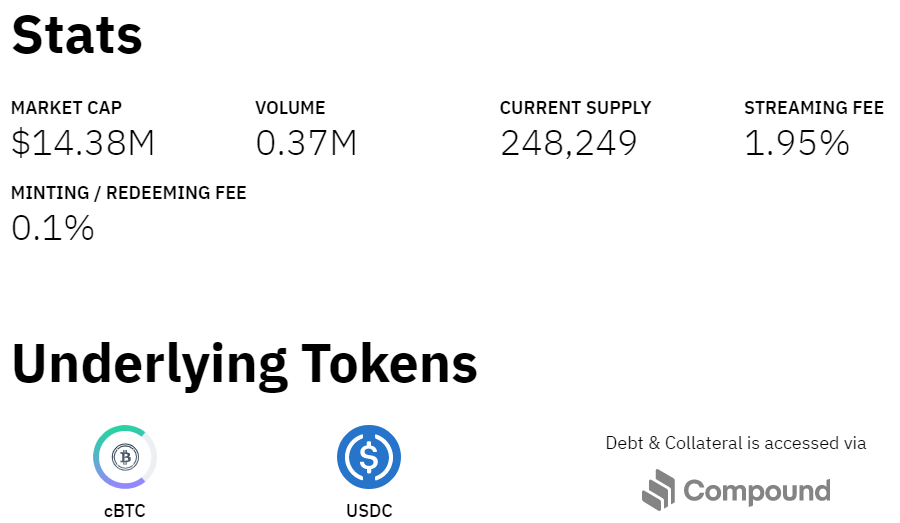
ETH2x-FLI is based on the cETH token from the Compound service and the USDC stablecoin. From the name/ticker itself, it is clear that the index implies 2x leverage.


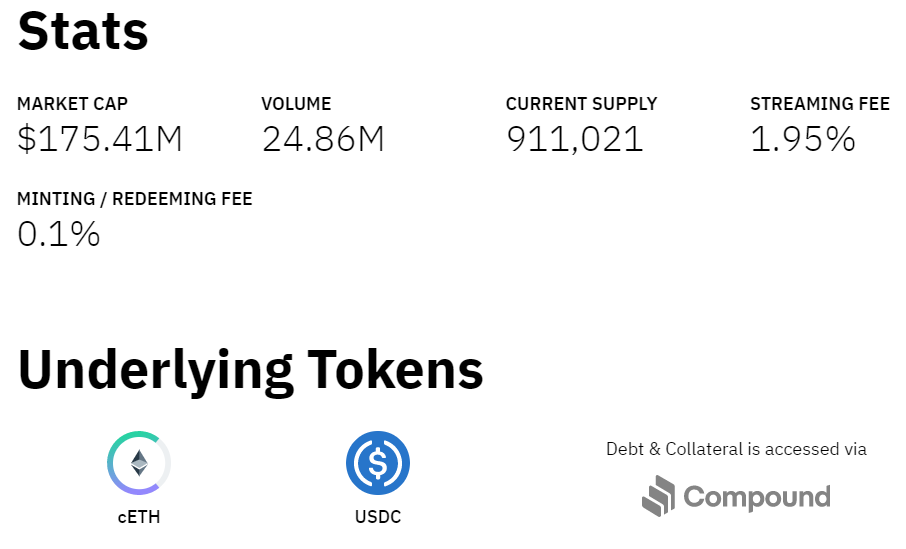
Data from CoinGecko shows ETH2X-FLI competes with DPI for the top spot in its segment’s market capitalization ranking.
Bitcoin Flexible Leverage Index (BTC 2x Flexible) is analogous to the previous instrument. The only difference is that it is based on Bitcoin, not Ethereum.


Bankless BED Index (BED) — simple to understand and at the same time the most diversified instrument from Index Coop.
It consists of three parts:
- 33.3% — Bitcoin;
- 33.3% — Ethereum;
- 33.3% — the DPI index.
Thus, BED covers most of the most capitalized assets, filtering out low-liquidity coins. The index rebalances monthly to maintain the above proportions.
Data Economy Index (DATA) covers the largest projects related to data in the digital economy. The index is based on the following tokens:
- Chainlink;
- Filecoin;
- The Graph;
- Basic Attention Token;
- Livepeer;
- Ocean Protocol;
- Numeraire.
To be included in the index, a token must have a market capitalization above $100 million.
Indexed Finance (NDX)
This is another protocol focused on portfolio management. Indexed Finance has a native token — NDX. An automated market maker (AMM) like Balancer, rebalancing indices, is implemented.
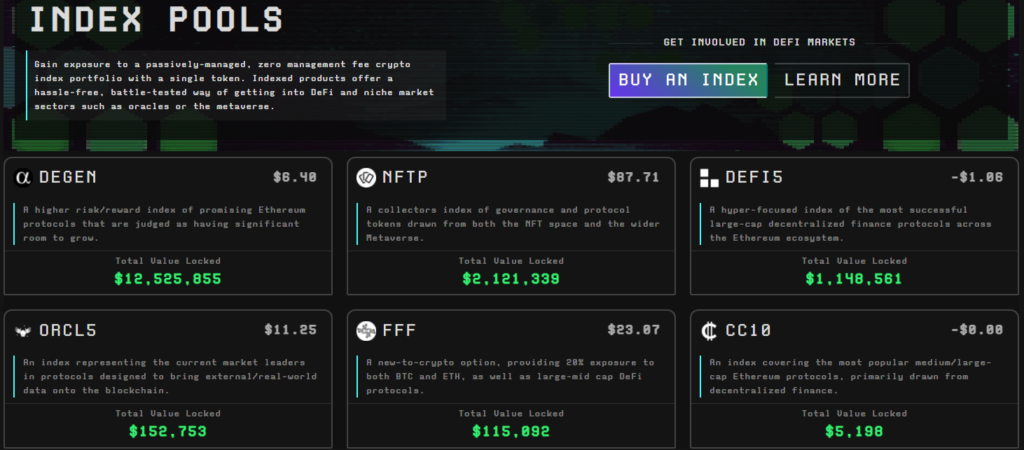
As of writing, the platform offers six indices:
- DEGEN — “promising Ethereum protocols with significant growth potential,” including REN, 1INCH, ALPHA, OCEAN and others;
- NFTP — protocols focused on NFT and metaverses (AXS, ENJ, MANA, SAND and others);
- DEFI5 — high-cap DeFi assets, including SUSHI, UNI, AAVE, CRV, COMP, MKR and SNX;
- ORCL5 — blockchain projects related to oracles (LINK, BAND and others);
- FFF — an index including wrapped Bitcoin and Ethereum, as well as DEGEN, DEFI5 and CC10;
- CC10 — DeFi projects of mid-to-high capitalization (OMG, UMA, YFI, BAT, UNI and others).


PowerPool
Indices from PowerPool are Balancer-based smart pools. The project features a governance token CVP. It enables users to vote on platform upgrades, new indices, portfolio strategies, and so on.
PowerPool offers the following products:
- YLA — an instrument based on an optimized basket of the most profitable yEarn stablecoin vaults;
- BSCDEFI — an index based on the blue chips of the Binance Smart Chain ecosystem;
- xCVP — a mechanism to distribute rewards from PowerPool DAO Treasury;
- PIPT — an index based on high-cap DeFi tokens (AAVE, SNX, COMP, MKR, YFI, UNI) and the native CVP;
- YETI — an instrument where the largest shares go to YFI and SUSHI (also includes CREAM, AKRO, PICKLE, KP3R and CVP).
PieDAO
PieDAO’s indices — the so-called Pies — resemble the tools from Index Coop.
In Pies, automatic rebalancing is driven by Balancer. There is also a governance token — DOUGH, holders can lock it for staking for periods from 6 to 36 months. Token holders can vote on new Pies and other platform developments.
PieDAO offers the following products:
- PLAY — an index based on metaverse tokens;
- DEFI+L — “blue chips” of DeFi such as LINK, MKR, AAVE, UNI;
- YPIE — a token based on the yEarn Finance and SushiSwap ecosystems;
- USD++ — an index based on stablecoins USDC, TUSD, DAI and sUSD;
- BCP (Balanced Crypto Pie) — a combination of WBTC, WETH and DEFI++;
- DEFI++ — an index consisting of DEFI+L and DEFI+S;
- DEFI+S — a product based on DeFi assets of relatively small capitalisation (UMA, REN, LRC, BAL, PNT and MLN);
- BTC++ — an index based on tokenised Bitcoins (imBTC, WBTC, pBTC, sBTC).
Advantages and drawbacks of DeFi indices
DeFi indices offer broad diversification opportunities. At the same time, there is no need to delve into the technical and monetary specifics of various projects — simply buy the index token on a DEX.
The performance of indices based on NFT, GameFi and metaverse sectors significantly outpaces market benchmarks. Consequently, investments in such products may contribute to portfolio growth.
However, one should not overlook risks, including potential hacker attacks. No project is immune, even with audits.
Many projects offer liquidity mining programs. Yet such programs typically provide only a short-term effect. Once programs end, liquidity often evaporates, and the native token falls sharply in price.
For the “financial LEGO” there are also systemic risks, since many protocols are built atop others. That means the failure of any one project could entail irrecoverable losses for token holders.
DeFi indices are not perfect. Even DPI, despite its conservative asset selection, underperforms Ethereum and the DeFi sector as a whole in terms of returns. Therefore, an experienced investor can, on their own, construct a higher-quality portfolio. However, this requires deep analysis of many projects, careful asset management, precise timing for purchases, and a certain amount of luck.
Conclusions
When choosing indices, investors should pay attention not only to their composition and historical price dynamics but also to fees and management strategies. Moreover, risk tolerance is important — it is individual for each market participant.
The decentralized index segment is still in its early stages. However, given its small size, one can expect the emergence of new products and growth in their market capitalization in the medium to long term.
Subscribe to ForkLog news on Telegram: ForkLog Feed — the full news feed, ForkLog — the most important news, infographics and opinions.