


Crypto plastic: what bitcoin cards are, how they work and why they matter
Crypto cards are debit or credit cards that let you pay for purchases with digital assets. At the point of sale, the assets are converted to fiat instantly.
Here we outline the benefits of this payment tool and five options on the market.
Benefits of crypto cards
Typically, investors hold bitcoin and other assets in custodial and non-custodial wallets. For everyday spending, however, most still rely on networks such as Visa and Mastercard.
Crypto cards are a bridge: they allow you to pay for goods and services with digital assets via popular gateways such as Apple Pay and Google Pay. Other advantages include:
- low barrier to entry. Crypto cards are much like familiar bank cards. They suit newcomers and holders of digital assets who prefer not to use non-custodial wallets;
- instant conversion. Automatic conversion removes the need to exchange crypto in advance;
- rewards. Some crypto cards offer users perks and crypto cashback.
Yet such cards are not a full-fledged tool for working with digital assets: compared with wallets, their functionality is limited. Holders must pass KYC, and crypto cards cannot send on-chain transactions or interact with DeFi protocols.
Visa and Mastercard issue crypto cards in partnership with firms that obtain licences and are responsible for holding users’ digital assets. Below are examples of such integrations.
Crypto.com Card
Crypto.com Card is a prepaid Visa card from Hong Kong-based Crypto.com. It can be topped up using other credit/debit cards, PayPal, a bank account and cryptocurrencies.
Users can choose among five tiers with different limits and perks. Depending on the card, they receive rewards for staking Cronos (CRO), rebates on Spotify, Netflix, Prime and X subscriptions, travel-booking cashback, airport lounge access and preferential service terms.
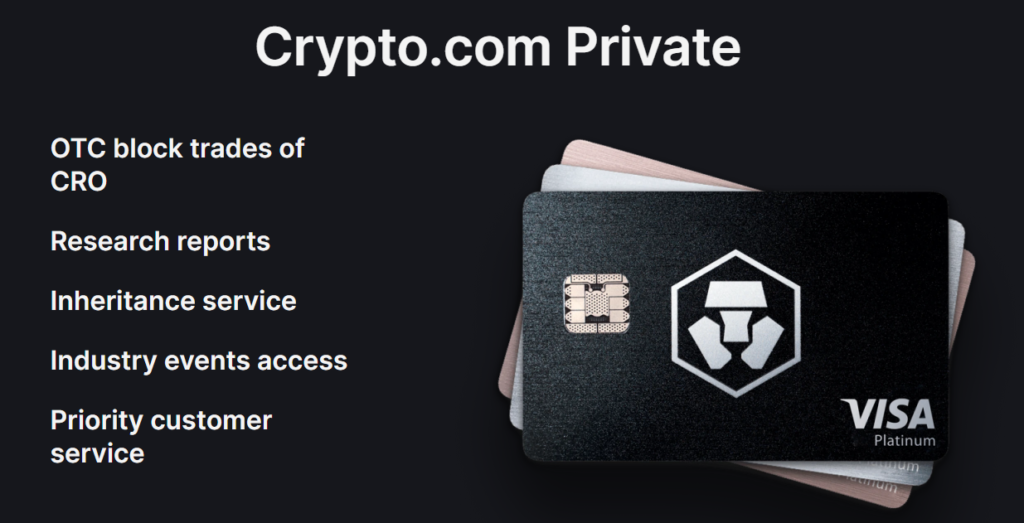
The service charges no issuance, maintenance or card-transaction fees, but some tiers require staking CRO from $400 to $400,000.
Countries: European Union, United Kingdom, United States, Singapore, Canada, Brazil, Australia.
Cryptocurrencies: 100+ coins, including bitcoin and Ethereum. The list may vary by the holder’s jurisdiction.
Fees: 0.5–2% on cash withdrawals above the limit.
Bybit Card
Bybit Card is a virtual or physical Mastercard debit card linked to a Bybit exchange account. Holders earn 2%–10% cashback and points redeemable for coupons, NFTs, subscriptions to services such as Netflix and ChatGPT, as well as gadgets and partner merchandise.
Maintenance is free. The exchange charges 5 EUR/USD only for issuing a physical card.
Countries: European Economic Area (except Croatia, Iceland, Ireland, Liechtenstein and Romania), Switzerland, Australia, Argentina.
Cryptocurrencies: BTC, ETH, XRP, USDT, USDC, TON, MNT & BNB.
Fees: 0.5–0.9% for crypto conversion, 0.5–7% on foreign-currency transactions. ATM withdrawals up to 100 EUR/USD per month are free; thereafter 2%.
Crypto
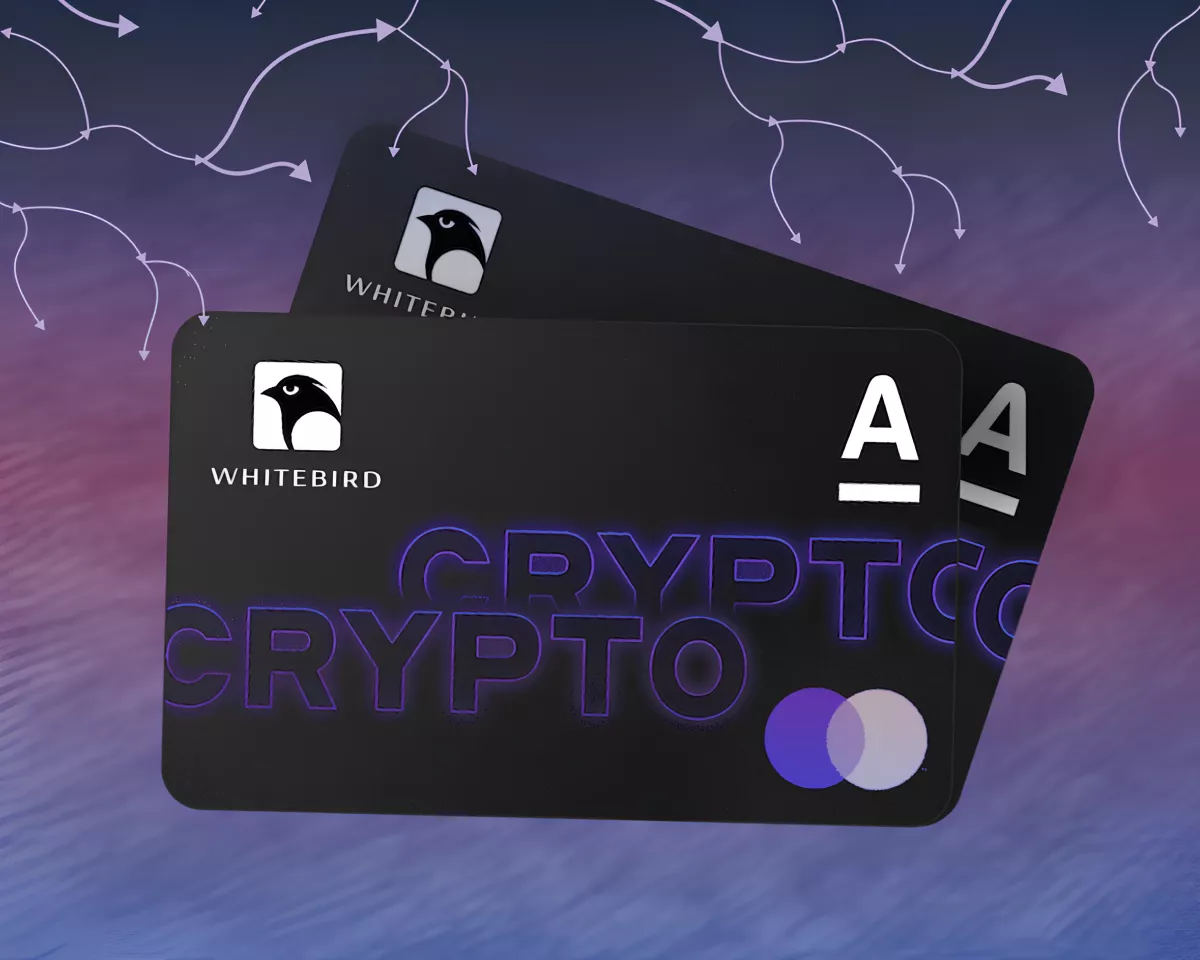
Crypto is a digital Mastercard debit card with access to the WhiteBird exchange service and linkage to the non-custodial Bitcash wallet.
WhiteBird is licensed in the Republic of Belarus and is a resident of the High-Tech Park. The company does not hold users’ money and operates in accordance with FATF requirements to prevent money laundering and terrorist financing.
Buying and selling cryptocurrencies on WhiteBird is available to holders of VISA cards from Belarus, Azerbaijan, Armenia, Kazakhstan, Moldova, Tajikistan, Turkmenistan, Uzbekistan and Georgia, as well as holders of Mastercard cards from Alfa-Bank (Belarus) and the Crypto card. The latter can be issued in your account on the service’s website.
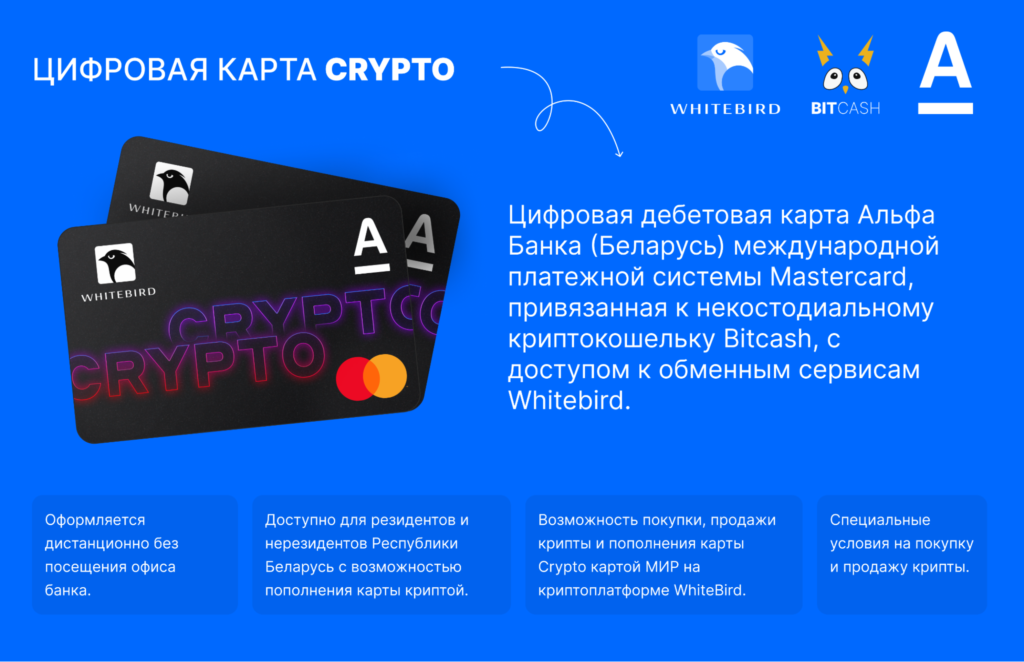
The Crypto package includes four cards in USD, EUR, BYN and RUB. Issuance for Belarus residents costs 0 BYN; for non-residents it is 250 BYN ($76) for the first card, with the others free. Identity verification requires a selfie and a photo of a document — a passport, residence permit or driver’s licence.
Cardholders can:
- link it to Apple Pay, Samsung Pay and Swoo Pay;
- make online and offline purchases in all countries where Mastercard is accepted;
- legally buy and sell cryptocurrencies with reduced fees, including for roubles with a MIR card.
Countries: Russia, Belarus.
Cryptocurrencies: BTC, ETH, TRX, TON, USDT (ERC-20, TRC-20, TON).
Fees: 2.5%–3% when exchanging digital assets on the platform.
Trustee Card
Trustee Card is a virtual Mastercard debit card linked to the multi-currency crypto wallet Trustee Plus. The product supports instant conversion into euros and local fiat currencies.
Trustee Plus charges no maintenance or card-transaction fees. To open it, top up the wallet balance by 10 EUR.
Users in Ukraine can verify their identity automatically via the Diia app. Verification with international-standard documents is also available.
Countries: Ukraine, Moldova, European Economic Area.
Cryptocurrencies: 30+ assets, including BTC, ETH, TRX, USDT, USDC and SOL.
Fees: 0.5% for conversion into euros and 1.5%+1 EUR for ATM withdrawals at NFC-enabled terminals.
MetaMask Card
MetaMask Card is a Mastercard debit card linked to the MetaMask wallet.
ConsenSys, together with Baanx, launched the product in pilot mode for several thousand users in EU countries and the United Kingdom. A full rollout, with subsequent expansion to other regions, is planned for late 2024.
Holders of MetaMask Card can spend digital assets from the wallet without converting to fiat. For transactions, the card uses Linea, ConsenSys’s zkEVM Layer-2 for Ethereum.
Countries: European Union, United Kingdom.
Cryptocurrencies: USDC, USDT, wETH.
Fees: stablecoins — gas on Linea, typically $0.02. For other assets, an additional 0.875% swap fee applies.
Conclusions
Crypto cards have been around for some time: one of the first was Coinbase’s Visa debit card, unveiled in 2015. Since then, other trading platforms, such as Bybit and Binance, and exchange services like WhiteBird, have entered the market.
They are a versatile product: crypto cards suit investors who want to convert digital assets to fiat quickly, as well as newcomers seeking to diversify into cryptocurrencies without learning complex trading mechanics.
Рассылки ForkLog: держите руку на пульсе биткоин-индустрии!