




What are pre-markets?
In traditional finance, pre-markets are trading sessions held before the main market opens.
In crypto, such platforms let users trade tokens that have not yet been issued or distributed to the wallets of participants in the airdrop. They give investors a way to bet on a coin’s future value, enabling trading in the period between a distribution announcement, the actual crediting of tokens and their official exchange listing.
Unlike traditional markets, crypto trades around the clock. Pre-markets are not limited to tokens; they also allow trading in protocol points for various activities, which may later become criteria for an airdrop.
Remember that pre-market trading is highly speculative. Always do DYOR before investing in any project.
Why are pre-markets gaining popularity?
The core aim of modern pre-market platforms is to provide a reliable and secure venue for deals. Before such venues appeared, investors resorted to unofficial arrangements to trade tokens ahead of launch.
These informal P2P pre-trading systems relied entirely on trust, which brings significant counterparty risk. Traders were also limited by their social circles, making it difficult to find partners beyond them.
New pre-market platforms connect buyers and sellers globally, widening opportunities and helping traders price assets more efficiently. As participation grows, liquidity improves, allowing users to buy or sell as many tokens or loyalty points as they require.
These venues also provide useful information for investors planning to engage with new assets after launch. As in traditional finance, crypto pre-markets let participants gauge an asset’s strength before official trading begins, using early demand data.
How do pre-markets work?
On traditional markets, pre-market trading occurs via electronic communication networks (ECN) that link buyers and sellers. The mechanics differ from regular hours—above all in liquidity and volatility. Pre-market quotes can influence an asset’s opening price, setting the tone for the day.
Suppose a company publishes quarterly earnings that beat expectations. Investors may anticipate a positive market reaction and start buying shares in the pre-market. That lifts demand and fuels price gains even before the regular session opens.
Pre-markets operate much like standard P2P platforms, with a crucial difference: they hold funds from both sides until the deal’s conditions are met. On decentralised platforms, funds are locked by smart contracts, whereas on CEX custodians perform that role.
On pre-markets, traders can create or fill existing buy or sell orders. To place an order, a trader specifies the price and quantity of the asset they wish to buy or sell at a given level.
When placing a sell order, a collateral deposit may be required, held until the deal settles. If the order is not fulfilled, the seller risks losing all or part of the collateral. The pre-market platform usually sets a settlement deadline by which the seller must deliver the promised asset; otherwise penalties apply.
Buyers must pay the full price when filling an existing order or creating a new one. Their funds are held until the seller delivers the asset.
Decentralised pre-markets use smart contracts to manage seller collateral, buyer payments and the release of assets to both sides upon completion. On centralised platforms, these functions are performed by the venue itself, acting as a third party.
What are the main types of pre-markets?
Pre-markets can be classified into two main types — pre-TGE platforms and points markets.
In the first case, traders can deal in a project’s tokens before they are distributed or listed on exchanges. Pre-TGE venues are the most popular pre-markets in crypto, where a large share of coins is distributed via airdrops.
Sellers on such platforms are typically airdrop recipients or holders of presale allocations; buyers are investors seeking profits from high-risk assets.
Anyone can become a seller if they can deliver the stated number of tokens before the settlement deadline. Pre-TGE venues are seeing strong growth in users and other metrics as the concept continues to attract crypto investors.
Points-trading systems are also gaining traction. Projects award points to users for activity on their platforms. Although points have no monetary value by themselves, projects may later allow conversion into tokens under loyalty programmes.
Points markets share a similar architecture with pre-TGE platforms, also relying on temporary custody of assets until the trading agreement completes or the settlement period expires.
Pre-markets also come as:
- centralised (KuCoin, Bybit);
- decentralised (Whales Market).
What is Whales Market?
One of the most popular pre-markets, this decentralised platform supports trading in pre-TGE tokens and points.
Initially supporting only Solana, the Whales Market team has gradually integrated other popular networks: Ethereum, BNB Chain, Base, StarkNet, Manta Network, Linea, Arbitrum and Merlin Chain.
According to Dune Analytics, the platform has over 30,000 users; trading volume exceeds $137m, and escrowed funds amount to about $75m.


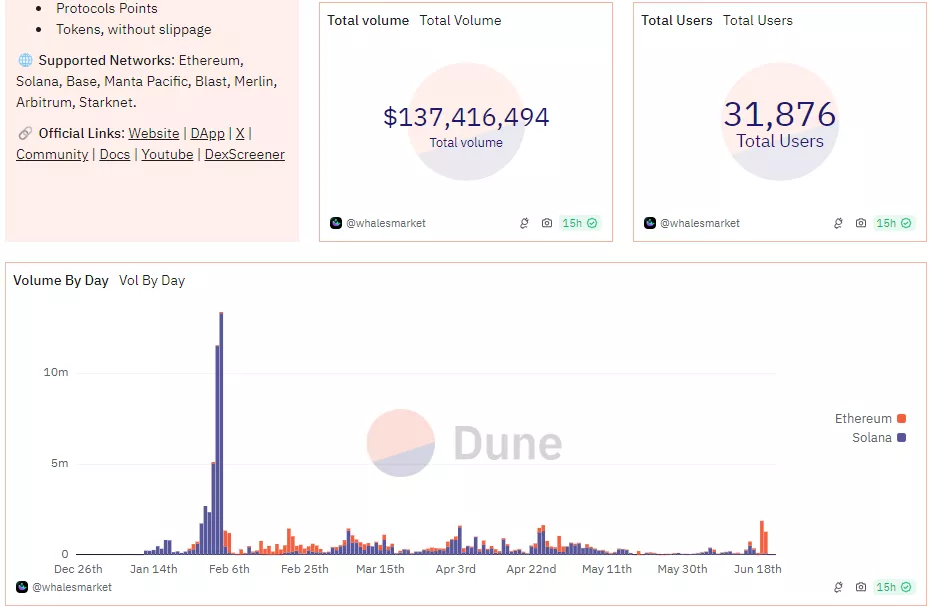
Whales Market uses smart contracts for pre-market and OTC deals. The developers say its main goal is to provide the safest possible environment for P2P operations in pre-launch tokens, points and ordinary OTC-swaps. They say the smart contract removes the need for a third party and/or a centralised custodian, and all processes are automated and permissionless.
Since launch, Whales Market has successfully hosted pre-trading for well-known projects such as StarkNet, Wormhole and Aevo.


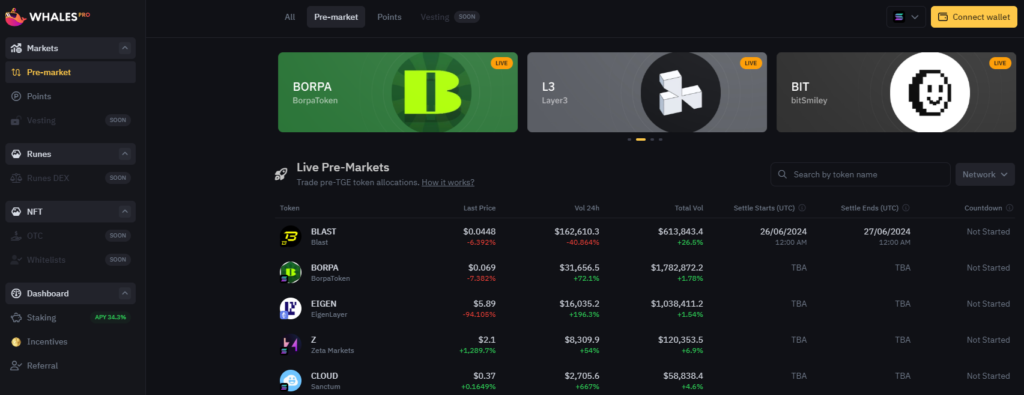
In the Pre-market section, traders can create and fill orders for tokens before their official launch. On the seller side, smart contracts manage posted collateral and apply penalties if the seller fails to deliver the agreed number of tokens before the settlement period ends.
On the buyer side, funds are held and released alongside the corresponding assets once the seller delivers.
Funds from both parties are locked until they meet the deal’s conditions. If the seller fails to deliver, the buyer may claim a portion of the seller’s collateral.
This mechanism provides security and transparency while minimising counterparty risk. Using smart contracts automates the process and removes the need for trust between parties.
Whales Market also supports trading in project points such as Swell, Grass, deBridge and Linea. Users can price these and other points before any conversion into full-fledged tokens.


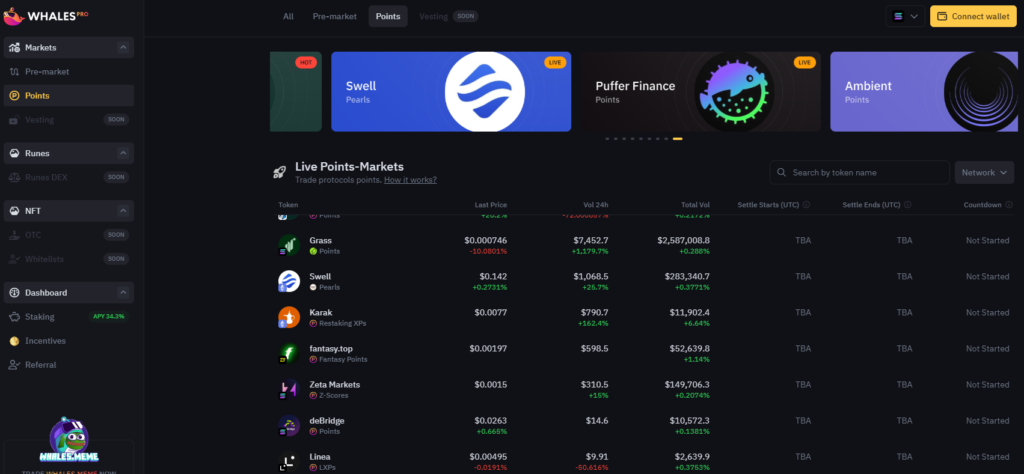
The Points Market works similarly to the Pre-market, with one key difference: a seller can receive payment for points only after they are converted into full-fledged cryptoassets. If a project does not carry out the conversion, the deal is cancelled automatically and funds are returned to the buyer.
The Points Market’s conditional contracts treat the conversion of points into tokens as a probabilistic event until the project’s official announcement. Funds from both sides are locked and held until those conditions are met.
What are the advantages and drawbacks of pre-market platforms?
Advantages:
- they facilitate price discovery, letting traders assess how different factors might affect nascent markets and anticipate potential trends ahead of TGE;
- they give investors early access to tokens of promising projects, offering the prospect of significant returns;
- using smart contracts removes reliance on third parties and reduces fraud risk. Automation enhances the security and transparency of deals;
- the absence of a central authority (on decentralised platforms) lets users interact directly, reducing the risk of censorship and manipulation;
- platforms enable fast, efficient transactions, avoiding delays typical of traditional markets;
- global access: anyone with an internet connection can take part.
Drawbacks:
- investing in early-stage projects carries high uncertainty and significant risks, up to a total loss of capital;
- pre-market instruments are far less liquid than established cryptoassets, making them harder to sell or swap quickly. Volatile price moves may not reflect fundamentals and can mislead participants;
- a lack of regulatory oversight leaves room for scams, requiring heightened vigilance from users;
- bugs and vulnerabilities in smart-contract code can lead to losses.