




From April to June, the crypto industry suffered losses of approximately $572.7 million due to hacking and fraud across 72 incidents, according to a report by Immunefi.


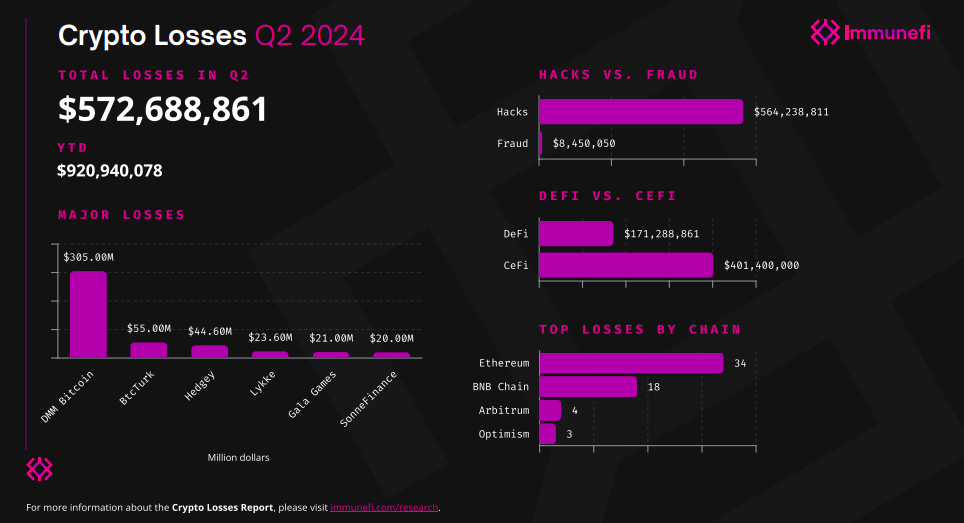
This figure represents a 70.3% increase compared to $336 million in Q1 and a 112% rise from the same period last year ($265.5 million).
“This quarter highlights how infrastructural hacks can be the most devastating in the crypto industry, as a single breach can lead to millions in losses. […] The increase in losses was mainly due to infrastructure hacks in CeFi, surpassing DeFi, despite fewer incidents in the sector. Robust measures to protect the entire ecosystem are crucial,” stated Immunefi founder and CEO Mitchell Amador.
The largest hack in the past three months was an attack on the Japanese centralised exchange (CEX) DMM Bitcoin, where hackers extracted about $305 million.

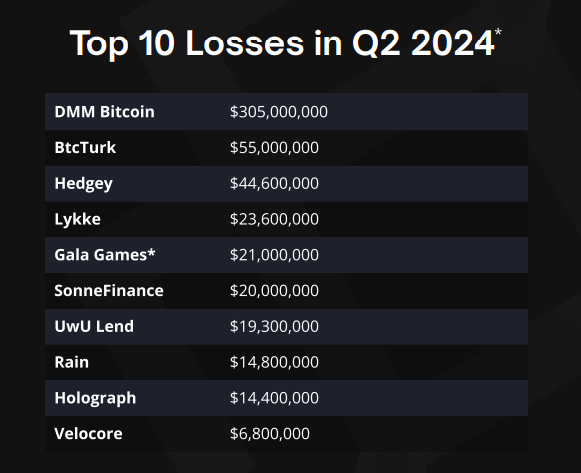
Following this was an incident with the Turkish CEX BtcTurk ($55 million), an attack on the token vesting platform Hedgey ($44.6 million), and a breach of the British crypto exchange Lykke ($23.6 million).
Thus, the two largest incidents accounted for 62.8% of the total losses in Q2.
The number of hacks significantly exceeded the number of fraud cases over these three months. The quarter recorded 53 hacking incidents with losses of $564 million and 19 scam events resulting in $8.4 million in losses.
The loss ratio between CeFi and DeFi stands at 70% to 30% respectively — $401 million versus $171 million.
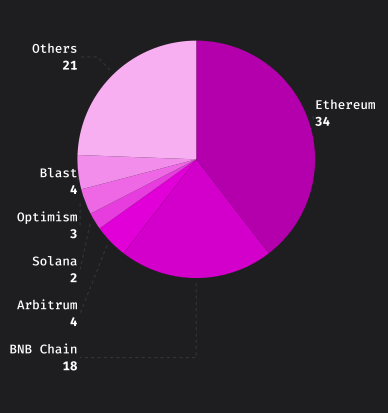
The most targeted network was Ethereum (34 incidents), followed by BNB Chain (18) — 71% of all incidents this quarter occurred on these two blockchains.

Analysts also recorded four instances where hackers returned funds totaling $26.7 million.


Earlier, researchers from Mailsuite found that among US crypto brands, scammers most frequently target Coinbase. From January 2020 to March 2024, the exchange’s brand was used in 416 fraudulent schemes and phishing attacks.
In June, a MakerDAO delegate had $11.1 million stolen in various cryptocurrencies.