



In May, inflows to companies with digital asset treasuries (DAT) amounted to $180.5 million, compared to $4 billion the previous month. Nearly the entire volume was attributed to structures holding Bitcoin on their balance sheets.


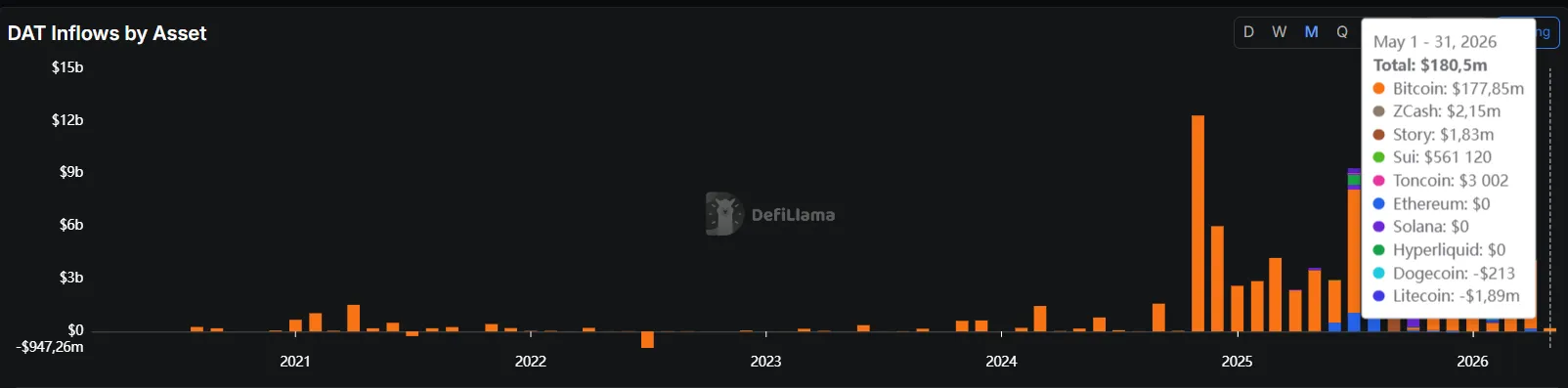
The figure is 95% lower than in April and approximately 93% below the average for January-May. This followed two months of heightened activity: $4.28 billion in March and $4 billion in April.
Companies with Bitcoin on their balance sheets accounted for $177.85 million (about 98% of the total volume). For comparison, this segment attracted $3.88 billion in April. There were no significant changes for other assets: minor inflows were seen in Zcash and Sui, while Litecoin experienced an outflow of $1.89 million.
End of the Passive Accumulation Era
According to a report by Galaxy, amid the market downturn in 2025-2026, premiums for DAT firms’ shares began to decline. Investors are no longer willing to pay extra just for access to Bitcoin or Ethereum through the stock market.
Research by Everstake confirms this trend: staking accounted for an average of 60% of total revenue for companies that disclosed data. Meanwhile, the combined net losses of the analyzed firms amounted to $1.41 billion.
Galaxy analysts highlighted several survival strategies for “DAT 2.0”:
- Staking and MEV: operating own validators to earn rewards and transaction fees;
- DeFi strategies: providing liquidity in AMM and arbitrage on liquidations;
- Basis trading: using futures to generate returns with neutral risk;
- Mergers and investments: acquiring operational businesses within the ecosystem (media, infrastructure).
An example of market transformation is Nakamoto’s acquisition of media holding BTC Inc. and the UTXO Management division. This allowed the firm to generate income not directly dependent on Bitcoin’s price volatility.
Experts emphasize that the emergence of spot crypto-ETFs has deprived public companies of the monopoly on providing regulated access to crypto assets. Now, their viability depends on the effective use of their balance sheets rather than the volume of coins held.
Earlier this year, corporate Ethereum holders faced billion-dollar “paper” losses following a market correction.