



The rally of the leading cryptocurrency to $75,000 is accompanied by an increasing risk of profit-taking. Several on-chain indicators suggest mounting pressure from sellers, noted Julio Moreno, head of research at CryptoQuant.
Bitcoin hit $76K resistance, and exchange inflows surged.
~11K BTC/hour moved to exchanges, the highest since Dec 2025 and above the March spike that preceded a pullback.
Large holders are positioning to distribute into strength. Watch for selling pressure. pic.twitter.com/zcTHglIVnL
— CryptoQuant.com (@cryptoquant_com) April 15, 2026
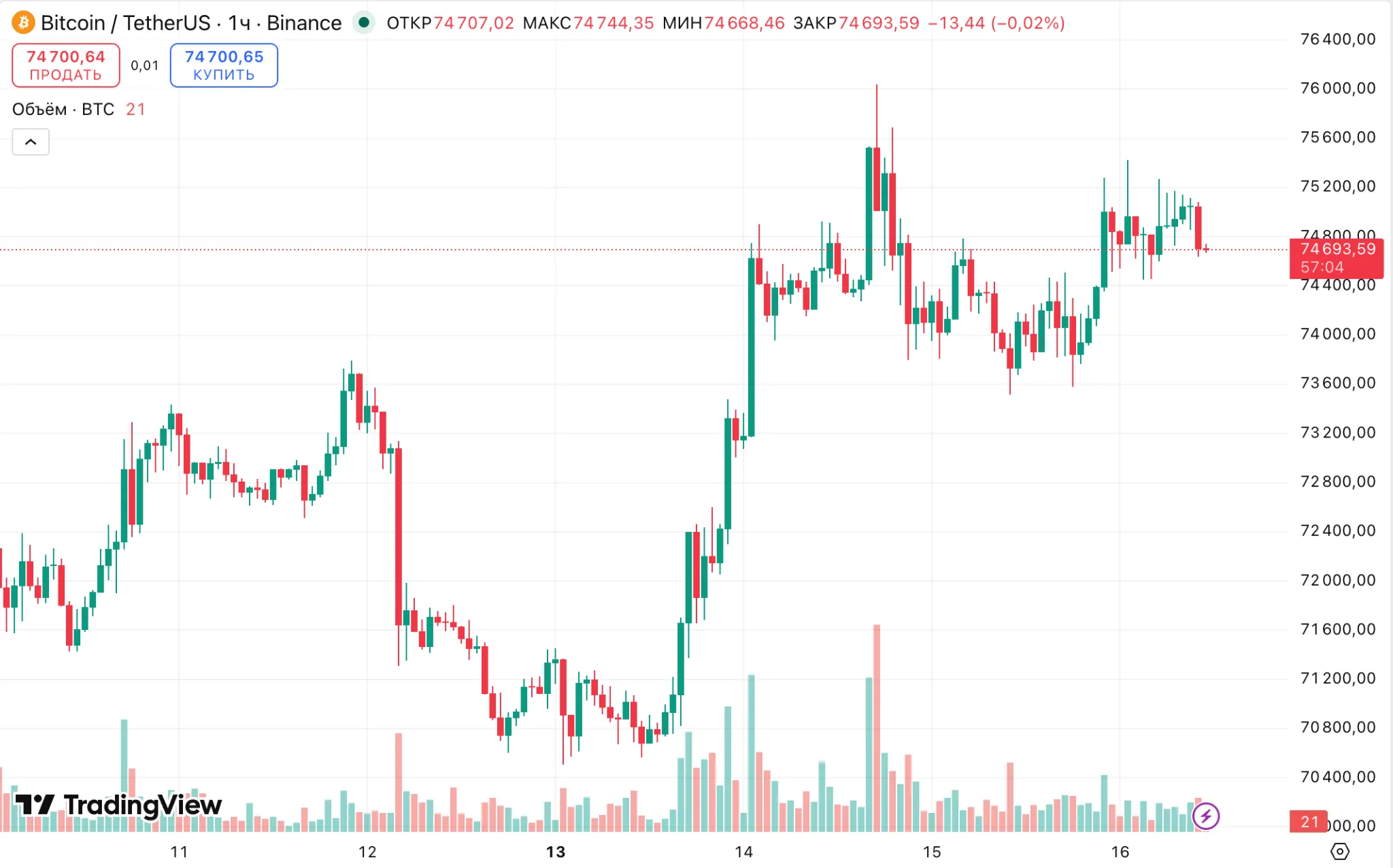
On April 14, the price of Bitcoin rose above $75,400 for the first time since early February. The growth was driven by the asset’s undervaluation, a temporary easing of tensions between the US and Iran, and a weakening of the US dollar.
At the time of writing, the digital gold’s rate had retreated to $74,700 but remains near the key level of $76,800 — the realized price for traders.
In a bear market, this mark serves as a strong resistance zone: as holders approach the breakeven point, they begin to sell coins, curbing further growth, the expert explained.


“In January 2026, this band halted the rally in the bear market, and prices went down. The same could happen if sellers become active. If the resistance holds, the lower band at $67,600 will become support,” Moreno emphasized.
A Warning Sign
As Bitcoin’s price rose, so did inflows to exchanges — up to 11,000 BTC per hour. This is the highest level since late December 2025. The analyst called the trend a “warning sign”: investors often transfer coins to trading platforms for subsequent sale.
Moreno recalled that in March of this year, hourly inflows of 9,000 BTC with a concentration of large deposits at 63% preceded a short-term drop in the first cryptocurrency’s rate.
According to CryptoQuant, the increase in exchange inflows is mainly driven by large holders. The expert noted that the average transfer size jumped to 2.25 BTC — the highest since July 2024. This is facilitated by large individual transfers to Binance exceeding 1,000 BTC.
“This pattern was already observed in January when the average deposit reached nearly 2 BTC before Bitcoin’s plunge from $100,000 to $60,000,” he added.
The share of large deposits also sharply increased — from 10% to 40% of the total volume of inflows to exchanges over a few days. Historically, such figures coincided with an increase in short-term selling pressure, Moreno emphasized.
Not Yet at the Peak
The volume of profit-taking by market participants is still far from peak levels. The daily realized income is about $500 million — below the $1 billion threshold, which in bearish phases usually signals a surge in sales.
“If Bitcoin holds above $76,000 or breaks the realized price for traders at $76,800, daily realized profit could sharply rise to $1 billion and above. This would add pressure on sellers and increase the likelihood of a rally halt or reversal,” the expert concluded.
Meanwhile, Glassnode noted that position closures are gaining momentum: the 30-day EMA of the realized profit/loss ratio is 1.16 — investors are selling on the rise.
Approaching the Ceiling$BTC holds ~$74K, ~5% below key $78K resistance. Spot and ETF demand improve, but profit-taking and cautious options positioning suggest a twitchy, flow-driven recovery lacking strong conviction.
Read the full Week On-Chain👇https://t.co/hLPc8PkKss pic.twitter.com/wW110xUd89
— glassnode (@glassnode) April 15, 2026
To sustainably consolidate above $78,100 (analysts call this level key resistance), the market will need to absorb this supply.
Correction Potential is Limited
Meanwhile, Bitfinex analysts drew attention to the actions of large players: over the past 30 days, whales have accumulated 270,000 BTC. This is the highest figure since 2013. Simultaneously, exchange reserves of the first cryptocurrency have fallen to a multi-year low.
Whales accumulated 270,000 $BTC in 30 days, the largest buying spree since 2013.
Exchange reserves are at their lowest since December 2017.
The supply to meet new demand is shrinking 🤔 pic.twitter.com/F6Td5a5XcL
— Bitfinex (@bitfinex) April 15, 2026
According to experts, the supply to meet new demand is shrinking. On one hand, this makes the market vulnerable to sharp movements — even a small volume of sales can cause significant volatility. On the other hand, the potential for a prolonged decline is limited: sellers will not have enough coins for sustained pressure on the price.
Specialists at K33 identified signs of a Bitcoin reversal after 68 days of consolidation.