


Cuba’s Postbank Economy
Is a crypto economy possible under sanctions and without power?
Cuba doesn’t see large volumes of bitcoin transactions, yet the country has become one of the clearest examples of cryptocurrency use under sanctions and limited access to international payment systems. Against this backdrop, part of the flow is shifting to P2P networks and messengers, forming elements of a postbank economy.
ForkLog examined how an island of more than 10 million people lives under financial isolation and why authorities began legalizing crypto for foreign trade.
Island in the Dark
On the evening of March 4, much of western Cuba lost power. First, one of the country’s key thermal power plants, Antonio Guiteras, about 100 km from Havana, shut down in an emergency. Minutes later the outages cascaded across the grid. Restoration took 16 hours.
Representatives of the Ministry of Energy linked the shutdown to the U.S. oil blockade of Cuba.
Soon after the arrest of Venezuela’s president, Nicolás Maduro, on January 3 during a military operation, Donald Trump’s administration declared Cuba an “extraordinary and unusual threat” to U.S. national security.
Washington tightened sanctions on Venezuela’s oil industry and threatened tariffs on countries supplying fuel to Cuba. That reduced regional shipments, including exports from Mexico.
Cuba needs about 110,000 barrels of fuel a day, but domestic production doesn’t exceed 40,000 barrels. The country has also completely run out of diesel and fuel oil. Add to this the physical wear of generation assets with no access to spare parts to keep them running.
In the following weeks the grid collapsed again, leading to a full shutdown of the national power system. By May, outages had become routine, reaching 18–24 hours a day in some regions.
By late May, available capacity stood at 1,175 MW against demand of 2,713 MW.
Beyond social fallout like water supply disruptions and broken cold chains, the blackouts also hit financial infrastructure. Banking depends critically on stable power and connectivity: ATMs, payment terminals and parts of digital services fail.
This stop-start mode further shifted attention to informal channels and cryptocurrencies. Digital assets had entered Cuban daily life long before the grid’s collapse, primarily due to chronic economic constraints and the gradual breakdown of traditional payment rails.
Financial Architecture
The Military Conglomerate
A key pillar of Cuba’s economy is the conglomerate GAESA, created in 1995 by Raúl Castro and run by the country’s armed forces. Initially meant to bolster defense finances, it later became a commercial empire.
Experts estimate GAESA controls 40% to 70% of the economy and 95% of the financial system, including Banco Financiero Internacional, one of the largest banks. Its operations span hotels, retail, port infrastructure, currency exchange and a large share of import channels. Some estimates attribute about 34% of Cuba’s total goods and services exports to the conglomerate.
An investigation by the NY Times emphasizes that GAESA functions as a closed corporate structure with limited public reporting and minimal external transparency, while its activities are effectively state-controlled.
The U.S. government contends the network’s revenues exceed the state budget more than threefold and that it may control up to $20 billion in illicit assets.
Cuba’s embassy in the United Kingdom disputed the figures, saying reporters mixed up currencies and overstated the amount by 24 times. According to the embassy, under basic local accounting rules the figures in the document required conversion into pesos at the official rate (1:24), which the authors failed to apply.
The @MiamiHerald & @ngameztorres claim Cuba’s GAESA hoards $18B USD, pushing a sensationalist narrative to justify brutal US sanctions. Basic accounting dismantles this “bombshell.” Let’s look at their own leaked document. This is a masterclass in journalistic malpractice. 🧵 https://t.co/UIhXozD4Iw pic.twitter.com/NInRidHEFA
— Cuba in the UK (@EmbaCuba_UK) May 16, 2026
“Basic accounting dispels this ‘sensation.’ Inventing a secret $18 billion hoard provides a convenient political pretext for tightening the very illegal sanctions that are strangling the Cuban population,” embassy representatives wrote.
Banking Woes
After the 2021 currency reform, the government further centralized access to dollar liquidity. Authorities scrapped the system of two currencies and simultaneously expanded the use of MLC — a special “freely convertible” accounting unit pegged to the dollar.
State stores selling scarce goods switched to MLC cards, and access to imports increasingly depended on foreign currency or transfers from abroad. The result was a parallel dollar system inside the country.
The crisis accelerated in spring 2025 when Cuba effectively began operating under an informal banking moratorium: authorities restricted the ability of foreign companies to withdraw dollar deposits from state banks. At the same time, the peso’s unofficial rate collapsed to about 510 CUP per dollar, while GDP fell roughly 11% over five years.
Amid this concentration of financial control, any external constraints — including U.S. sanctions on entities linked to GAESA — further squeeze international banking channels and limit options for traditional cross-border payments. As of November 2025, 93% of remittances in Cuba moved through informal networks.
Cryptocurrencies plugged into this system. Cuban entrepreneurs use them to pay foreign suppliers, settle imports and access dollar liquidity outside the traditional system.
For many households, crypto became an alternative tool: it’s used to receive transfers from relatives, store savings and bypass banking limits.
It’s nearly impossible to verify whether political elites use cryptocurrencies. Cuba lacks robust public asset disclosures for officials, and much of the state’s and military-linked entities’ financial flows remain opaque.
Regulation and the Real Market
Formally, crypto isn’t banned in Cuba. In 2021 the central bank acknowledged the potential use of virtual assets for socioeconomic purposes.
The regulator’s resolution defined them as a digital representation of value that can be sold or transferred digitally and used for payments or investments.
By 2022, the government began issuing crypto service providers licenses valid for one year with renewal options. A distinctive feature is a mandatory assessment of a business’s economic and social relevance to the state.
Exchange, transfer and custody services are allowed only with central bank–approved assets under the specific authorization. Violations carry fines of up to 50,000 CUP for individuals and up to 5 million CUP for legal entities.
The only publicly known license holder is Lithuania-registered EBIORO UAB, founded in 2019 by Cuban émigré Yulexi Matienzo Carcases.
Despite early steps on regulation, the market continued to develop largely in the gray zone. Its hubs are Telegram channels, WhatsApp groups and local P2P platforms such as QvaPay and Heavenex.
Crypto pricing in Cuba reflects real user-to-user deals and depends on global trends and local factors — currency shortages, sanctions and high demand for dollar liquidity. Participants watch current buy-sell posts and the cost of cash dollars and MLC.
Rates on local P2P platforms are usually more balanced thanks to the Cuban diaspora and inbound remittances. In Telegram and WhatsApp communities, prices are often less favorable for buyers as private brokers add a premium for speed, convenience and access to liquidity. Prices can also vary significantly by deal size, payment method and counterparty reputation.
The largest Cuban crypto communities on Telegram range from a few hundred to nearly nine thousand members.
P2P platforms partially reduce risk via escrow, while private channels and informal groups see more fraud due to a lack of guarantees.
Cuban authorities have repeatedly warned about the risks of unregulated crypto use and pointed to its vulnerability to illegal schemes. The best-known case was the Trust Investing pyramid, which spread via Telegram and social media in 2020–2021. According to available estimates, up to 300,000 people were involved. Most users lost access to funds; total losses remain unknown.
Life Outside the Stats
Unofficial data suggest that in 2022 between 100,000 and 200,000 Cubans used crypto. More recent counts point to a decline in active market participants to about 10,000.
In 2023, Cuba ranked 136th out of 155 in Chainalysis’s Global Crypto Adoption Index. It didn’t appear in subsequent editions.
Measuring the true size of the crypto economy is difficult because most activity occurs off centralized exchanges and barely shows up in public statistics.
Chainalysis notes that in countries with currency controls, unstable banking and high demand for dollar liquidity, digital assets are most compelling as infrastructure for cross-border transfers rather than as an investment vehicle.
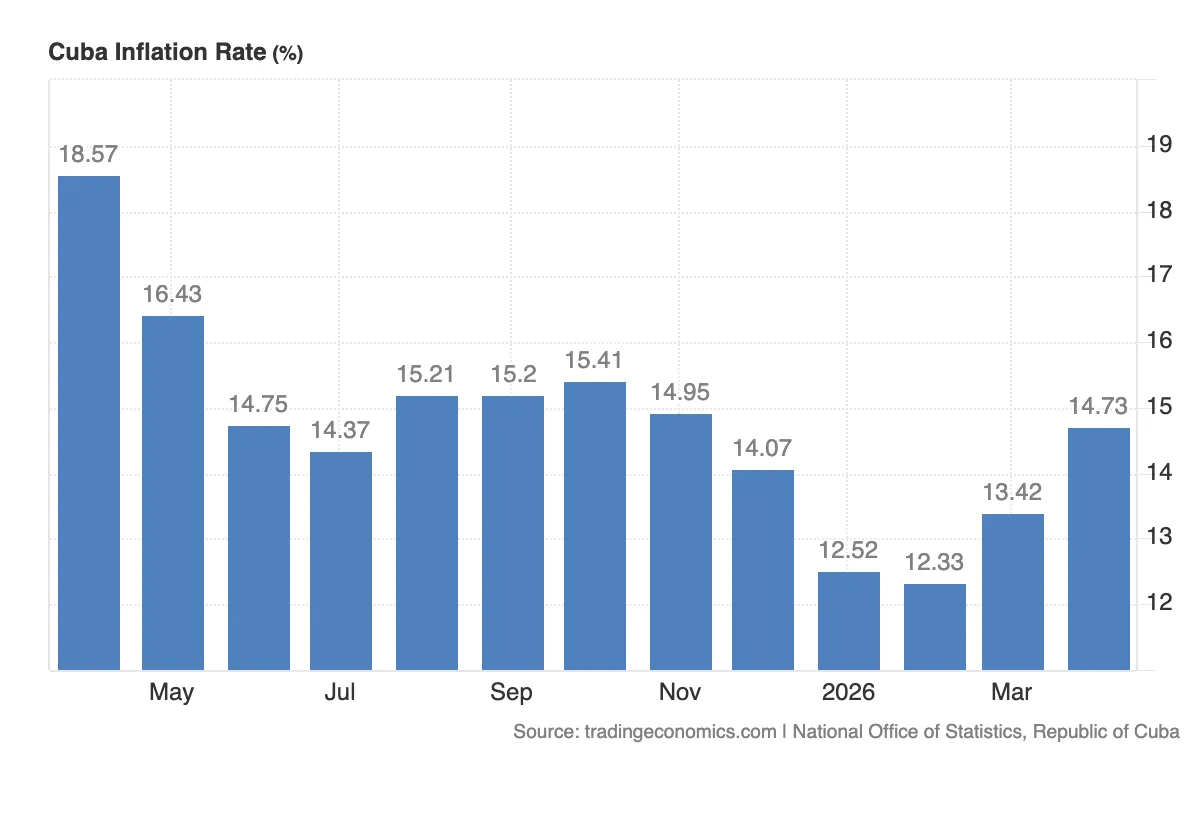
USDT is the dominant asset in Cuba’s crypto economy. The tilt toward stablecoins stems from high inflation — the official annual rate was 14.73% in April, though the real figure may be much higher.
According to Chainalysis and Artemis, small “stablecoin” transfers are the main driver of crypto use in countries with weak financial infrastructure. A similar pattern is seen in Iran, Venezuela, Lebanon and African countries.
In 2025, global USDT payments under $1,000 reached $156 billion — mainly remittances, P2P and day-to-day transactions.
$156B of USDT payment transfers under $1,000 in 2025 🤯 pic.twitter.com/tVBleoKwd1
— Paolo Ardoino 🤖 (@paoloardoino) December 12, 2025
Business Shift
In March 2026, Cuba’s central bank issued the first licenses for companies to use crypto in international settlements. Nine small and medium-sized firms and one joint venture operating in technology, transport and gastronomy received approvals. Licenses are valid for a year with renewal options.
All transactions must go through official virtual asset providers. Domestic operations and speculative trading are strictly prohibited under this initiative.
Each company must disclose transaction volumes, the digital assets used and the chain of intermediaries. The regulator reserves the right to revoke licenses for violations.
As for domestic payments, most remain in a gray zone. In theory, businesses must obtain a central bank license to conduct commercial crypto transactions, but in practice many merchants operate without one. The state largely looks the other way, especially at small volumes.
According to BTC Map, 54 locations in the country are marked as accepting crypto at the time of writing, many clustered in Havana and focused on tourism. The listed payment options reflect a stated possibility and don’t guarantee an actual method of settlement.
Better Sun Than ASICs
There’s effectively no large-scale mining infrastructure on the island: unstable power, voltage spikes and patchy internet make operating ASIC farms highly risky and uneconomic.
After the March blackouts, crypto circles debated whether bitcoin mining could, in theory, help balance local grids built on renewables. Forbes highlighted models where miners absorb excess solar generation during low demand and shut down during grid stress.
At the same time, Cuba is expanding solar power, in large part with Chinese support, to cut reliance on imported fuel and aging centralized networks. For now, though, the focus is on stabilizing basic electricity supply rather than building a full-fledged crypto mining industry.
Crypto Inside the Crisis
What’s emerging in Cuba isn’t a full-fledged crypto economy. It’s more a postbank economy, where messengers partially take over financial functions and blackouts act as a systemic cap on transactional activity.
In these conditions, cryptocurrencies don’t transform the country’s economic model so much as slot into existing constraints, offsetting the lack of access to international financial infrastructure. Limited state initiatives and structural problems prevent a shift to a sustainable alternative.
Рассылки ForkLog: держите руку на пульсе биткоин-индустрии!