




Can you build a monastery in Minecraft and retreat into it with a VR headset? Who lives in neural networks: wrathful entities or the Buddha? And when, at long last, will the quantum Maitreya appear? Pondering these questions, ForkLog sought answers from Mikhail Matrekhin — a researcher of Eastern spiritual practices and author of the Telegram channel «У Пустого Трона».



ForkLog: We all know cyberpunk, dabble in the cybereconomy of cyberspace and spent more than a few hours fighting the Cyberdemon in Doom. But what is “cyber-Buddhism”? Is there a single definition, or is it just another word with a flashy prefix?
Mikhail: Slap “cyber” on anything and it looks modish. But even plain “Buddhism” is an umbrella term for numerous religions, philosophies and psychopractices. “Cyber-Buddhism” is another umbrella under which Buddhist concepts intersect with contemporary science, futurist worldviews and the aesthetics of cyberpunk — itself indebted in part to Eastern philosophies.
Don’t forget the steady rise in popularity of psychotechniques borrowed from Buddhism and Hinduism. Inevitably, people try to graft them onto a modern Western life: say, slotting meditation into employees’ schedules so they feel better and become more efficient on the building sites of capitalism. The religious aspect is tossed overboard. (Though I’m sure that if belief in Buddhist deities boosted productivity, that would be kept too.) In a corporate setting, cyber-Buddhism can mean any hollowed-out Eastern practices repurposed for efficiency.
Many researchers in neuroscience move the same way, finding efficacy in Buddhist techniques. Why are they called Buddhist at all? The Buddha didn’t patent them two and a half millennia ago, but the first systematic forms — vipassana, shamatha, and the like — come via his teaching. They let you focus on your own experience and extract something from it. And to everyone’s surprise, neuroscientists found they do work in some way. Now they have champions among atheists and even nihilists like Thomas Metzinger, who has meditated for 30 years and argues in his works (popularised as the books “Being No One” and “The Ego Tunnel”) that the self does not exist. That too is cyber-Buddhism.
There is also plenty of pure cultural pulp. The Matrix, Grant Morrison’s comics — proto-cyber-Buddhism that inspires people to erect their “original” ideas atop pop-cultural foundations. As art projects, fine. The Matrix is an endless source. I’m not sure what exactly inspired the Wachowski sisters, then still brothers. Some say French philosophers.
ForkLog: In the first film Neo apparently reads Jean Baudrillard’s Simulacra and Simulation.
Mikhail: Exactly. But illusionist theories of reality surely played a part too. The idea, presented simply — a virtual world built for people grown as batteries — hits an unprepared mind hard. It becomes part of the cultural narrative and spawns new phenomena. People start asking what underpins The Matrix’s universe. Conspiracy theories sprout that the film is true, and those who have gobbled some substance experience a “revelation”: “Oh gods, we’re in the Matrix!” From there they inevitably stumble onto digests of Buddhist ideas and start pushing their own cosmology online.
All this blends into a chorus labelled “cyber-Buddhism”. In Russia there’s even a cyber-Buddhist band, t_error404. They were clearly smitten and swerved from cybergoth to cyber-Buddhism.
ForkLog: Under this umbrella sprouting from an umbrella, is there anything shared with “analog” Buddhism? Crudely: does cyber-Buddhism have cyber-relics?
Mikhail: Best not to talk cyber-relics — I personally frown on mummy-veneration. But yes, of course. In the East they like things to look good. All the jokes about drivers who turn their dashboards into iconostases are child’s play compared to Nepali or Indian long-haul trucks. They are temples on wheels. Naturally, when you have diodes and screens, you can rig… Haha, it’s dark here. Enjoy. Thank you, ladies and gentlemen. Good luck. See you next time.
(The Matrix seems to have glitched; we had to load a fresh copy of our interviewee.)
Mikhail: Where were we?
ForkLog: On Nepali truck-temples.
Mikhail: In Asia, science and technology help build spectacle in the religious, so to speak, sphere. You’ve probably seen the Japanese robots that deliver sermons. At bottom, these are conventional ritual practices, no different in essence from a Tibetan prayer wheel: you spin the handle, it turns — and it counts as you reciting the mantra.
Hence a logical conclusion: if you can “recite” a mantra by merely spinning a wheel, why not set an animated gif as your avatar? Or hang a ticker screen in the temple. But these are aesthetic, external matters. Cyber-Buddhism begins when the religious field is permeated by things tied directly to scientific advance and digitisation.
Put simply, a computer-drawn thangka or, say, the well-known installation of a Buddha watching TV is just art. Debates about AI and Buddhist ethics are squarely on topic.
ForkLog: Someone from a Christian culture might say neural nets are full of demons. Can a Buddhist retort, “No, the Buddha is in there”?
Mikhail: What is a neural net in itself? An add-on to creative capacity. But first, recall this.
In Buddhism humans live in the middle realm, above which sit two tiers: the asuras and the devas, in constant opposition. Think a heavenly USA and a heavenly USSR. Asuras are aggrieved titans brimming with ressentiment, envious of the devas and forever at war. Devas are gods who can create worlds at will, or anything else grand. They spend most of their time generating content that pleases them — and relishing it.
There are classes of devas who create virtual realities, and higher classes who luxuriate in others’ virtual realities. Among them lurks the chief tempter, a Buddhist version of Satan: Mara, a deva who tirelessly promotes multiverses. A celestial Zuckerberg who dislikes users unplugging from his marvellous metaverse. Mara is not “evil”, doom and death, but mindless lingering in illusion.
When you generate with a neural net, you probe something fundamentally average. The US military once tried to build the perfect cockpit. They measured a hundred parameters across thousands of pilots and designed to the mean. It turned out no one could sit comfortably in the averaged cockpit. The average human doesn’t exist; everyone differs. A neural net is the ideal average creature, built from statistics and lacking even minimal agency.
Gazing at an archetype built from the averaged version of you is mesmerising. From a Buddhist view, when you gain access to an endlessly productive tool that can conjure anything from anything, you become a deva, a celestial trust-fund kid. But here’s the rub. You can freeze, entranced for aeons, playing — and miss the crucial moment you might have spent on awakening. Afterwards it may be too late.

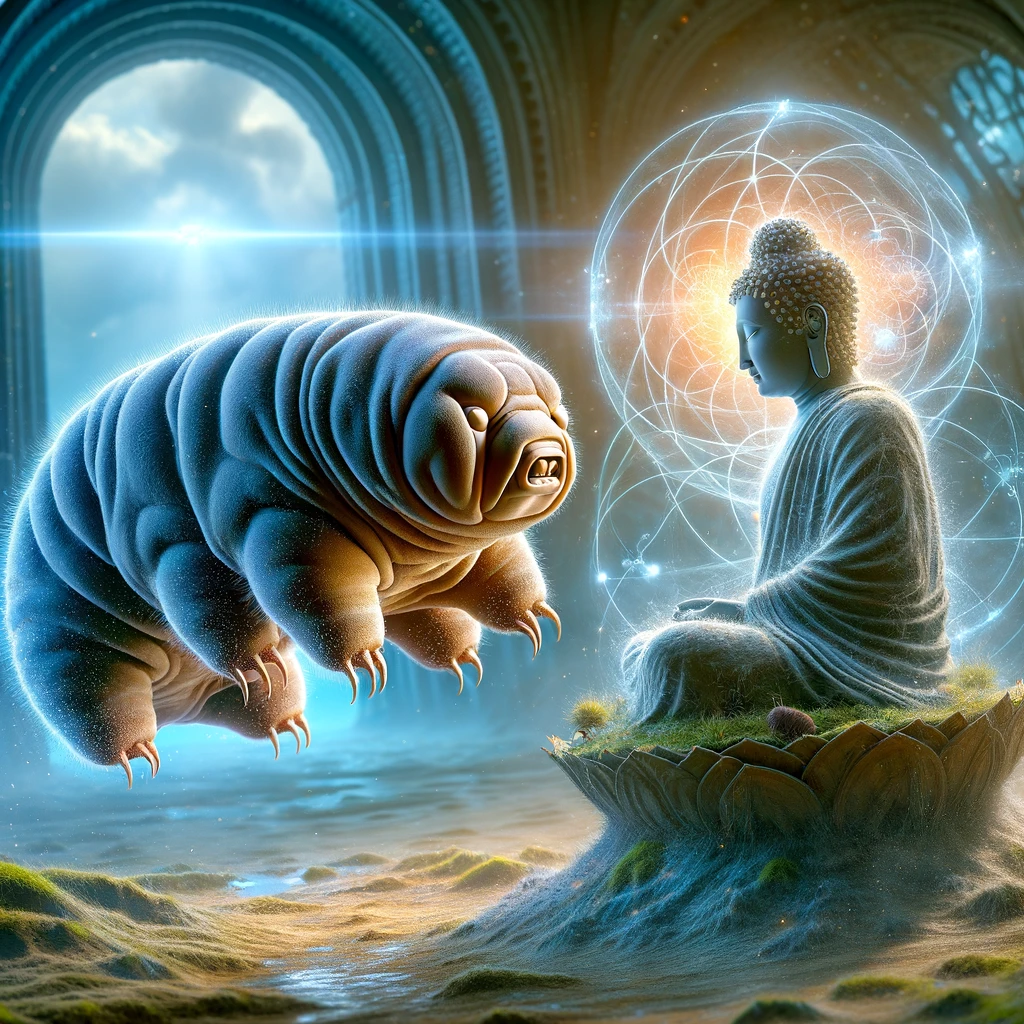
ForkLog: If you stare long enough at images generated to our averaged notions of beauty, you may find them, well, cringe — ugly enough to flee from.
Mikhail: That is a deeply Buddhist thought — precisely where renunciation begins. You see the shabbiness even of the conventionally prized. Midjourney gives you “beauty”, yet it feels predictable, stock. You start to suspect the rest may be just as stock, cookie-cutter. And you begin to ponder serious existential questions. In Buddhism, that’s a valuable moment.
Neural nets show us our own minds in the mirror. We fail to grasp that it’s our reflection and imagine a new entity on the screen. In content produced by a net trained on our data, we see more than is there. That’s scary, because illusion-making via such a product of the human mind is highly efficient. It’s easy to imagine entire worlds built for individuals, in which they are kept like in prison cells.
ForkLog: If we assume we live in a photostock, can we upgrade our plan? At least switch to premium.
Mikhail: From the Buddhist point of view (or rather, Buddhisms), one should strive from “reality-as-constructed” to the immediate real. But we can’t look at it directly because we’re inside a spacesuit of perception. We constantly construct a reality overlaid upon the real; those with a more efficient model are closer to how the immediate, unconditioned real is.
Some think immediate perception is attainable; others think it’s impossible. We’re condemned to dwell in our own perceptual suits, never certain another person sees the same reality. Hence fundamental questions about qualia, which may differ yet go unnoticed.
The neural net is a handy metaphor to teach big philosophical questions; through it you can explain general ideas on your fingers. But it’s unlikely to yield clear soteriological conclusions. You can extract a very non-universal moral: “Ditch neural nets, do everything by hand; it’ll be more real.”
ForkLog: But how can anything be more or less real in an originally illusory world?
Mikhail: Illusory doesn’t mean “doesn’t exist at all”. Everything exists — conventionally. And (at least intuitively) there is a hierarchy of “realness”. For a person, what they make with their own hands carries higher status. Neural nets churn out content that feels less “real”. The ontological status of the end-product may be close, but ask a net to write poetry and you’ll immediately spot where it’s AI and where it’s a living human. Have you tried making poems with a net?
ForkLog: Of course. Asked for verse, ChatGPT produces something that is the opposite of what people expect from poetry — a surprising angle on the world.
Mikhail: So it is with many things — a jamming into the Procrustean bed of the average. Yet it’s possible to use today’s net-tech to create something maximally original — which will also look wild. But if we return to this from a Buddhist angle, the whole kaleidoscope of meanings, ideas and images turns out superfluous. For a Buddhist it is pointless. The point lies in what is usually deemed pointless: simply sitting, doing nothing, observing the processes of the mind. Then you realise your brain, your mind, is also a neural net constantly generating in predictable patterns. When it stops generating content, that’s the ideal state.
ForkLog: Can one build a Buddhist monastery in, say, Minecraft — and withdraw into it?
Mikhail: What matters is the end effect. We already live in virtual reality, all the time — at its base layers. If you add another layer, it won’t change how you feel at the layer that is basic for you. In principle, you can retreat into Zuckerberg’s monastery. You’ll still have to maintain physiological functions.
VR headsets are more a decent tool for deprivation — central to monastic practice. For instance, limiting communication, which leads to imaginary friends appearing out of nowhere. Put someone in a cave for 40 days and they’ll start talking to objects; images will appear with a reality that grows the longer the isolation. Vajrayana and Tibetan Buddhism use this: three-year cave retreats with no contact. If you’re in a virtual monastery in Minecraft and cannot talk to other players, that will have a psychoactive effect. Your marbles will, naturally, begin to roll, but ideally it accelerates transformational processes — if done by the book (don’t try this at home without an instructor). So a virtual monastery is possible, but in some cases it’s tantamount to a virtual asylum.


ForkLog: Does cyber-Buddhism condemn killing a llama in Minecraft?
Mikhail: On Buddhist forums, such questions crop up. In principle, program code is not a “sentient being”. Is telling a story about someone’s death a killing? So I’d say killing a llama in virtual space is not objectionable for some Buddhisms, though it will likely alarm others.
ForkLog: There is a pop meme: “If you meet the Buddha, kill the Buddha.” In cyber-Buddhist terms, is it fair to restyle it as “If you meet a llama in Minecraft, kill the llama in Minecraft”?
Mikhail: It’s a call to reject authorities and to test everything in personal experience. If you personally see killing a llama in Minecraft as a manifestation of that refusal, it may be useful. If you consider it a dubious gesture, it probably won’t be.
ForkLog: The current Dalai Lama actively promotes bringing Buddhism and science together: Buddhism with neuroscience, cognitive science, quantum physics. For Christian theology, that’s largely an old stage; mainstream theologians no longer insist the Earth was made in six days seven thousand years ago. They grapple with speculative metaphysics. Can Buddhism be reconciled with science — and is it justified or useful?
Mikhail: To start, Ngawang Lobsang Tenzin Gyatso represents one strand of Buddhism: the northern. He is first and foremost a Tibetan politician. Treating him like a pope is odd: he speaks for a very small stratum of Buddhists that got a voice because most émigré lamas went to the US. Hence attention to the occupation of Tibet — or rather, the complex and ambiguous politics around Tibet — led to the Dalai Lama being perceived as speaking for all Buddhists.
Naturally, he courts the Western progressive milieu and promotes “Buddhism with a human face” through engagement with science. Science is good, rational; science “proves” Buddhist practices work. It works well in the short term. There’s the monk Yongey Mingyur Rinpoche, on whom lab tests confirmed the efficacy of Buddhist meditations. Reports of those experiments reached Thomas Metzinger, who, duly impressed, wrote The Ego Tunnel. Peter Watts read it and wrote the novel Blindsight. Four handshakes later, a heap of people are curious about Buddhism. Science works!
ForkLog: Let’s peer ahead. Debates around quantum computers have rekindled. What would “quantum cyber-Buddhism” look like?
Mikhail: There’s a Buddhist prophecy that, in the future, the Buddha Maitreya will come when humanity reaches maximal lifespan and becomes so technically perfected that it is looped on itself. People will no longer be able to step beyond sensuous existence. They will need a reminder of Buddhist ethics, psychopractice and philosophy so that these transhuman beings can be liberated.
Each time we imagine fantastical scenarios, we forget that the slightest tweak to daily life shifts the whole picture. Suppose people live longer. That alone brings societal and technical upheavals. Imagine an unreplaceable elite of long-livers. Or, if people get productive and computational capacities beyond our ken? We can’t predict what will be. A quantum computer could crack anything anytime, hijack any access codes — turning our world into Russian roulette, as anyone might be first to seize the secrets of strategic value. So with a hypothetical “quantum cyber-Buddhism”: future tech will surely be usable in psychopractice. It may prompt radical transformations — not necessarily positive.
ForkLog: We’ve discussed attempts at a secular Buddhism stripped of religion. Are there counter-movements within cyber-Buddhism towards the mystical?
Mikhail: Mostly it looks marginal, but of course such trends exist. In the West there are many “chemical Buddhists”: people who had a strong psychoactive experience with states typical of Dharmic religions, then took up Buddhism and tried to reconcile it with modernity — combining Eastern techniques with psychoactives.
Why not? Vajrayana did use psychoactive substances; what prevents using modern pharmacology and VR for the same ends? Usually it yields the most miserable results, but it happens. After all, if your choice is between corporate meditation to boost productivity or “get wrecked and contemplate ultimate reality in the company of wrathful deities’ avatars”, the latter sounds more exciting.


ForkLog: Historically Buddhism has made a point of enlightening people, so perhaps there’s no contradiction in these explorations.
Mikhail: Yes. Tibet won Mongol patronage thanks to the monks’ intellectual and cultural achievements that genuinely impressed the khans. The monks, in turn, were aghast at the practice of slaughtering elders and prisoners and asked them to stop; the Mongols, in principle, agreed. It led to a measure of humanisation inside medieval Asian states. The patron shapes the ward — and the ward shapes the patron. So today: exiled Tibetan lamas seek refuge from Chinese repression in the West, then it all cycles back in the form of imagery and research via the First World’s cultural hegemony.
ForkLog: So Buddhism undergoes a sort of “pizza effect”?
Mikhail: It’s not new — Buddhism has seen this many times. Think of Chinese pilgrimages to India that yielded Journey to the West, one of China’s great novels. Medieval “travel bloggers” suspected they’d been sold a distorted Buddhism, so they went to the source to take a backup, return home and update (or rather, roll back) to something closer to the original. This happens constantly, and newer versions often end up closer to the source. But that’s now a doctrinal question.
Overall, stereotyped perceptions of Buddhism get in the way — born of many causes. When the British colonised India, we got one stereotype. Mid-20th-century stereotypes followed — hippies, the popularisation of The Tibetan Book of the Dead, and so on. No less stereotypical is seeing Buddhism through Free Tibet. The notion that the Buddha is a plump golden Asian god persists, though that figure is the bodhisattva Hotei.
All this shapes Westerners who sometimes feel deflated when they reach the sources and find the same things as in their own culture: similar ethics, similar clericalism, ritualism. The average Buddhist is not far from an Orthodox granny — perhaps a tad more upbeat and humane. It’s easy to disappoint the Western public (both secularists and esotericists) with the various Buddhisms.
The scholar of religion Yevgeny Torchinov described how hip, Beat-inspired Americans went to Zen monasteries in Japan. With iconoclast clichés in mind, they saw statues of the Buddha everywhere and asked: “How so? ‘If you meet the Buddha, kill the Buddha.’ Let’s destroy the statue.” Locals were, naturally, flabbergasted.
(Mikhail likely refers to an episode from Yevgeny Torchinov’s Introduction to Buddhology: “It is worth recalling a curious incident involving the contemporary American populariser of Japanese Zen, P. Kapleau. When he first arrived in Japan and entered a Zen monastery, the first thing he saw was a monk lighting a candle before a portrait of the monastery’s founder. Kapleau said to him, ‘Why are you lighting the candle? Wouldn’t it be better to smash this image?’ The monk replied, ‘If you want to do that, smash it. And I would rather place a candle in front of it.’”)
To avoid stereotypes and bias, acquaint yourself with everything — and keep in mind that every mode of perception has a corresponding philosophy. That applies not only to Buddhism but to anything else we may dislike. It’s worth accepting this to deal more effectively with people around us — whose viewpoints can at least be modelled and roughly anticipated. Then you can find consensus. Such is the way of things.