


Data-scientist shortage in Russia, robo-car flees police, and other AI news
We aim to inform readers not only about developments in the Bitcoin industry but also about what is happening in related technology sectors — cybersecurity and the world of artificial intelligence.
ForkLog AI has gathered the most important AI news of the past week.
- In Russia, there is a shortage of AI developers.
- American tech giants will create an AI institute in Eastern Europe.
- Apple began testing next-generation M2 processors.
- Ukraine released an app for safe school experiments in augmented reality.
- Robo-car tried to flee police in San Francisco.
- Niantic developed a new augmented reality game.
- Most important AI deals of the past week.
HeadHunter: Russia faces a shortage of AI developers
Russian companies столкнулись with a shortage of AI developers, and Western sanctions tied to the war in Ukraine have exacerbated the situation.
According to the recruitment service HeadHunter, there are at most two candidates for each AI vacancy. From January through March 2022, analysts found only 16 000 résumés of AI engineers, while in March alone more than 200 000 IT-related résumés were identified.
Sanctions restricted developers’ access to international data repositories for training neural networks and caused a shortage of computing power required due to the withdrawal of cloud operators from Russia. This led to the postponement of many AI projects in the public sector and in business, and to the emigration of some IT specialists, Kommersant reports.
In Eastern Europe, an AI Institute will be created with backing from tech giants
Amazon, Google and DeepMind поддержали создание Института искусственного интеллекта и технологий INSAIT в Восточной Европе.
The Bulgarian government, together with Swiss universities ETH Zurich and EPFL, will build a research centre in Sofia. The authorities say INSAIT will help in developing AI and computing, and will prevent the brain drain of talented researchers and programmers from the region.
The Bulgarian government will allocate $100 million over 10 years to develop the institute and to turn the region into a leading centre for computer research, and to “устранения технологического разрыва между Восточной и Западной Европой”.
INSAIT will receive support from AWS, Google and DeepMind in the amount of $3.75 million, $3 million and $285,000 respectively. The funds will be used to support research on automated thinking, cloud computing resources and funding scholarships for women at the institute.
Media: Apple tests new in-house M2 chips
Apple began testing at least nine Mac models with four different M2 variants. This may signal an upcoming product launch, journalist Mark Gurman reports.
According to logs from third-party apps in the App Store, running on unannounced chips, the processor has eight CPU cores and 10 GPU cores. The previous model contained eight cores of each type.
Gurman also said the company is testing new laptops based on the M2 Max with 12 CPU cores and 38 GPU cores (compared with 10 and 32 in current models).
According to the source, the company is preparing successors to the M1 Pro and M1 Ultra models.
Ukraine releases app for safe school experiments in augmented reality
Ukrainian developers have created a mobile app for students, AR_Book, with a virtual laboratory for safe experiments in augmented reality.
Interactive practical lessons in physics, chemistry, biology and other subjects are based on Ukrainian textbooks. All experiments can be downloaded to a smartphone for offline use.
The app is free and available to Android and iOS users.
Australian court overturns ruling recognizing AI as inventor
The Federal Court of Australia overturned a ruling recognizing an AI as an inventor under the country’s patent law.
A five-judge panel ruled that only “natural persons” can be considered authors. In their view, AI systems cannot be named as inventors on Australian patent applications, though this does not preclude registering AI-made inventions.
Earlier, Imagination Engines founder Stephen Thaler tried to patent two inventions on behalf of the neural network DABUS in several countries. Regulators rejected it and said only a human can be an inventor. However, the Australian court found the patent-office decision unlawful and ordered the agency to reconsider the application.
Reports: Meta will release AR glasses in 2024
Meta plans to release an augmented reality headset in 2024.
According to The Verge, the first version of Project Nazare AR glasses will be able to operate independently of a smartphone. The device will work with a “phone-shaped” device for processing and a CTRL-Labs bracelet for controlling via electrical signals.
Presumably, the headset with a “socially acceptable” exterior will be Android-based. It will support full AR with 3D visualization, eye-tracking and stereophonic sound. The glasses will feature a forward-facing camera with a relatively wide field of view. A hallmark of the device will be interaction with “holograms” of other people.
Meta also plans to release a simplified version of AR glasses called Hypernova that will work in tandem with a smartphone. The device is set to debut in 2024.
Louis Vuitton accused of illegal biometric data collection
The luxury fashion house Louis Vuitton has been accused of illegally collecting biometric data from customers via an online virtual try-on tool for sunglasses and frames.
According to the class-action, LVMH’s North American unit’s Virtual Try-On collects detailed and confidential information, including full facial scans, without consumers’ prior consent or notice that such data are being collected.
The virtual try-on tool is hosted on the LVMH site. Using a webcam, it creates a live video of the customer wearing the chosen frame or sunglasses. The data collected are converted into computer code and allegedly sent to an external server where they are stored, the suit says.
The suit cites Illinois biometric privacy law, which prohibits collection and storage of such information without consent and provides penalties of $1,000 to $5,000 per violation.
Louis Vuitton North America declined to comment.
Robo-car “attempted” to flee police in San Francisco
The driverless Cruise vehicle confounded San Francisco police when officers attempted to stop the driverless taxi at the wheel.
A Twitter user posted a video showing the attempt to pull over the vehicle, possibly due to off headlights at night. After waiting for an officer, the autonomous car continued driving, crossed the intersection on a green light and pulled over on the curb, presumably deeming the spot safer.
Welcome to the future. Cop pulls over driverless car (because no lights?) Then Cruise goes on the lamb. (via https://t.co/mtmsIeOAUP) pic.twitter.com/ecQ5xXuSnS
— Seth Weintraub (@llsethj) April 10, 2022
The company said the autonomous driving system reacted to the approaching patrol and the instruction to pull over as programmed. The officer contacted Cruise staff via a 24/7 hotline and received clarifications, the startup added.
Miso Robotics unveils AI-powered coffee machine
The Miso Robotics company developed the CookRight Coffee coffee machine powered by AI.
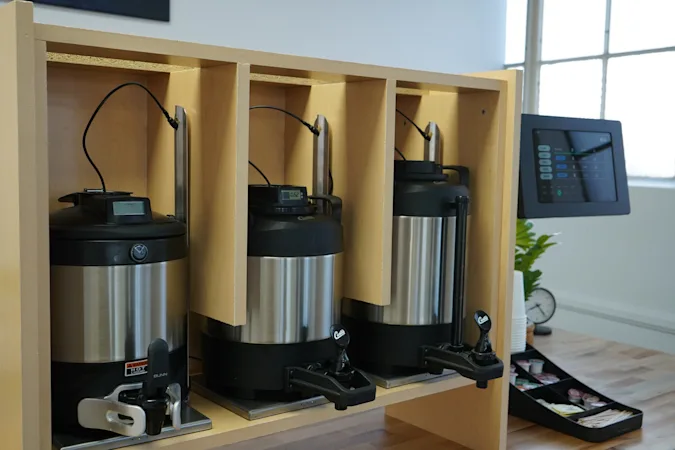
The device tracks temperature, coffee volume and time. The system also uses predictive analytics in preparing the beverage.
The device will be tested at Panera Bread’s bakery cafés in the United States. Miso Robotics says CookRight Coffee will remove human involvement and help restaurants operate more efficiently.
Niantic develops a new augmented reality game
Niantic unveiled the AR game Peridot. It is described as a mix of Tamagotchi and Pokémon Go.
Players must breed and care for unique virtual pets.
“Peridots” or “Dots” slept for thousands of years and now need players’ help to survive: feeding, exploration, entertainment and development into adulthood,
the press release says.
In the near term, the company plans to begin a soft launch of the app in select markets. Interested users can sign up for the waitlist.
Top AI deals of the past week
From 10 to 16 April 2022, AI startups raised over $220 million. Here are the most notable deals.
- Neptune.ai получила $8 млн на улучшение хранилища метаданных моделей машинного обучения.
- Union.ai привлекла $10 млн на развитие платформы для оркестрации ИИ.
- Noogata собрала $16 млн, чтобы упростить доступ к искусственному интеллекту корпоративным пользователям.
- Observe.AI привлекли $125 млн.
- PassiveLogic получила $15 млн на масштабирование платформы для автономного управления системами здания.
- EvolutionIQ собрала $21 млн на расширение команды разработчиков сервиса для оптимизации обработки страховых требований.
- Создатели диалоговой ИИ-платформы Quiq привлекли $25 млн.
Также на ForkLog:
- Китайский регулятор проверит алгоритмы рекомендаций техгигантов.
- В ЕС создадут единую базу данных для систем распознавания лиц.
- Экс-сотрудница Meta предупредила об угрозе приватности в метавселенной.
- Илон Маск предложил свыше $43 млрд за покупку Twitter и объяснил, почему хочет купить соцсеть.
- Американские военные запросили $29,8 млн на развитие ИИ-инфраструктуры.
Подписывайтесь на новости ForkLog в Telegram: ForkLog AI — все новости из мира ИИ!
Рассылки ForkLog: держите руку на пульсе биткоин-индустрии!