



Global debates over Bitcoin mining’s energy intensity and its impact on the environment continue to rage.
In December 2021, US Senator Elizabeth Warren expressed the view that the electricity consumption involved in mining digital gold is comparable to the figures for Denmark, Chile, Argentina and the state of Washington. In early 2022, she requested data from six mining companies on environmental impact.
In June, the Swedish central bank urged a ban on Bitcoin and other cryptocurrencies mined using Proof-of-Work (PoW), due to environmental impact. According to the bank’s report, the energy consumption of this mining method is equivalent to that of 200,000 households.
It is possible that, after The Merge in the Ethereum network, environmental debates will flare up anew — Bitcoin, the largest PoW cryptocurrency, will be criticised even more.
How large is Bitcoin’s energy consumption globally? What will it be in the coming decades if the price of the first cryptocurrency rises to $2 million? Armed with analytical materials Arcane Research and the Cambridge Centre for Alternative Finance (CCAF) materials, ForkLog determined Bitcoin’s share of global energy consumption and its long-term growth prospects.
- Debates over the environmental impact of mining continue around the world.
- The energy efficiency of cryptocurrency mining improves over time, and the share of green energy in the mining industry increases.
- Contrary to critics’ views, Bitcoin’s energy consumption globally is not large, but in the coming decades the situation could change substantially.
Between Kazakhstan and Pakistan
CCAF’s site presents intriguing comparisons aimed at giving a sense of Bitcoin’s energy appetite.
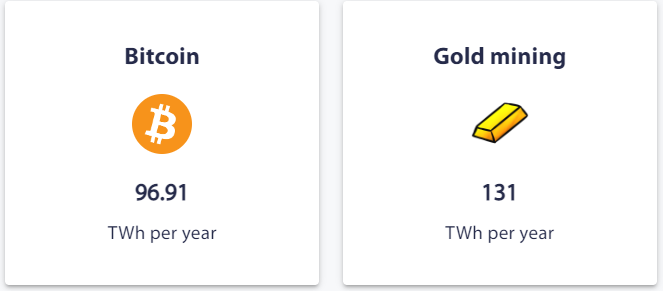
For example, the energy consumption of the Bitcoin network is comparable to the same measure for gold mining.


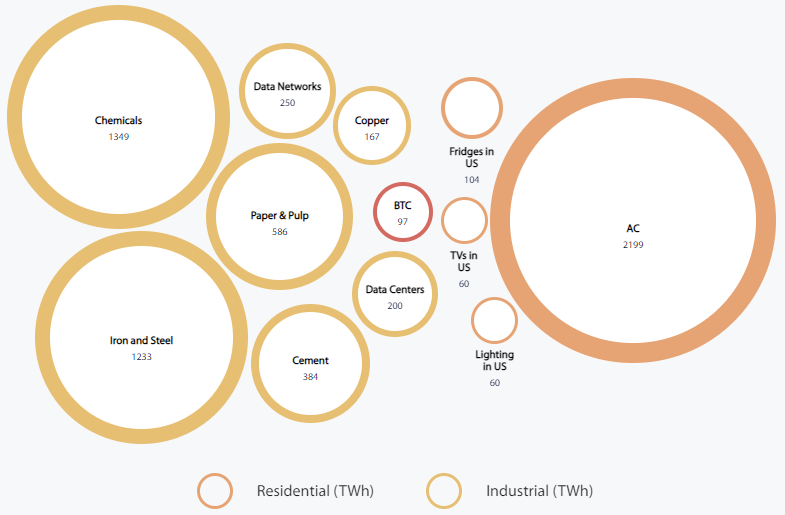
Сайт позволяет сравнить энергопотребление биткоина с различными отраслями и сегментами — например, со всеми холодильниками и телевизорами в США или с глобальным производством цемента.


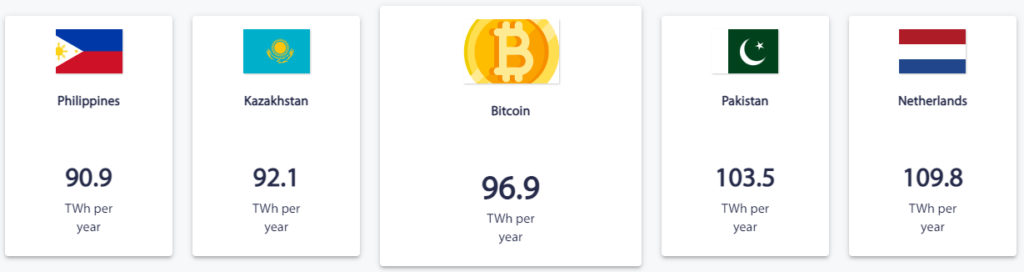
По уровню энергопотребления сеть биткоина сопоставима с такими странами, как Филиппины, Казахстан, Пакистан и Нидерланды.


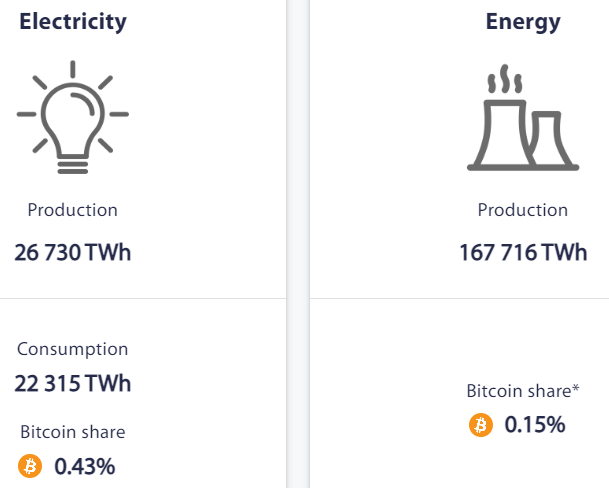
Показатель в почти 100 ТВт⋅ч может показаться впечатляющим. Однако в глобальном масштабе он не так уж велик — менее 1% от объема мирового потребления.


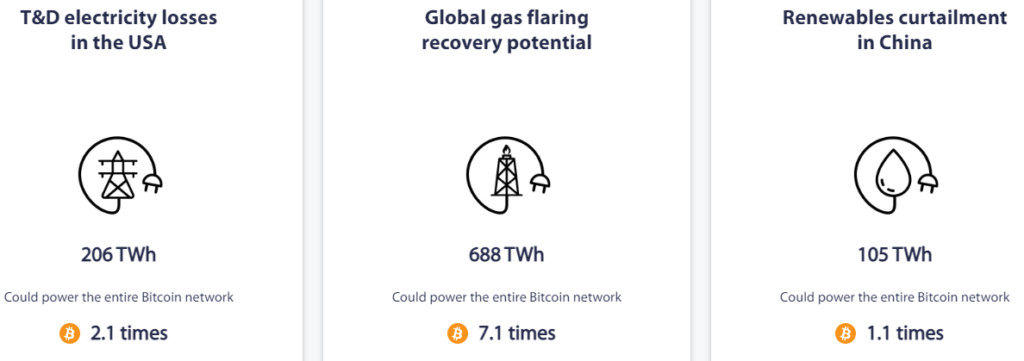
Еще пример: энергии, выработанной при сжигании факельного газа, хватило бы для обеспечения работы семи сопоставимых с биткоином сетей.


Согласно данным Bitcoin Mining Council (BMC), энергопотребление майнинга повышается, увеличивается и доля зеленой энергии в индустрии добычи цифрового золота. Впрочем, есть и немало критиков BMC, сомневающихся в объективности подобных исследований.
Сколько сеть биткоина будет потреблять в будущем?
В долгосрочной перспективе цена биткоина стремится к росту. Это обусловлено жестко ограниченным предложением, растущим принятием криптовалют в мире и планомерным снижением темпов эмиссии вследствие халвингов награды за блок.
Можно предположить, что с ростом цены первой криптовалюты будет развиваться и майнинговая индустрия, наращивая мощности. Это означает рост энергопотребления сети, даже несмотря на более эффективные и зеленые технологии.
Исследователь Arcane Research Джаран Меллеруд смоделировал показатели энергопотребления биткоина до 2040 года при различных ценах актива. Он перечислил наиболее существенные компоненты своей модели:
- цена биткоина;
- транзакционные расходы;
- процент от дохода, который направляется на покрытие затрат на электричество;
- средняя цена электроэнергии.
Меллеруд вывел следующую формулу:
Годовое потребление сети биткоина = цена биткоина * (вознаграждения за добытый блок + средняя транзакционная комиссия в расчете на блок) * число добытых блоков за год * процент от дохода, потраченный на электроэнергию / средняя цена электричества в майнинговой индустрии
По его словам, рыночная стоимость криптовалюты — наиболее важный фактор, определяющий потребление ее сети в будущем.
“Цена биткоина, умноженная на вознаграждение за блок, определяет общеотраслевой доход майнеров. Он покрывает затраты и обеспечивает прибыль. Рост цены криптовалюты увеличивает доходы майнеров в масштабах всей отрасли и их прибыль в краткосрочной перспективе,” — отметил исследователь.
Он подчеркнул, что добыча биткоина — гиперконкурентная отрасль с низкими входными барьерами. Следовательно, потенциально высокая рентабельность может в будущем привлечь в сегмент множество игроков, увеличив энергопотребление.
По словам Меллеруда, большинство майнеров почти не обращает внимания на поступления от транзакционных комиссий — их доля в общих поступлениях пока крайне низка.
“Поэтому вас может удивить, что уровень дохода от комиссий имеет решающее значение для будущего энергопотребления,” — добавил эксперт.


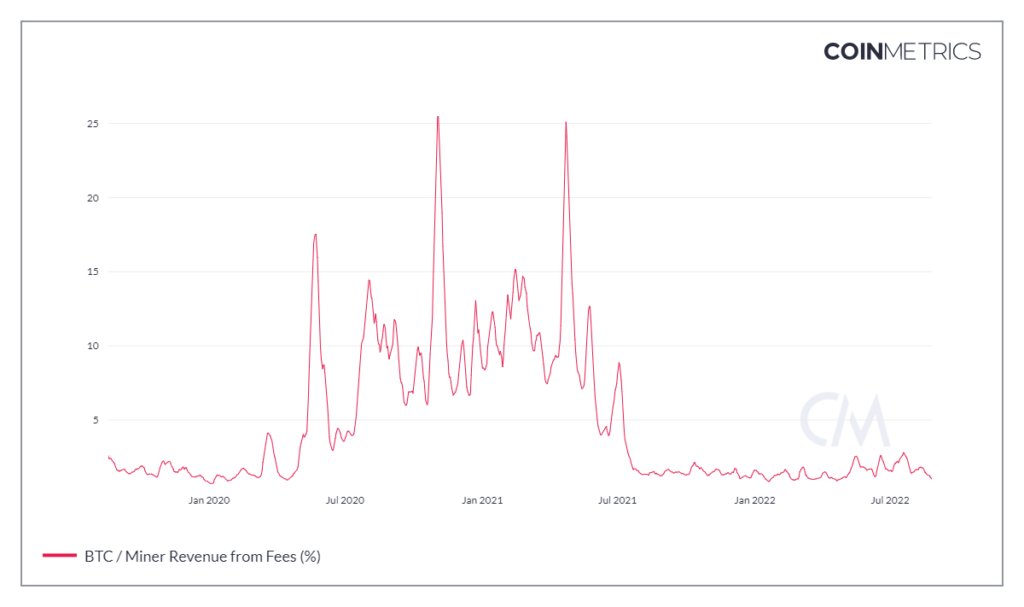
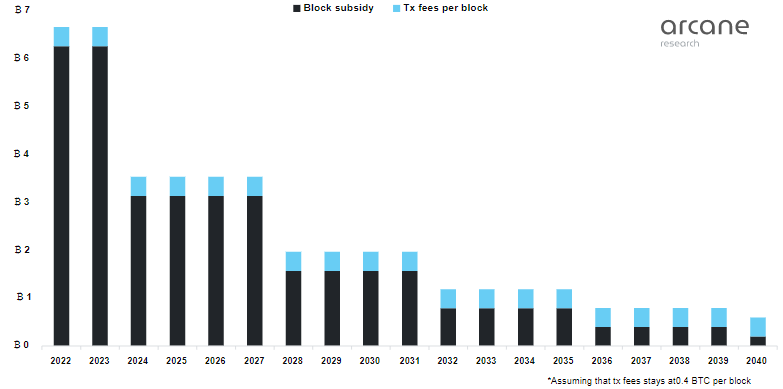
Биткоин-майнеры добывают 52 560 блоков в год. При этом, согласно Coin Metrics, исторически средний объем транзакционных сборов в расчете на блок составляет 0,4 BTC.
“Комиссии могут казаться маловажным компонентом награды, но их значение в будущем будет постепенно расти из-за халвингов. Последние происходят каждые четыре года, сокращая вдвое награду за блок,” — констатировал Меллеруд.
Его модель предполагает сохранение показателя в 0,4 BTC до 2040 года. По расчетам исследователя, доля комиссий в поступлениях майнеров достигнет к этому времени 67%. Происходящие каждые четыре года халвинги сократят к 2040 году награду за блок до 0,195 BTC.


“Bitcoin miners will spend a certain percentage of their revenues on electricity. And the higher that percentage, the more energy consumption in the industry,” — noted the researcher.
The researcher reminded that costs in any industry can be broken down into two main components:
- CAPEX (capital expenditures);
- OPEX (operational expenditures).
For Bitcoin miners, CAPEX includes investments in equipment and electrical infrastructure. OPEX is predominantly electricity costs.
Taking into account total network energy consumption and an average price of $50 per MWh, the researcher concluded that Bitcoin miners spend about 50% of their revenues on electricity.
“I am confident that the share of miners’ electricity costs will rise relative to current levels as the sector matures. Competitive forces will likely erode profits in the long run. The exception will be miners with access to very cheap electricity,” — the researcher said.
The researcher suggested that the CAPEX component will gradually decline as innovation in ASIC device manufacturing slows.
Taking the above trends into account, the annual growth rate of miners’ share of electricity costs will be 2%. By 2040, the figure will reach 71%.
“I estimate the average electricity cost in the mining industry at $50 per MWh. I expect that figure to hold in the foreseeable future. Global inflation is already high and likely to persist. Yet the ultra-competitive nature of mining will, over time, spur participants to seek cheap energy,” the researcher said.
Mellerud is confident that miners will spread to diverse corners of the globe. Some market participants monetise the heat produced by their devices, which also “offsets the impact of inflation”.
“Looking at any mining headlines, you might think the industry is a major global energy consumer,” — noted the researcher.
Yet Bitcoin’s share of global energy consumption remains minuscule — around 0,05%. The figure, in Mellerud’s view, is “on the margin of rounding error”.
On the other hand, energy use has historically risen with price. Therefore, Bitcoin’s rally over the next few decades could indeed make the network a “global energy user.”
The researcher modeled three scenarios:
- bullish: the cryptocurrency price rises linearly to $2 million by 2040;
- neutral: Bitcoin reaches $500 000 by 2040;
- bearish: $100 000 by 2040.
The chart below shows that Bitcoin’s future energy consumption will largely depend on the cryptocurrency’s price.


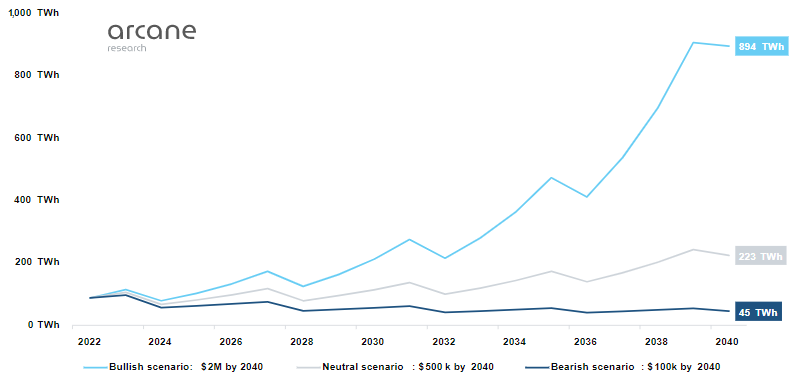
According to the researcher, at a Bitcoin price of $2 million by 2040 the network would consume 894 TWh annually — roughly ten times the current level.
“That is 0.36% of the expected global energy consumption in 2040, implying a substantial increase from the current 0.05%,” noted Mellerud.
The neutral scenario envisions annual energy consumption of around 223 TWh, a little over twice the current level.
The researcher also proposed an analysis of scenarios that consider not only price but also transaction fees.


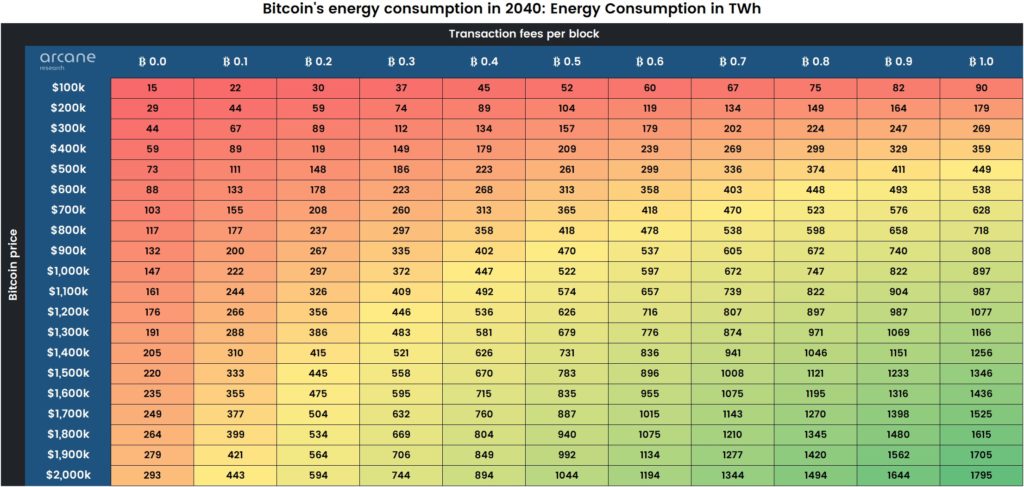
“In the table above we see that at a Bitcoin price of $2 million in 2040, transaction fees have a huge influence on energy consumption. For every additional 0.1 BTC of fees per block, energy consumption rises by 150 TWh — a figure almost twice the current level,” explained the expert.
Another interesting finding is that with the historically average transaction fees per block (0.4 BTC) and Bitcoin reaching $200,000 by 2040, energy consumption remains roughly at the current level. This, the researcher says, is a result of halvings that prune low-efficiency players from the market.
The next table is similar to the previous one. However, instead of energy values in TWh, the cells show the share of global energy consumption. An annual growth rate of 2% is assumed through 2040.


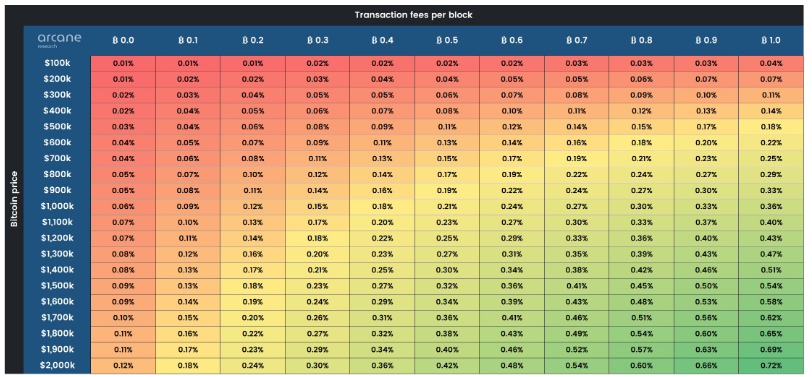
As noted, at Bitcoin’s price of $2 million by 2040 its share of global energy consumption would be 0.36%. According to Mellerud, while the figure is high compared with today, it remains far below the “apocalyptic estimates” voiced by some critics of digital gold.
“With that level of consumption, Bitcoin mining would be considered a fairly energy-intensive industry. Yet it would still lag well behind sectors such as cement production, which accounts for around 2% of global energy use,” the researcher noted.
He is also convinced that regular halvings will restrain the growth of network energy consumption, even as the market value of cryptocurrencies gradually increases.


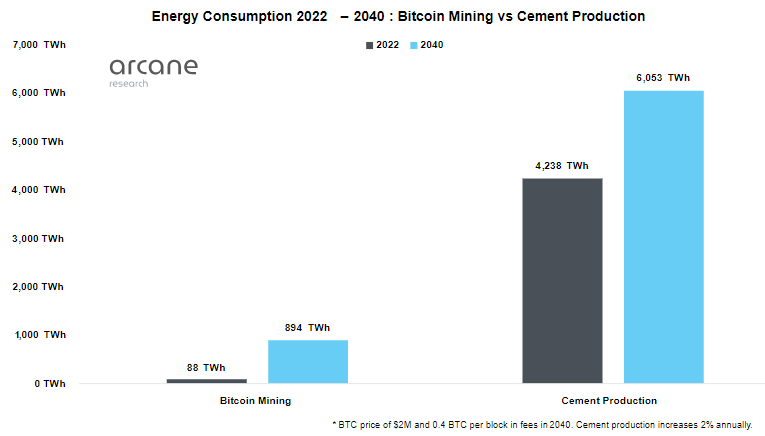
“Halving rewards every four years. To offset this effect, the price of cryptocurrencies would need to double during each of these periods. Therefore, for energy consumption to exceed current levels, Bitcoin’s market value would need to be around $650,000 by 2040,” explained Mellerud.
Conclusions
Bitcoin’s energy consumption depends on a variety of factors, and forecasting it into the future is fraught. Yet, one can conclude that digital gold could become a genuinely meaningful energy consumer if its price reaches several million dollars.
Rising market value spurs mining activity and, accordingly, raises energy consumption. But regular halvings counter this: to raise total electricity costs in the long run, the price of the cryptocurrency would have to rise extremely quickly.
Rising transaction fees could mitigate the impact of halvings on Bitcoin miners. But this would only be possible if Bitcoin is actively used as a means of payment.
The price of the first cryptocurrency mainly depends on market demand for it as a store of value. In turn, the size of the fee is determined by Bitcoin’s use as a means of exchange.
Total energy consumption will rise only if the first cryptocurrency continues to perform the above-mentioned money-like functions in the coming decades.
A share of 0.36% at a price of $2 million in 2040 is not particularly high, given Bitcoin’s usefulness and potential adoption by millions of market participants around the world.
Follow ForkLog’s Bitcoin news in our Telegram — cryptocurrency news, prices and analysis.