



The Open Network — the decentralised legacy of Pavel Durov — is gaining momentum: the DeFi ecosystem is slowly increasing its TVL, new services are appearing, and the Toncoin token remains in the top 30 of market capitalisation.
However, researchers from Whiterabbit have concluded that not all is smooth for the project. One of the main risks is centralisation due to excessive concentration of utility tokens among a small number of ecosystem participants linked to the TON Foundation.
- Almost 86% of the total Toncoin supply is held by a small group of TON ecosystem participants.
- Many “whale” addresses interact closely with each other and are also linked to the TON Foundation.
- Whiterabbit researchers see in this signs of centralisation of the TON project and risks of manipulating the utility token price.
The Open Network’s rocky history
To put the issue in context, a brief history of the project is in order.
The Open Network — a blockchain based on Proof-of-Stake, initially created by Telegram but now supported by external developers.
The first information about plans to create an ambitious blockchain project appeared on 22 December 2017. Former VK employee Anton Rosenberg said that Pavel Durov planned to conduct an ICO for Telegram. He revealed the name of the project — Telegram Open Network (TON) — and the token — Gram.
By then the messenger had 180 million users, and the crypto industry was booming with initial coin offerings.
The Telegram team decided to conduct a private token sale with professional investors, which resembled a typical tech company financing round. In exchange for money investors were to receive Gram tokens, but only after the TON network launch.
In January 2018 the call for ICO participation began. It was conducted in accordance with U.S. law, as investors from the United States took part in the token sale.
The hype around the ICO was truly immense: in the first round the volume of applications reached $3.8 billion, far exceeding the planned figure. The goal of raising $850 million was quickly reached.
Apart from American investors, Asian and Russian entrepreneurs invested in TON, including Roman Abramovich and Mikhail Abyzov. A further $850 million was raised in the second round.
TON was conceived as the next step after Bitcoin and Ethereum in blockchain development. It was to be a platform for decentralised applications with smart contracts and a virtual machine. Yet the TON architecture was designed with scalability far beyond Ethereum’s capabilities.
An important direction involved integrating Gram with Telegram, which would give access to hundreds of millions of users. It was envisaged that tokens could be used to pay for advertising in channels.
Although TON’s creation was conducted behind closed doors, external developers participated, and the results were published publicly. This enabled the project to launch in 2020 without Telegram and Pavel Durov’s involvement.
In spring 2019 a testnet went live. Access was granted to several external teams, including TON Labs.
By autumn it became clear that TON was in the final stages. The test.ton.org site displayed the code for a full node, and a block explorer for the test network was launched.
Under the terms of the Telegram contract, ICO participants could receive Gram tokens only after the main TON network launch, but no later than 31 October 2019. This date served as the deadline for delivering the project.
However on the eve of the launch, on 11 October, SEC suddenly announced the adoption of “emergency measures and restrictions” against two offshore TON-related companies. The Commission said that Gram had been sold to investors illegally. Officials also concluded that the rights to 1 billion tokens had been sold to 39 U.S. residents.
SEC obtained a temporary restraining order on Gram’s distribution, making TON’s launch impossible. The agency also filed suit against Telegram for selling unregistered securities.
Ultimately Pavel Durov announced the project’s closure, and his company did not contest the court order on Gram issuance.
TON’s rebirth
By spring 2020 all technical elements of Telegram Open Network were ready, and the community claimed the possibility to launch the network without Telegram, which had refused any single‑entity control over the project. The decentralised launch scenario was backed by the network’s leading validators.
After TON’s closure, several independent teams continued to work on a blockchain based on the project’s code:
- Free TON, later renamed to Everscale;
- the Chinese TON Community project (which at present is not developing);
- NewTON.
In March 2021 representatives of Telegram transferred the ton.org domain and GitHub repository to the The Open Network community (the former NewTON).
By then the emission of the ecosystem’s native token — Toncoin — amounted to 5 billion coins. The number of accounts in the network had surpassed 70,000.
“We are disappointed that Telegram was forced to withdraw from the TON project in 2020. However the community will continue to develop the technology underpinning TON,” said The Open Network participants.
In December 2021 Pavel Durov publicly backed the Toncoin developers.
He said he was proud that the technology “is alive and developing.” Durov also stressed that Toncoin does not depend on the Telegram team, and wished the developers success:
“With a proper go-to-market strategy, they have everything they need to build something grand.”
The statement triggered a substantial rise in the token’s price.
In early November 2022, on the Fragment platform, sales of Telegram usernames for Toncoin began. The first lot — @auto — was sold for 900,000 Toncoin (about $1.4 million at the time).
In February 2023 validators TON voted to suspend 194 wallets with a total balance of 1.08 billion Toncoin (over $2 billion), which had not conducted any transactions since distributions from 2020 to 2022.
“Thanks to the potential suspension of these wallets […] there will be clarity about the amount of Toncoin available,” said the project’s blog.
The procedure does not cover addresses that did not participate in the initial distribution. The suspension will last four years. The affected addresses will lose the ability to transact during this period.
The volume of frozen coins equates to 21.3% of the total supply.
Also in February the TON developers presented a roadmap for 2023. It includes:
- launch of a single protocol for interaction between ecosystem applications and wallets;
- improved security and stability of the network;
- support for signature verification of the EVM;
- improving TON wallet address formats and turning the latter into decentralised encrypted messengers;
- introduction of a mechanism to burn part of the fees;
- cross‑chain transfers between TON and Polygon, and also a bridge to transfer BTC, ETH and BNB;
- splitting nodes into collators and validators to improve blockchain throughput.
Among other things, the TON team launched the Ton.vote platform. Through it Toncoin holders can participate in decisions on all network projects.
As of 19 March 2023, the aggregate TVL of TON ecosystem apps stood just above $15 million. By comparison, BNB Chain and Tron TVLs were $7.76 billion and $5.45 billion respectively.



Unusual distribution
In the summer of 2020 the project began distributing digital assets via mining based on Initial Proof-of-Work (IPoW). The latter, according to developers, combines the advantages of various consensus algorithms.
“The blockchain runs on Proof-of-Stake technology, making it fast and inexpensive. However the initial distribution of tokens was accessible via mining, implying decentralisation and equal conditions for all participants,” said on the project’s site.
According to TON representatives, all tokens were dispersed among “tens of thousands of miners”:
“The project decided not to conduct an ICO, IEO or any other token sale. This growth was organic, to a large extent like Bitcoin.”
According to Whiterabbit researchers, on 6 July Telegram developers moved tokens from the system address to 20 contracts for token distribution.
Contract addresses were of two types: Small Givers and Large Givers.
“The latter distributed more tokens (each time 100 000 instead of 100), but required greater computing power,” explained Whiterabbit experts.
In their observations, mining continued from 6 July 2020 to 28 June 2022. However almost all minted coins were distributed within 51 days after mining began:
- From 6 July to 26 August 2020, Large Givers distributed 4.8 billion (96%) tokens, while Small Givers accounted for just 9.9 million (0.2%);
- From 27 August 2020 to 28 June 2022, Small Givers distributed 117.3 million tokens (2.35%).


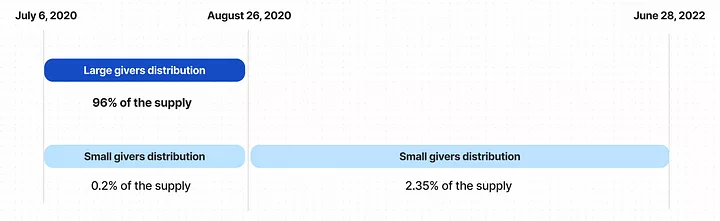
“It is notable that de facto Large Givers finished mining on 24 August, but two addresses received the last 100 000 tokens from the participants of this group on 26 August,” the researchers noted.
The remaining 1.45% of coins were distributed in 2019–2020 from the system address, “for testing.” Subsequently most of these funds moved to one of the TON Foundation addresses within TON Foundation.


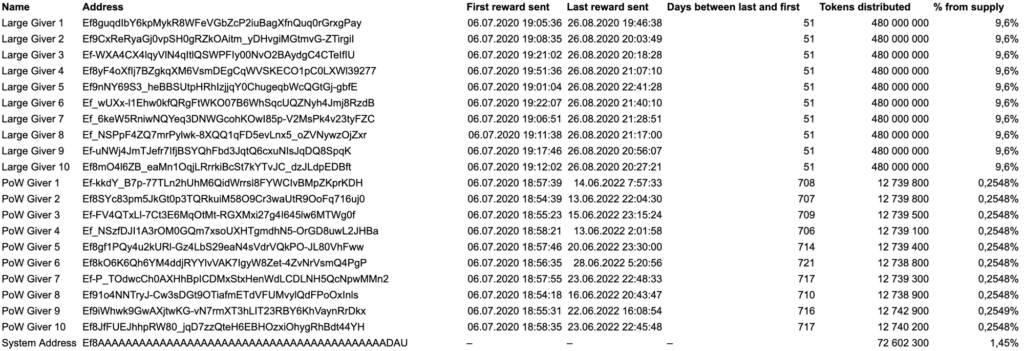
“It is worth noting that by 24 August 2020 Large Givers had effectively finished mining, but two addresses received the last 100,000 tokens on 26 August,” the researchers added.
According to their observations, the remaining 1.45% of coins were distributed in 2019–2020 from the system address “for testing.” Subsequently most of these funds moved to one of the TON Foundation addresses.
Experts stressed that after mining, “test Gram” were renamed to the mainnet Toncoin tokens, and their market capitalisation rose from zero to $11 billion within three years.
“Most major holders (Large Givers miners, active since 2020) continue to hold the coins. Many of them may have long-term plans for the ecosystem,” the researchers concluded.
In their view, TON’s market depth remains modest. As a result, it is almost impossible to sell these coins without significantly impacting the price.
The TON press office noted that mining occurred with a degree of natural concentration of power and interest among participants. A project spokesperson said that this is why large holders emerged in the ecosystem.
The omnipresent whales
Whiterabbit researchers also found that mining involved 3,278 unique addresses. However, only 248 interacted with Large Givers. The latter, as noted, distributed 96% of the token supply. The findings somewhat contradict TON’s claim of “tens of thousands of miners.”
“Moreover, these 248 addresses are closely interconnected […]. We also observed some retail activity, but the majority of tokens were mined by a group of whales linked to each other,” Whiterabbit noted.
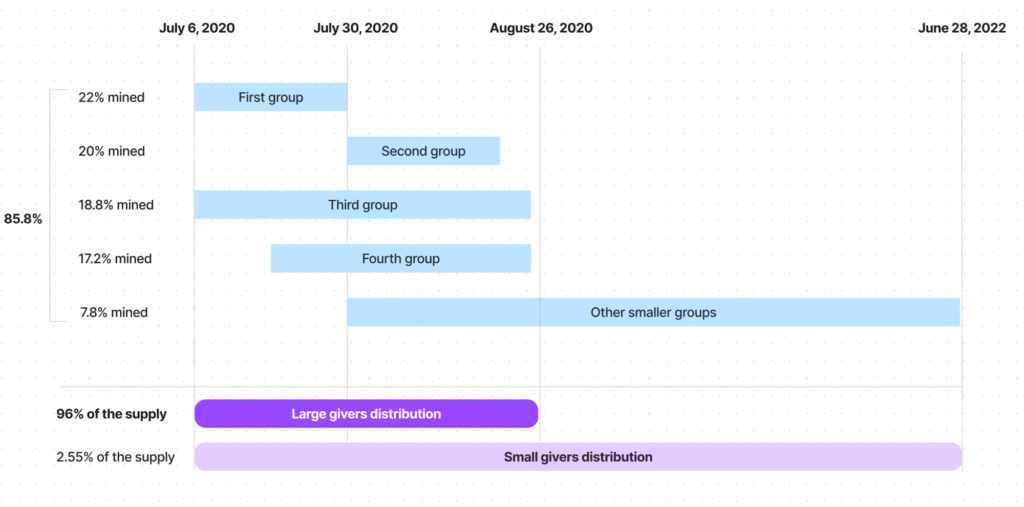
On-chain analysis allowed researchers to group the major miners into several cohorts that interacted with Large Givers and were linked to the TON Foundation:
- First group (6 July – 30 July) distributed 22% of the total supply;
- Second group (30 July – 24 August) 20%;
- Third group (6 July – 24 August) 18.8%;
- Fourth group (19 July – 24 August) 17.2%;
- Smaller groups that began mining on 1 August — 7.8%.
“According to our calculations, TON Foundation–linked addresses control at least 85.8% of the token supply,” the researchers emphasised.


The team at Whiterabbit also found that the aforementioned mining groups were linked to 170 validators (of 272 active at the time of the study). In addition, 12 participants in the ecosystem received funds from the TON Foundation “either directly or via proxy addresses.”
“Thus, there are 182 (~ 66.9%) validators that received coins from the aforementioned mining groups. The latter may be controlled by the early TON miners,” the researchers noted, attaching a table with detailed on‑chain results.
Whiterabbit concluded that the addresses controlling at least 85.8% of the supply are also tightly bound to one another.
“The group of people controlling these addresses are slowly releasing TON tokens onto the market, constraining supply and creating a liquidity‑constrained effect. This positively affects TON’s price,” the researchers added.
It is not clear who exactly runs these addresses. But at least some of the market participants appear to cooperate with the TON Foundation, investigators suggested.
“This group has sent tens of millions of TON tokens to centralised exchanges to provide liquidity. The integration with these trading platforms was announced and overseen by the TON Foundation,” they added.
Additionally, transfers from these addresses were made to key community members. Test transactions with the TON Foundation, exchanges and other services were observed.
Researchers also voiced the view that the recent freeze of 1.08 billion Toncoin addresses is unlikely to solve the supply-concentration problem — the mining groups will continue to hold the lion’s share.
“Potential investors will see centralisation risks in such token distribution,” Whiterabbit suggested.
TON’s prospects
As noted, there is a possibility that the TON Foundation will begin distributing tokens more actively among the community and key projects to popularise the blockchain. In an interview with ForkLog, Whiterabbit researcher Ilya Sleptsov suggested that some of these coins could be sold or even distributed to other institutions that could bring value to the ecosystem (for example popular DeFi protocols on Ethereum).
“One potential solution for the ecosystem would be to sell or even airdrop tokens to other institutions that can benefit the ecosystem (for example popular DeFi protocols on Ethereum),” the expert noted.
TON noted that token distribution is already taking place actively through grant programmes, contests, hackathons and airdrops.
Regarding the impact of the freeze on the project’s economy, Sleptsov said:
“Risks have, of course, diminished because 20% of the token supply has been taken out of circulation. This 20% will not participate in governance and cannot be sold ‘to the market’ for the next four years. But the centralisation issue among token holders remains unsolved. The token is owned by one group of people, and mostly only they are interested in developing the blockchain.”
Also, he said, the TON Foundation is in close communication with some early miners. The latter can easily manipulate the token supply and, therefore, its price.
Looking ahead, Sleptsov again highlighted centralisation concerns. He also pointed to the high entry barrier for developers, who must learn a new development paradigm and a new language to release dapps.
The expert did not rule out the possibility that TON’s DeFi ecosystem could eventually compete with BNB Chain, Polygon or Avalanche.
“Thanks to the Telegram integration, asynchronous architecture and a strong developer base, the ecosystem is evolving and could at some point reach the sizes of the aforementioned examples,” the researcher stressed.
TON Foundation rebutted a close link with miners. A project representative told ForkLog that the team was interested in cooperation with relevant ecosystem participants, but not affiliated:
“The main (and perhaps the only) interaction between mining addresses and the TON Foundation address is donations to a reserve for network development. Donations were made by miners after public calls for this in April 2021 and April 2022. […] Undoubtedly, the TON Foundation is interested in cooperating with miners, but most miners are not TON Foundation participants, and most TON Foundation participants are not miners.”
The organisation noted that the concentration of liquid assets in the hands of a group of large holders is a common feature of crypto projects. A representative said a similar pattern exists in Bitcoin and Ethereum networks.
The press service also added that the impact of the token freeze on the project’s economy will be “limited”. This is because access to the relevant addresses “was lost even before the vote on suspension”.
Conclusions
When performing thorough fundamental analysis of projects, investors should pay attention to the token’s issuance nature and pace, as well as plans and features of its future distribution.
If a substantial portion of the coins is concentrated among a small number of addresses, this indicates centralisation of the project. In the TON case, for instance, one of the main risks is decisions made by a small group of ecosystem participants to their own advantage. In TON’s case, for example, this could mean address-freezes following validators’ votes or potential sale of large token volumes “to the market.”
Nevertheless, a strong development team, innovative technology, and integrations could help create a powerful network effect capable of offsetting many drawbacks.