



In 2024, the DeFi sector’s TVL doubled to more than $120bn, marking a renaissance for the industry. A change of guard in the White House eased regulatory pressure rooted in the notion that tokens are securities. Against that backdrop, protocol teams revived discussions about the fee switch—a revenue-sharing mechanism that would pay dividends to DeFi-token holders.
This ForkLog piece explains how the concept works and why company leaders keep delaying its implementation.
How the fee switch works
The fee switch is a mechanism through which a DeFi protocol shares part of its profits with holders of the native token.
Revenues for the main DeFi lines—DEX and lending platforms—are generated from user fees. In most protocols, a significant share is directed to liquidity providers (LP).
A fee switch means the platform’s stewards withhold a slice of income previously sent to LPs and pass it to token holders. Stakers of the native token and governance participants thus gain additional financial upside for voting or delegating that right.
Fee switches could address several problems with DeFi tokens at once:
- adequate valuation. Linking token market prices to real operating metrics makes them more appealing to long-term investors and curbs purely speculative moves;
- escaping inflation. The mechanism tackles a problem of the previous DeFi cycle—capitalisation dilution from constant token issuance to reward participants. The inflationary model later depressed asset values. The new approach favours more active buybacks and burns, lifting value by scarcity rather than quantity;
- gives tokens utility value. They would provide not only governance rights and access to services, but also automated reward mechanics for staking and other interactions with the protocol.
How major DEXs resist the fee switch
On 23 February 2024 the largest DEX, Uniswap, once again published a proposal to redistribute protocol fees to UNI holders. In the 1–6 March “temperature check”, an overwhelming majority expressed support for the fee switch.
A final vote was set for 31 May 2024, but on the day the leadership cancelled it, saying:
“Over the past week, a stakeholder raised a new issue related to this work that requires additional diligence on our part. Because of the […] sensitivity of the proposed update, we made the difficult decision to postpone the vote.”
The community was unhappy. For example, crypto researcher Gabriel Shapiro said UNI token holders were being made “second-class citizens”.
By February 2025, Uniswap’s fee-switch proposal had been rejected three times. According to OAK Research, wallets of major players—the fund a16z and the protocol’s founder, Hayden Adams—were decisive, voting “against” and citing regulatory risks.
In 2024 the platform indeed received notices from the SEC and paid a fine in a case brought by the CFTC. That may not be the only reason its leaders are avoiding dividend payouts to token holders. Governance remains rather centralised: according to Dune, only about 4.5% of UNI holders vote.
OAK Research says that of the 30 largest delegates, 14 skipped the ten most recent votes and only seven authored even one proposal.



Anders Helseth of K33 Research thinks UNI holders are unlikely to get a fee switch, and liquidity providers will keep winning the fight for trading fees. A large share of tokens sits with big investors who have little incentive to change the tokenomics.
Another heavyweight—second by TVL on DeFi Llama—is Aave.

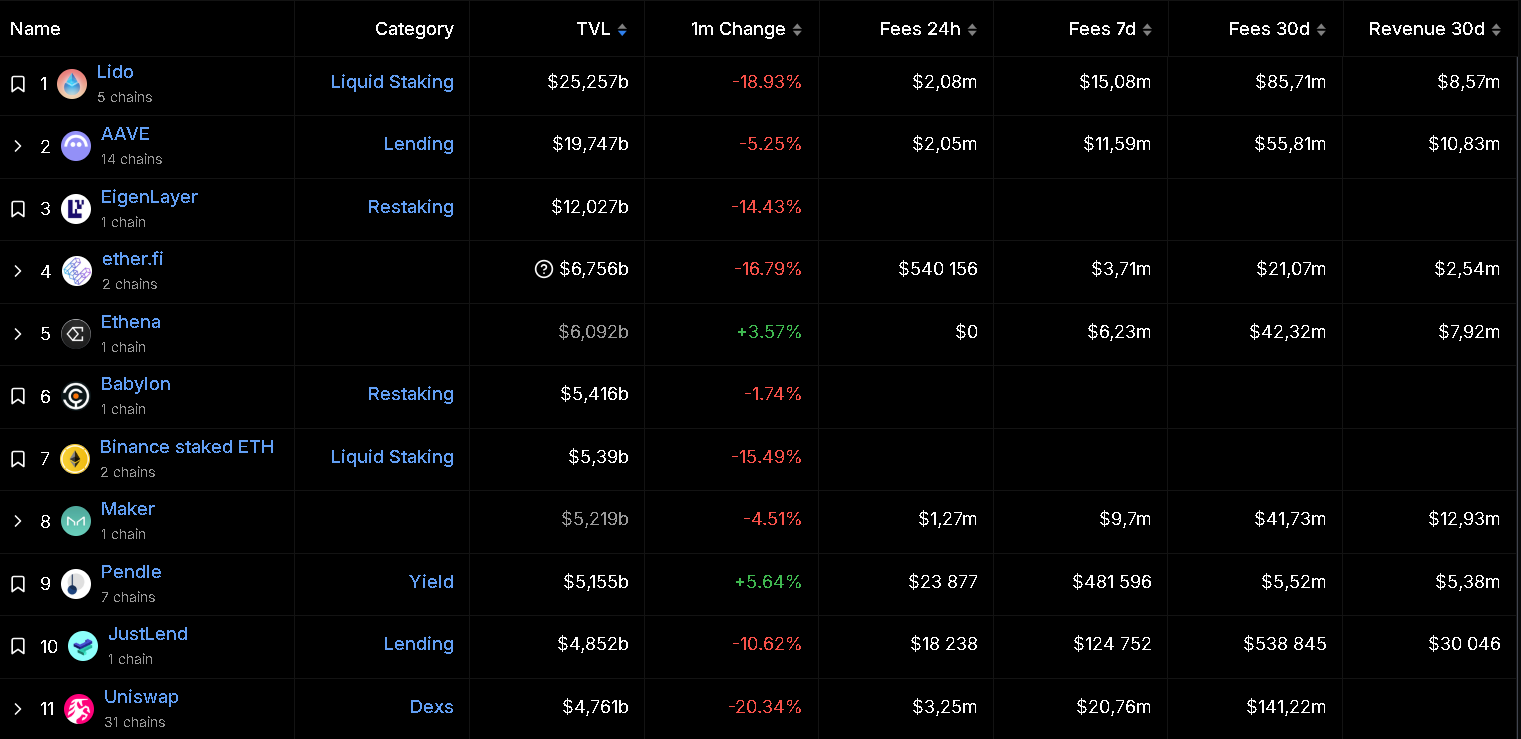
The team behind the largest decentralised lending protocol launched a “temperature check” in July 2024 for a new initiative to redistribute transaction fees.
The “buy and distribute” mechanism would direct part of revenues to buy AAVE on the secondary market for subsequent distribution to stakers.
On 4 January 2025, project head Stani Kulechov, responding to news of a nearly formed $100m fund, posted on X: “Fee switch incoming.”
The experience of the sector’s biggest names shows the obstacles DeFi must clear to reach genuine decentralisation. Yet after the change in the White House, protocol teams will likely vie to adopt new narratives, which may ultimately push them to upgrade.
Early movers and newcomers
The fee-switch idea is not new, and while large protocols keep failing votes to adopt it, more modest projects have been using it for over five years.
Among the first was Synthetix. The team proposed sharing revenue with holders of the SNX token back in 2019. In 2020 the protocol moved to decentralised governance. Early in 2023 it deployed its third version, and by year-end scrapped SNX’s inflationary model.
According to DeFi Llama on 17 February 2025, holders’ daily profits were about $2,500.
Another of DeFi’s “ancients”, SushiSwap—a decentralised exchange spun out of Uniswap—managed in 2020 to poach roughly 70% of its parent’s liquidity via a “vampire attack”. The fork offered high liquidity-mining rewards to holders of the SUSHI token.
Uniswap soon won its users back, while SushiSwap struggled for years with a poorly designed security set-up. At the time of writing, daily income for SUSHI holders is around $2,550.
Some DEXs use a game-theory-inspired escrow mechanism—ve(3,3). It lets participants lock tokens in exchange for a wrapped version with a ve prefix.
The model usually combines three interdependent mechanics: buying and staking the token; locking it into a ve version; and freely selling the native coin into the market. If the first two exceed the last, the system benefits.
In August 2023, the DEX Velodrome Finance launched a fork on the Base layer-2. The venue, Aerodrome, captured a significant share of liquidity on the network. The fork adopted the governance system and tokenomics.
At Aerodrome, ve(3,3) works as follows:
- trading fees. Each transaction generates fees that are redistributed to liquidity providers in proportion to their pool share;
- incentive tokens. Distribution of the native token AERO in certain pools spurs liquidity provision. Rewards are calculated based on the amount of liquidity supplied and the length of participation;
- locking AERO for veAERO. The system encourages long-term staking and governance, reduces sell pressure and optimises yields.

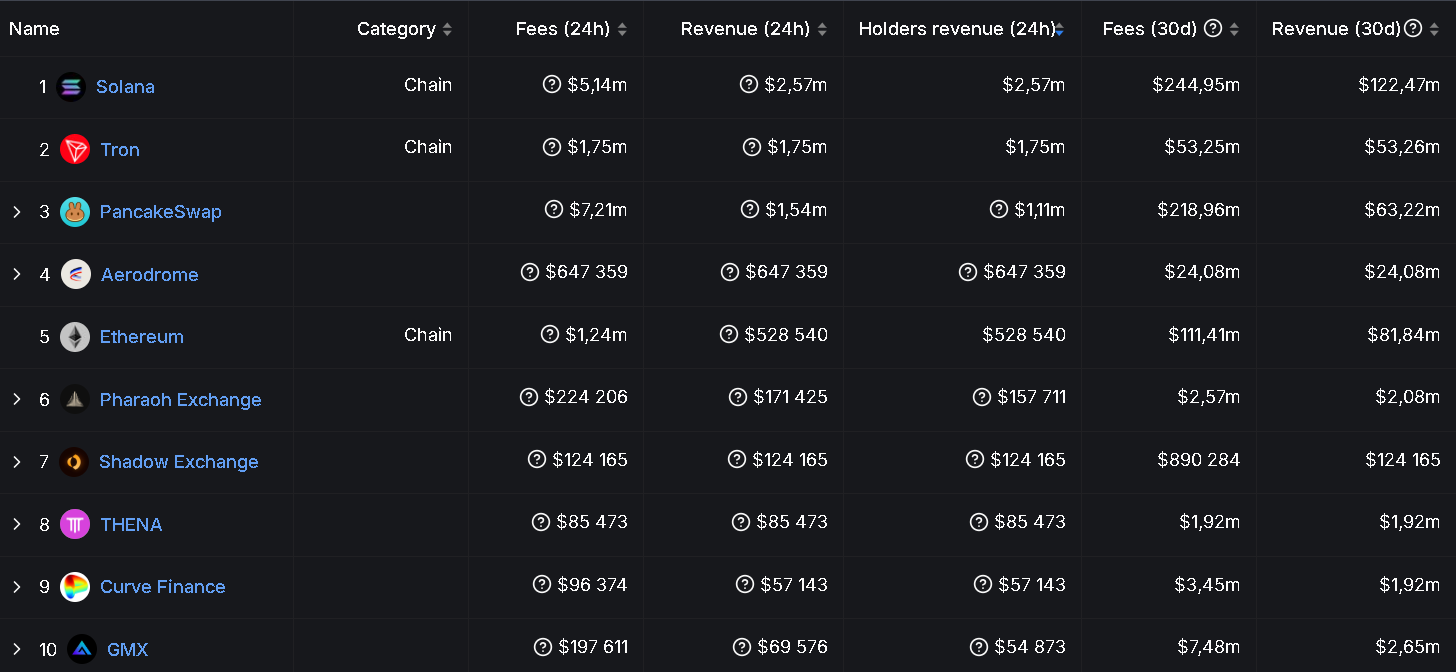
PancakeSwap—a popular exchange and a top-three payer to holders—uses a model built on staking CAKE. Earnings accrue in a wrapped form, veCAKE.
Politics nudges decisions
Over the past two years, the SEC has tightened oversight of the blockchain industry, classifying many digital assets as securities. Enabling a fee switch could lead to similar treatment of DeFi tokens, implying compliance with strict rules—or fines.
With Mr Trump’s team in office, the mood has changed markedly. In one speech while still a vice-presidential candidate, JD Vance criticised the SEC’s approach to crypto regulation, in particular its designation of utility tokens as securities. He urged the Commission instead to focus on meme coins, whose numbers are swelling and whose status needs defining.
On 12 February 2025, SEC commissioner and “crypto mom” Hester Peirce sought to reassure meme-coin fans. She thinks this asset class is unlikely to attract the agency’s attention.
In March 2024, experts at Bernstein said they were confident that regulators would “change their narratives” on tokens often branded as securities. They expect DeFi to recover faster.
After the Uniswap and Aave cases and a softer regulatory stance, many in the industry began actively discussing flipping the fee switch. We will see how protocol teams balance their own revenues, those of liquidity providers and those of holders.
If the rules do turn more favourable, that could spark a fresh wave of interest in DeFi and encourage widespread adoption of the mechanism.