




The decentralized finance (DeFi) sector continues to attract heightened attention from cryptocurrency investors. ForkLog has gathered the most important events and news from the past weeks in a digest.
Key metrics of the DeFi segment
Total value locked (TVL) in DeFi protocols rose to $107.79 billion. The top three positions are held by lending protocols Aave ($9.81 billion), Compound ($7.24 billion) and MakerDAO ($5.93 billion).


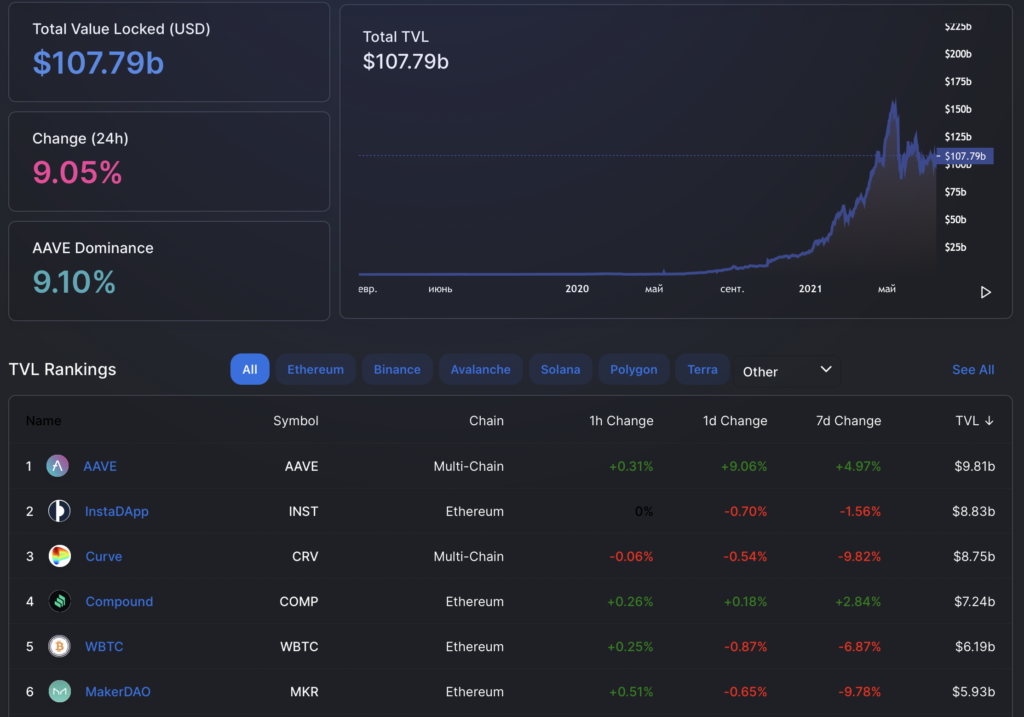
DeFi Llama includes in the final value group of tokenized Bitcoins. WBTC at $6.19 billion ranked fifth. hBTC with $1.26 billion placed 21st.


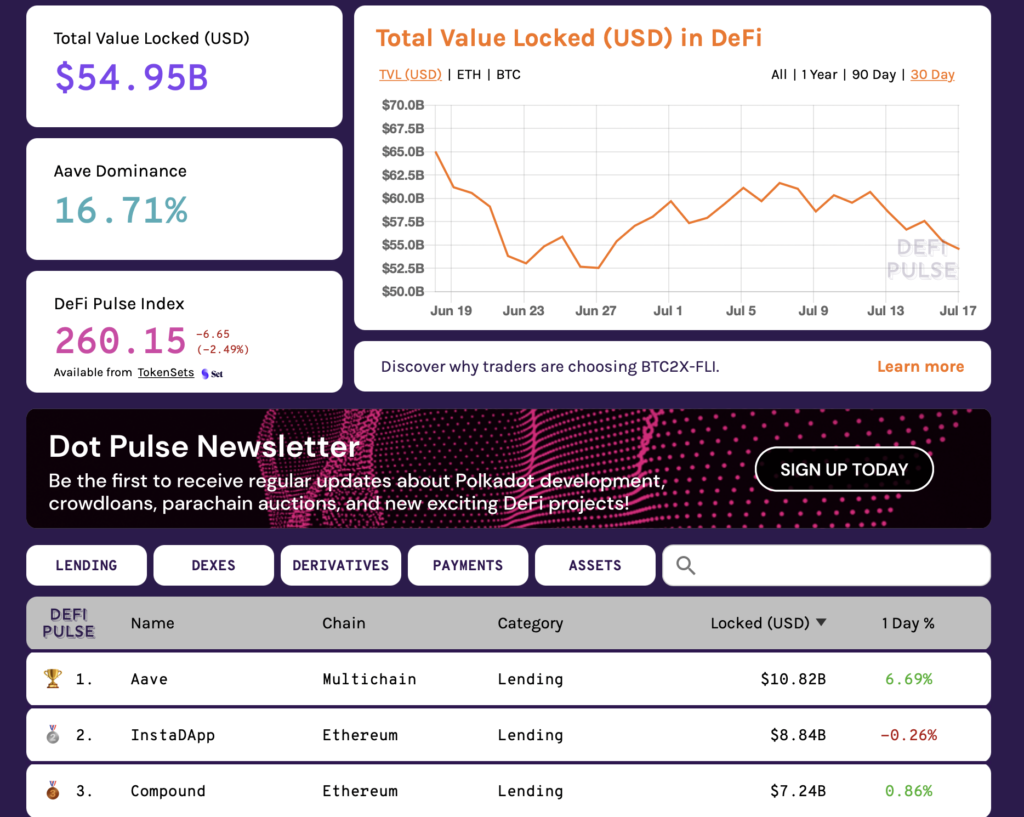
The total market value of tokenized Bitcoins on Ethereum rose to $8.1 billion. Three weeks ago the figure was $7.8 billion.


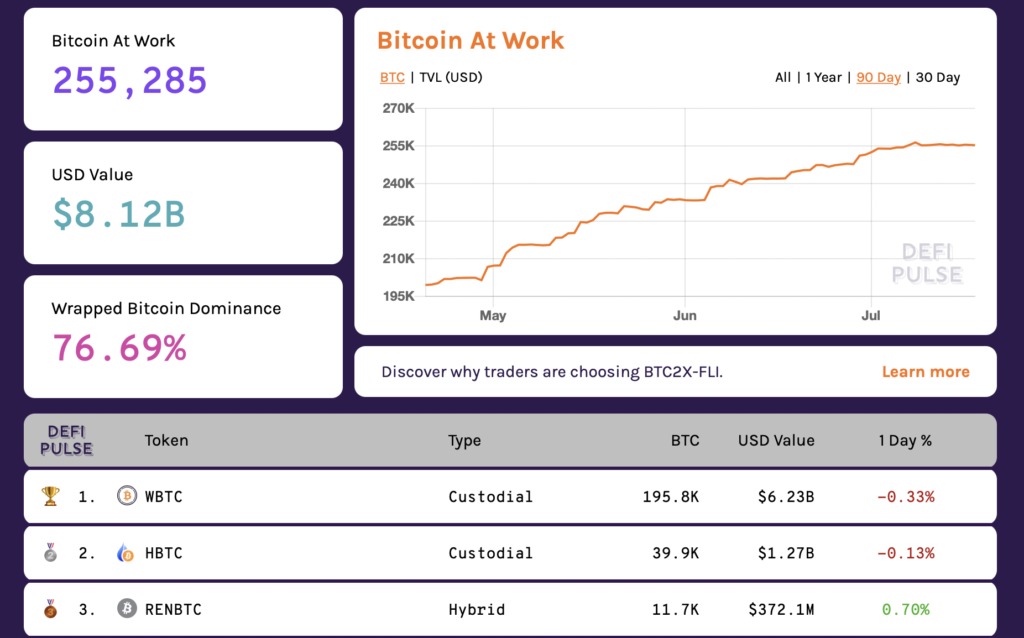
Trading volume on decentralized exchanges (DEX) over the last 30 days stood at $61.7 billion.
63.8% of total non-custodial exchange turnover is on Uniswap. The second DEX by trading volume is SushiSwap (9.4%), the third Curve (9.1%), the fourth 0x Native (5.4%).
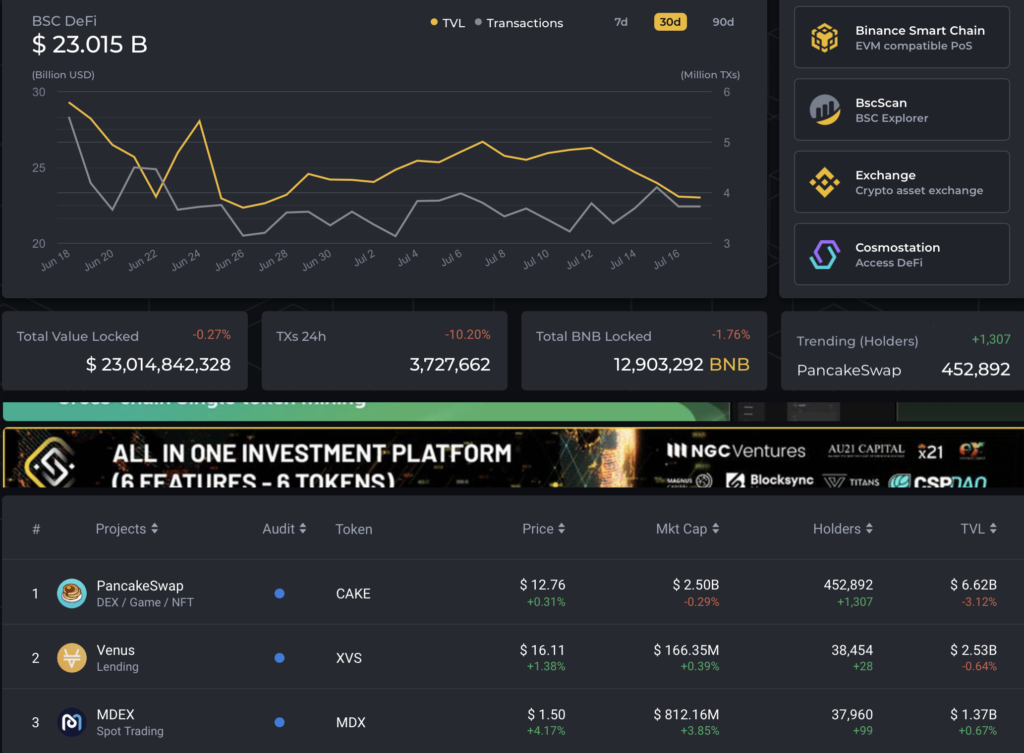
TVL of projects on the Binance Smart Chain (BSC) fell to $23 billion, down 21% over the last 30 days.


1inch Network launches its own stablecoin
The DeFi project 1inch Network, in partnership with the ICHI platform launched a new stablecoin for internal use by the community — one1INCH.
Users will be able to use the new asset for:
- paying operating expenses;
- providing liquidity;
- distribution of liquidity rewards.
The ICHI platform positions itself as the world’s first protocol for creating decentralized monetary institutions that enable any DeFi community to issue a stablecoin based on its own tokens.
For one1INCH, the coin will be minted with the project’s native 1INCH token and USDC. Stablecoins issued via ICHI will always cost exactly $1.
Chia Network founder announced the creation of a decentralized exchange
The founder of the Chia cryptocurrency, Bram Cohen has shared plans to develop DeFi products in the project’s ecosystem.
Among them he named a decentralized exchange and an automated market maker.
Nassim Taleb criticises trading of tokenized securities
The philosopher and author of The Black Swan, Nassim Taleb stated that the DeFi sector has reinvented “bucket shops,” and advised young traders to learn from the older generation.
By “bucket shops” they mean companies that in the early 20th century allowed ordinary Americans to trade stocks or commodities without owning them. This practice was eventually deemed illegal.
“Bucket shops appeared only about 90 years ago! Now DeFi manages to reinvent them. A Twitter-raised generation should sit with surviving traders, sip aged brandy, stay quiet and learn,” — Taleb wrote.
He commented on the Bloomberg article, which described synthetic versions of Tesla, Apple, Amazon and other public companies.
Aave to launch institutional-focused DeFi protocol
The lending project Aave will launch an institutional-focused DeFi protocol called Aave Pro in response to growing demand.
In the initial phase the new protocol will support four assets — Bitcoin, Ethereum, Aave and USDC — and offer clients the same services as the main project. Its pools will be separated from other liquidity sources.
Access to the platform will be granted to “institutions, corporations and fintechs” that have passed Fireblocks’ KYC checks. For this, Aave V2 will integrate “whitelists.” The blockchain startup will also implement anti-money-laundering measures and counter fraudulent practices.
In the future the institutional protocol will be moved to decentralized governance.
Investments in DeFi
The payments-focused DeFi protocol Superfluid Finance raised $9 million in a seed round led by venture firm Multicoin Capital.
The startup was also backed by Semantic Ventures, DeFiance Capital, Aave founder Stani Kulechov, Messari founder Ryan Selkis and others.
The raised funds will go to expand the team and promote the solutions being developed. The team will organise hackathons and launch a targeted grant programme.
Superfluid Finance plans to build an ecosystem of real-time DeFi applications. They will allow instant transfer of cash flows, including recurring payments like subscriptions or salary payments.
Superfluid Finance believes that in the future decentralized organizations will receive payments via “continuous streams of assets, moving from one wallet to another, second by second.” This should speed up exchanges and reduce “idle capital.”
The cloud platform for developers Shipyard Software raised $4 million from Polychain Capital and other investors to build the Clipper decentralized exchange.
The funds will be used to improve the code of the DEX launched on June 30 and increase liquidity of its pools.
Other participants included 0x Labs, 1inch, DeFi Alliance, Quantstamp and others. $17 million in liquidity for the DEX will come from Polychain Capital, Nascent, Three Arrows Capital.
Designed primarily for traders with smaller capital, Clipper has integrated with aggregators 1inch and 0x.
Hacks and scams
The WhaleFarm DeFi project team is suspected of stealing $2.3 million from investors. The native token’s value fell by 99% within minutes.
The anonymous WhaleFarm developers had promised earnings “up to 7,217,848% annualized.” The yield-farming project accepted many different cryptocurrencies, including BNB, BUSD, USDT, BTC, ETH, ADA, DOT and LINK.
Fueled by a large influx of investors, the token’s price spiked. But on June 30 it collapsed by 99%. Simultaneously the project team deleted its official Telegram group and Twitter account.
According to DappRadar, WhaleFarm has more than 1,500 unique users and a total transaction volume of $23.6 million.
The DeFi protocol Safe Dollar on the Polygon blockchain was hacked, and its stablecoin devalued.
The developers paused liquidity pools and are investigating the incident. Users were asked to refrain from operating with the SafeDollar (SDO) stablecoin and withdraw their funds.
According to RucDoc, on June 28 unknown actors withdrew $250,000 from the protocol’s smart contract in USDT and USDC stablecoins.
PeckShield analysts believe the attackers exploited a vulnerability in the protocol’s codebase that allowed unlimited SDO minting.
Hackers exploited a critical vulnerability in the ChainSwap cross-chain bridge and withdrawn more than $4 million from DeFi projects. The developers will release a new token version ASAP to mitigate the fallout.
The ChainSwap protocol acts as a bridge between different blockchains, including BSC, Ethereum, Polygon and Huobi Eco Chain.
In July 2021, this was the second attack on the protocol. Earlier in the month unknown attackers exploited a vulnerability in ChainSwap’s code and withdrew $800,000 in various DeFi tokens.
The project team contacted law enforcement and cooperated with the Bitcoin exchange OKEx to mitigate at least part of the damage. The developers agreed to return Corra and Rai tokens.
The THORChain protocol lost $4.9 million in cryptocurrency due to a hacker attack. To resolve the incident, all network operations are paused by node consensus.
THORChain is a liquidity protocol that enables cross-chain asset swaps without transferring them to a third party.
Earlier the team said attackers withdrew 13,000 ETH (~$24.76 million at the time of writing). This number was later revised to 4,000 ETH (~$7.62 million).
According to community-sourced data, the damage was lower — under $5 million. An address marked by Etherscan as linked to the attack holds assets worth $4.58 million.
The project team promised to detail the incident once all details are known. It is known that the attackers managed to “dupe” Befrost, the service responsible for connecting nodes to blockchains and relaying witness transactions.
Also on ForkLog:
- CoinGecko released two new editions of its DeFi book.
- 1inch presented a new governance voting system for protocol settings.
- ShapeShift will transition to a decentralized governance model.
- Compound Labs provided institutional access to the DeFi ecosystem.
Read ForkLog’s Bitcoin news in our Telegram — cryptocurrency news, prices and analysis.