




The decentralised finance (DeFi) sector continues to attract heightened attention from cryptocurrency investors. ForkLog has compiled the most important events and news of recent weeks in a digest.
Main DeFi metrics
Total value locked (TVL) in DeFi protocols rose to $125.29 billion. The first, fourth and fifth places are held by lending protocols Aave ($13.29 billion), Compound ($8.85 billion) and MakerDAO ($8.78 billion).


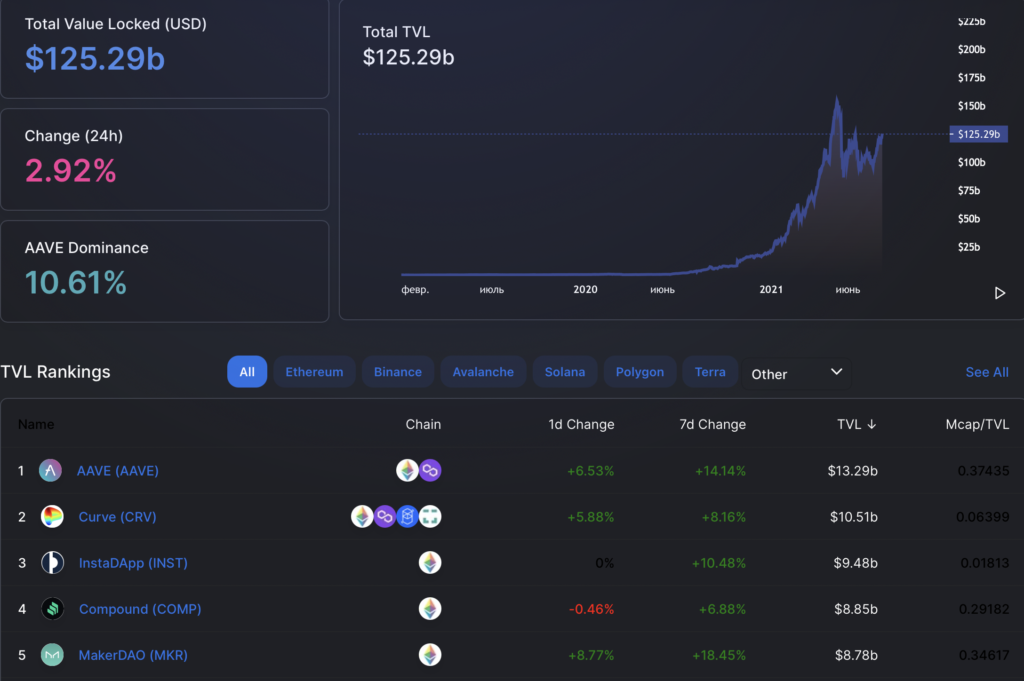
DeFi Llama includes a component of tokenised bitcoins. WBTC, at $8.42 billion, ranked sixth. hBTC, at $1.73 billion, was nineteenth.
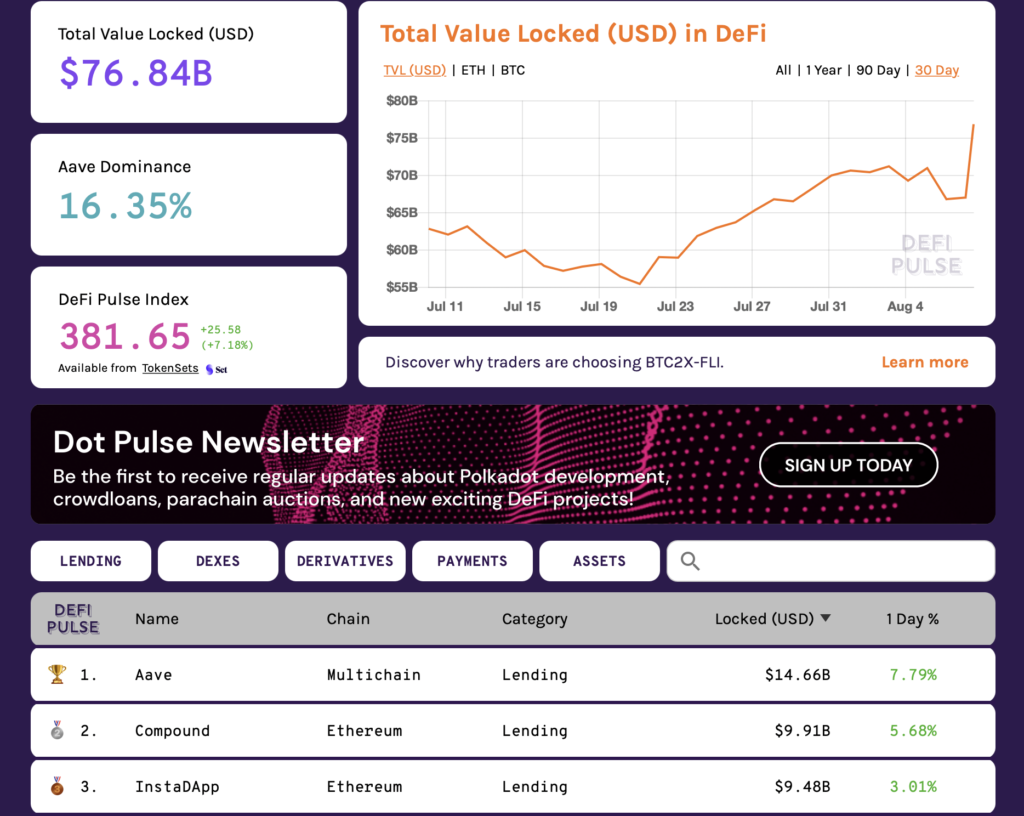
TVL in Ethereum applications rose to $76.84 billion. Over the last 30 days the figure grew 12%.


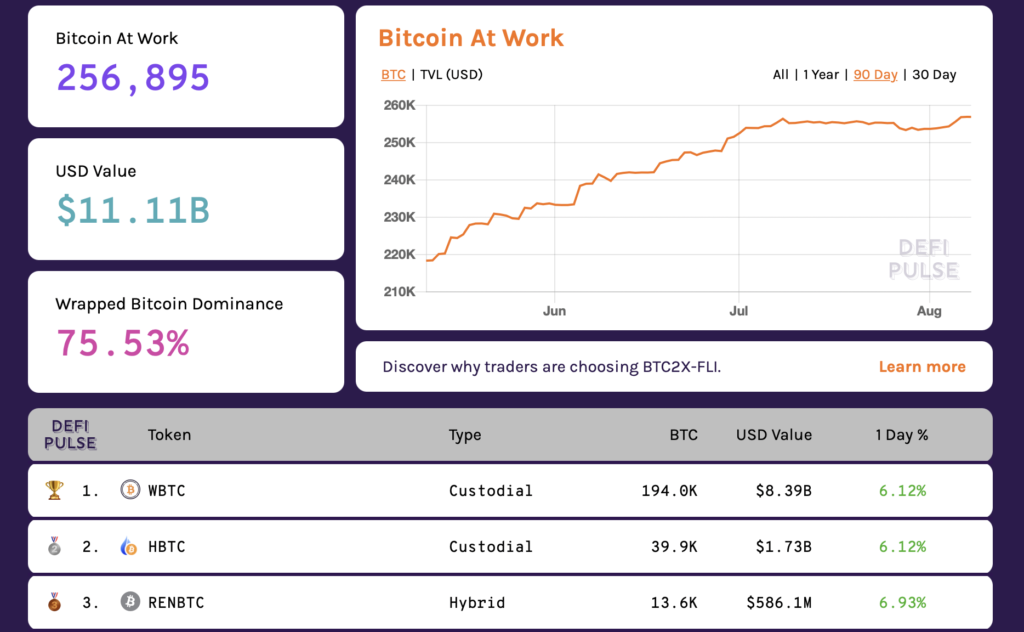
The total market value of tokenised bitcoins WBTC, HBTC, renBTC and others on Ethereum rose to $11.1 billion. Three weeks ago the indicator stood at $8.1 billion.


Trading volume on decentralized exchanges (DEX) over the last 30 days amounted to $61.3 billion.
66% of the total turnover of non-custodial exchanges is accounted for by Uniswap. The second-largest DEX by trading volume is SushiSwap (10.4%), the third is Curve (8.6%), the fourth is 0x Native (5.7%).
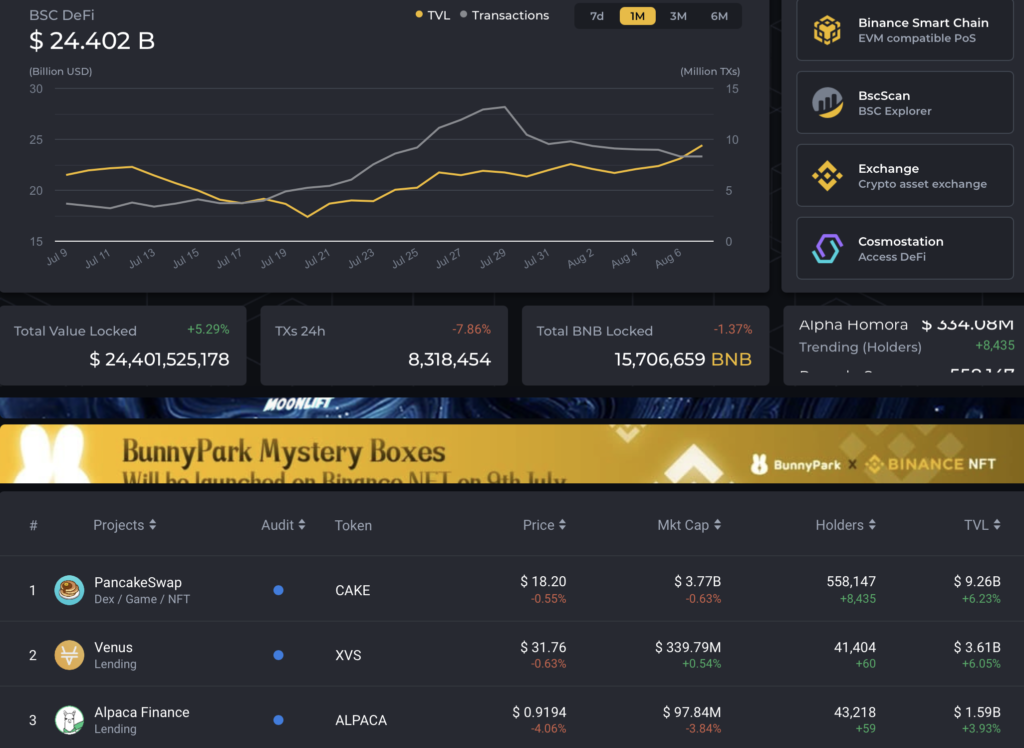
TVL on the Binance Smart Chain (BSC) rose to $24.4 billion, up 13% over the last 30 days.


Hester Peirce says DeFi projects require real decentralisation
Full decentralisation from launch is the only way for DeFi projects to avoid financial regulation. This view was expressed by SEC Commissioner Hester Peirce.
She noted that decentralised organisations and DeFi are new concepts for regulators. Systems without central intermediaries differ greatly from what regulators typically deal with, Peirce added.
“If you want to be decentralised, you truly need to be, and that will put you in a different category with regulators, because it is simply not what we have dealt with before,” the commissioner said.
She emphasised that if a regulator can identify an element of centralisation, it will seize upon it.
“Therefore, I think it’s prudent to be cautious in building your things, because in the future this may have regulatory consequences,” said the SEC representative.
In her view, existing rules are crafted so that all players involved in the financial sphere fall under one norms.
“If you want to prove that you are something other than centralized finance or traditional finance, then you must show that you do something radically different, and in my view that requires decentralisation,” Peirce says.
She also warned about the danger of “shadow centralisation” in the DeFi sector, where groups of developers or investors control a protocol through opaque governance.
MakerDAO founder announces full decentralisation of the DeFi platform
MakerDAO founder Rune Christensen announced that the DeFi platform has gone through a full development cycle and is now fully decentralised.
“With a few key elements approved to coordinate all activities within the framework of a decentralised autonomous organisation and a global community now responsible for every aspect of the Maker protocol, the DAO is now fully self-sustaining,” he wrote.
Christensen emphasised that the Maker Foundation has fulfilled its obligations to develop the project. In the coming months the organisation will be wound down.
Goldman Sachs files to launch ETF based on DeFi companies
Goldman Sachs filed with the SEC to launch an exchange-traded fund (ETF), whose basket will include shares of public companies in the DeFi sphere.
The document mentions the Goldman Sachs Innovate DeFi and Blockchain Equity ETF, but it is unclear which exact companies are tracked by the index.
The ETF will hold ordinary shares, including American depositary receipts, of companies listed on stock exchanges in developed and emerging markets worldwide. Goldman Sachs will invest in securities listed on exchanges in Australia, Canada, France, Germany, Hong Kong, Japan, South Korea, Switzerland, the Netherlands, the United Kingdom and the United States.
Founders of DeFi project settle with SEC for over $12 million
Founders of the DeFi Money Market project settled with the SEC. Gregory Kif and Derek Akri agreed to pay investors more than $12 million and pay fines of $125,000 each.
According to the press release, from February 2020 to February 2021 Kif and Akri offered unregistered securities to users of Money Market in the form of mTokens and DMG. The regulator says they sold assets worth more than $31 million.
Holders of mTokens were promised returns of up to 6.25%. DMG was positioned as governance tokens for the DeFi protocol.
The operators promised a guaranteed return by reinvesting client funds into “real-world assets.” Subsequently, mToken redemptions were backed by reserves of Blockchain Credit Partners, also owned by the defendants.
In February 2021, DeFi Money Market announced closure “due to regulatory issues.” Representatives noted that the issue of mTokens had ceased, but redemption remained possible.
The SEC said the DeFi Money Market case was the first precedent in which a regulator held a project in the DeFi space to account. Commissioner Peirce stressed that it was “decentralised only on paper.”
Investments in DeFi
The decentralised video platform Livepeer, built on the Ethereum blockchain, raised $20 million in a Series B round.
Led by Barry Silbert’s Digital Currency Group, with participants including Northzone, Coinbase Ventures, CoinFund, Animal Ventures and 6th Man Ventures.
The raised funds will go toward accelerating market entry, expanding technical capabilities and supporting other blockchains. Livepeer plans to grow its team from 18 to around 30 by year-end.
The startup Saber Labs, behind the cross-chain decentralized exchange for stablecoins and wrapped tokens, raised $7.7 million in a seed round. It was led by Race Capital.
Saber Labs also received backing from Social Capital, Jump Capital, Multicoin Capital and the Solana Foundation, as well as a number of angel investors, including Tristan Iver from FTX and Jason Lau of OKCoin.
Funds will be used to expand staffing and scale the platform on Solana.
Institutional infrastructure firm Fireblocks raised $310 million in a Series D round. Investors valued it at more than $2 billion.
Fireblocks was backed by heavyweight investors: Sequoia Capital, Stripes, Spark Capital, Coatue, DRW and SCB 10X — the venture arm of Thailand’s oldest bank, Siam Commercial Bank.
Raised funds will go toward preserving independence, developing the platform and building an “industry-standard backend for digital asset infrastructure for traditional financial institutions.”
Fireblocks first entered the DeFi space in early 2020, integrating its platform with Compound.
Hacks and scams
DeFi project Popsicle Finance was hacked, losing $20.7 million. The bug was found in the Sorbetto Fragola product, which allows users to place assets in the most profitable liquidity pools.
According to Popsicle Finance, the exploit drained 85% of the Sorbetto Fragola pools.
“The hacker forced the contract to believe it earned as much in fees as the total assets locked in the pool, and accordingly claimed $20.7 million that were in the pool,” the project said.
Subsequently, the hacker swapped the stolen coins for Ethereum on Uniswap and sent them to Tornado.Cash to launder the funds, Popsicle Finance asserts.
SushiSwap developer Mudit Gupta said the hack was complex, but the bug was simple. He estimates the attacker withdrew $25 million. Popsicle Finance offered the attacker $1 million “in any currency” for the return of funds.
On July 23, THORChain was hacked again for the second time in a month. The damage was estimated at around $8 million. On July 27 the team announced a suspension of operations after several hacks.
During the first attack, attackers managed to “trick” Bifrost, a service responsible for connecting nodes to blockchains and implementing witness transactions.
A few days later the protocol again came under attack. Using a special contract, the attacker forced THORChain’s Bifrost to accept fake assets, which were withdrawn as real ones.
There were also reports of another fraud method: hackers conducted an airdrop of UniH tokens to 76,000 Ethereum addresses. However, THORmaximalist’s Twitter account advised ignoring the tokens, as accepting them would enable the contract to drain the wallet when exchanging on Uniswap.
What to read next
Over the last three weeks, ForkLog published educational cards on the non-custodial PancakeSwap platform on BSC, the lending DeFi protocol Aave, and the MakerDAO smart-contract platform.
Also discover what Flash Loans are in DeFi protocols, what they are for and how to use this feature.
Also on ForkLog:
- The DeFi platform dYdX will release a governance token and distribute it among users.
- 1inch Foundation will distribute 10 million 1INCH as compensation for gas costs.
- BitMEX launched perpetual contracts on baskets of altcoins and DeFi tokens.
- Aave will launch the institutional DeFi platform Aave Arc.
- Opinion: DeFi does not fall under total regulation.
Read ForkLog’s Bitcoin news in our Telegram — cryptocurrency news, prices and analysis.