




The decentralized finance (DeFi) sector continues to attract heightened attention from cryptocurrency investors. ForkLog has collected the most important events and news from recent weeks in this digest.
Key DeFi metrics
Total value locked (TVL) in DeFi protocols rose to $165.51 billion. The first, fourth and sixth places are lending protocols Aave ($13.73 billion), Compound ($11.03 billion) and MakerDAO ($9.04 billion).


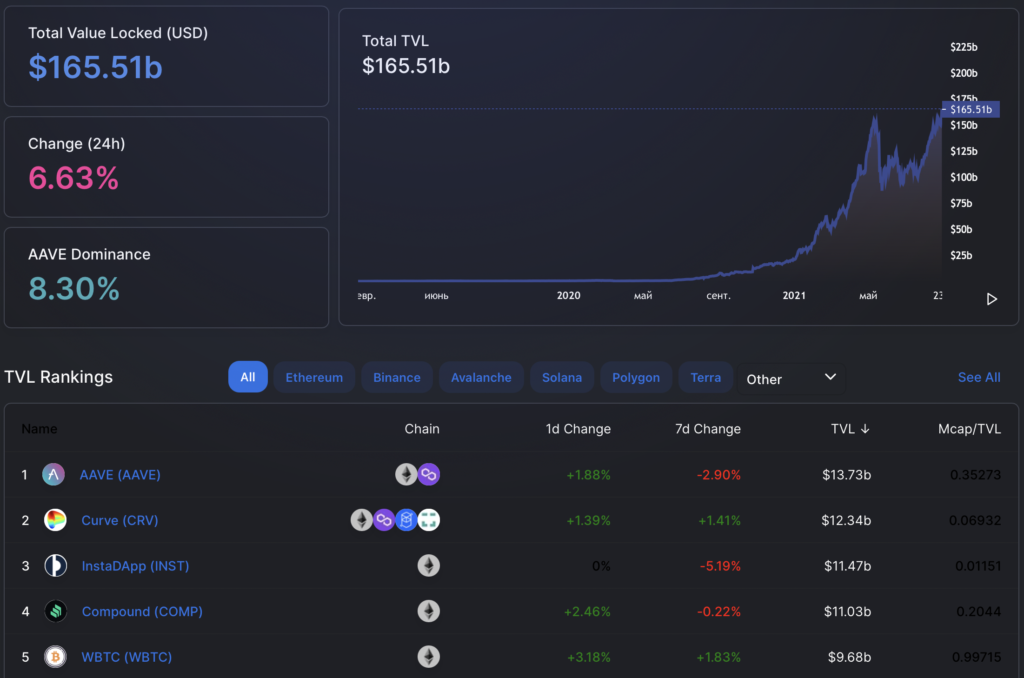
Defi Llama includes in the final value a group of tokenized Bitcoins. WBTC with $9.68 billion took fifth place. hBTC with $1.96 billion ranked 19th.
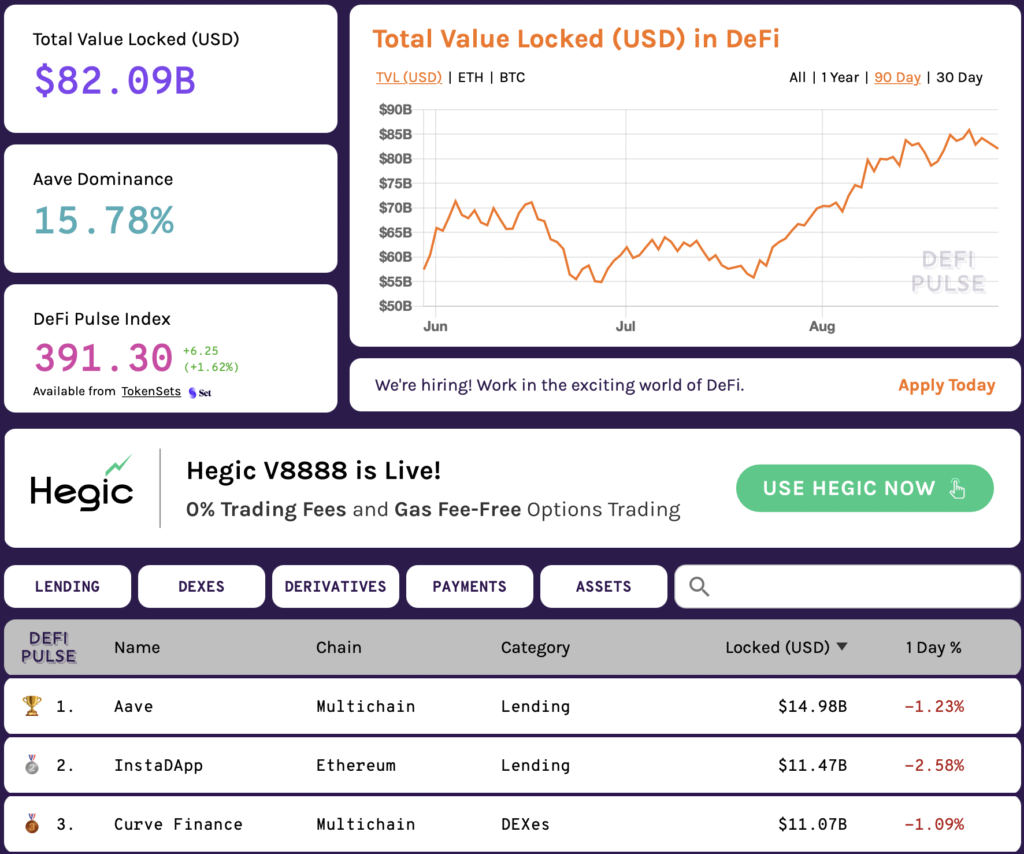
TVL in Ethereum applications rose to $82.09 billion. Over the last 30 days the figure grew by 23%.


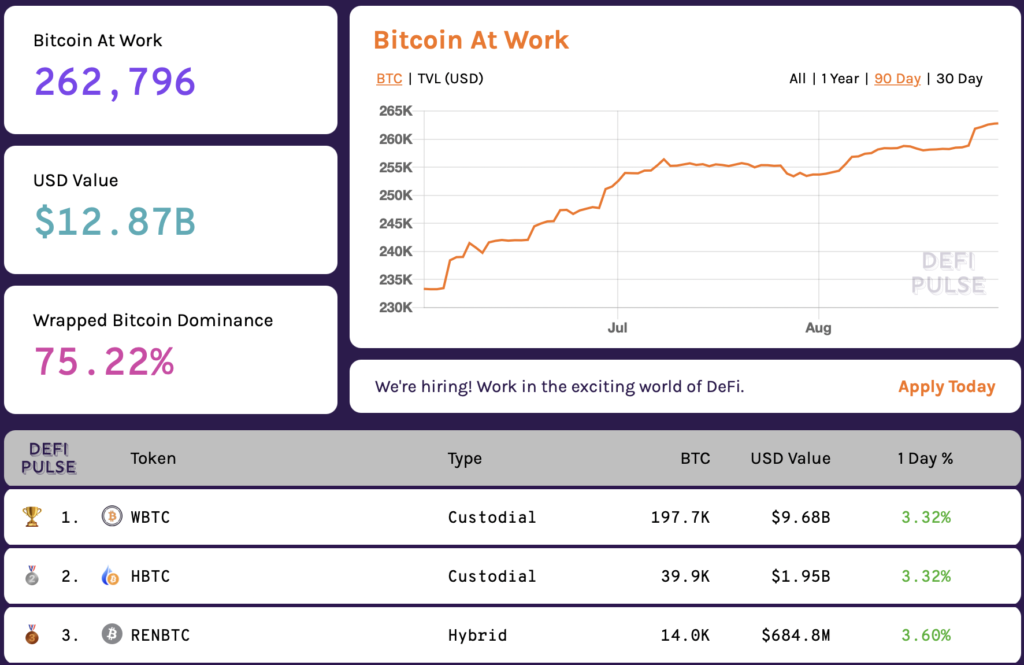
The total market value of tokenized Bitcoins WBTC, HBTC, renBTC and others on Ethereum rose to $12.87 billion. Three weeks ago the figure stood at $11.1 billion.


Trading volume on decentralized exchanges (DEX) over the last 30 days stood at $73.5 billion.
71.1% of the total non-custodial exchange turnover is accounted for by Uniswap. The second DEX by trading volume is SushiSwap (11.9%), the third Curve (5.6%).
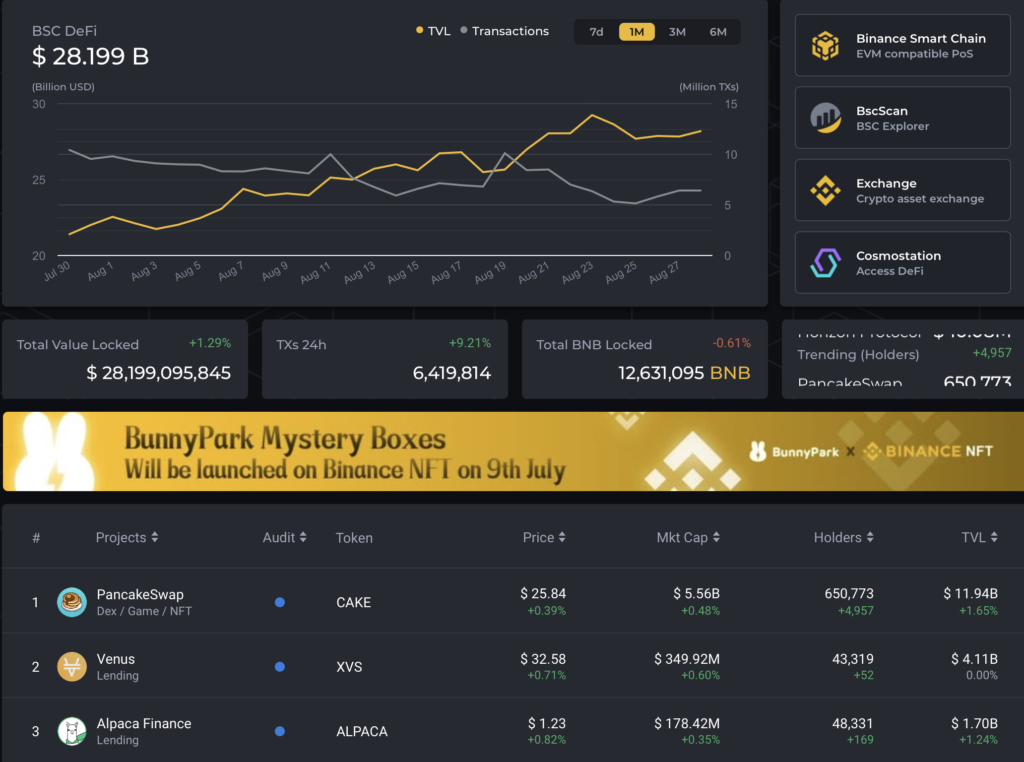
TVL of projects on Binance Smart Chain (BSC) rose to $28.2 billion, up 32% over the last 30 days.


Jack Dorsey to lead development of a decentralised Bitcoin exchange
Twitter head Jack Dorsey said he is working on an open TBD platform to build a DEX on the back of his payments company Square. Cash App head and TBD director Mike Brock said more details.
“We believe that Bitcoin will become the native Internet currency. While many projects are working on increasing the decentralisation of the Internet, our focus is solely on a robust global monetary system for all,” he wrote.
According to Brock, today Bitcoin is acquired through centralized services such as Cash App and Coinbase. He is confident that the platform has a number of drawbacks, and they are not distributed evenly around the world.
“This is a problem we will solve. … You can think of the project as a fiat-to-cryptocurrency decentralized exchange. As we have said, the platform will be fully public, with open source and protocol, with support for any wallet,” Brock emphasized.
He also added that there will be no organisation or governance model to control TBD.
Representatives of the non-custodial crypto platform Bisq proposed that Dorsey discuss a collaboration.
“We spent the last five years building Bisq v1 to become a peer-to-peer DEX for experienced Bitcoin users. Right now we are working on the second version,” the developers wrote.
Buterin proposes to move away from governance of DeFi projects via token voting
DeFi projects require decentralized governance, but token voting in its current form poses many threats to the sector’s development. This view was voiced by Vitalik Buterin.
He argued that either this form of governance needs to be improved or abandoned for other approaches.
He highlighted two main problems with token voting:
- inequality and misaligned incentives among governance-token holders;
- the possibility of direct attacks through various forms of vote-buying.
If the first already has several mitigations (for example, delegation), he does not see solutions to the second within the existing token-governance mechanisms.
In token voting he pointed out several drawbacks:
- the ability of “whales” to better serve their interests. Small token holders have little incentive to think about what they vote for;
- expansion of governance rights to other community groups;
- possible conflicts of interest among large voting blocs that may also hold tokens of other DeFi projects.
Nevertheless, he sees a number of hybrid approaches.
SEC to monitor DeFi transactions
The U.S. Securities and Exchange Commission (SEC) entered into an agreement with analytics company AnChain.AI to monitor and regulate the DeFi sector.
The initial contract is for $125,000. There are five separate annual options at $125,000 each, totaling $625,000.
“SEC is very interested in understanding what happens in the world of smart-contract-based digital assets. Therefore we are providing them with technologies for analysing and monitoring smart contracts,” explained AnChain.AI cofounder and CEO Victor Fang.
The AI/ML startup specializes in tracking illicit transactions on crypto exchanges, DeFi protocols and traditional financial institutions.
In many deals, coins may be securities, and trading platforms are becoming more complex, Fang noted.
In fact, Uniswap is a “mix of 30,000 individual smart contracts that carry out the actual token exchange,” he stressed.
Investments in DeFi
The Ondo Finance project, founded by former Goldman Sachs employees, raised $4 million in seed funding.
The round was led by Pantera Capital. Other investors include Genesis Trading, CMS Holdings, CoinFund, Divergence Ventures, as well as Aave founder Stani Kulechov and Quantstamp founder Rich Ma.
Ondo Finance enables Ethereum users to put crypto assets into Vaults, earning a fixed or variable yield.
Ondo Finance CEO Nathan Allmen said the raised funds would allow the project to expand staff, add support for various blockchains and yield strategies. The platform plans to launch its own token in the future.
The Avalanche Foundation created a $180 million fund to attract applications and assets from the DeFi sector into the network.
In a first phase dubbed Avalanche Rush, $30 million in AVAX tokens were allocated. They will be used for liquidity mining in three projects after their deployment — the lending platform Aave, the decentralized exchange Curve and strategy aggregator Stake DAO.
In the coming months the organization will announce the second phase of the program.
The Gemini cryptocurrency exchange run by the Winklevoss twins acquired the decentralized prediction platform Guesser. The company plans to broaden the use of the GUSD stablecoin and strengthen its DeFi ecosystem presence.
Hacks and scams
On August 10, an unknown hacker hacked the cross-chain protocol Poly Network and stole $611 million in various cryptocurrencies. The project team urged exchanges to block the stolen assets.
Initial estimates show the attacker stole $273 million in Ethereum, $253 million in Binance Smart Chain and $85 million in USDC on Polygon. Assets in WBTC, WETH, RenBTC, DAI, UNI, SHIB, FEI and others were affected. The hack was the largest in DeFi history.
After the theft, Tether blacklisted USDT on Ethereum, which had been stolen during the attack, for about $33 million.
Experts attributed the breach to a cryptographic issue — the hacker somehow forged a transaction signature to steal the funds.
As a result, the O3 trading pool, which uses Poly Network for token swaps, paused cross-chain functionality.
Slowmist blockchain-security specialists tracked down the attacker’s identifier. They say they learned the attacker’s email address, IP information and device fingerprint.
Experts also noted that to finance the attack the hacker swapped Monero for BNB, ETH, MATIC and other tokens. Slowmist said they obtained this information via partner Chinese crypto exchange Hoo and other trading platforms.
On August 11 the attacker returned 1,000 BTC, 26,629 ETH and 119,664,866 BUSD. The hacker added that he has already become a “legend” after carrying out the largest hack in DeFi history and the industry at large.
DeFi protocol Luna Yield on Solana suddenly stopped operating a few days after launch. The website and social networks were taken down, its developers withdrew around $8 million from the protocol.
The Luna Yield team conducted an IDO on the SolPAD platform on Monday, August 16. By Friday the platform announced that it had shut down social networks and website, and anonymous developers withdrew all liquidity from the protocol.
According to blockchain explorer Solscan, assets in WBTC, WETH, USDT and LUNY (Luna Yield’s native tokens) were moved to a Tornado Cash mixer address.
SolPAD said it would compensate investors up to 60% of the funds lost in the incident. To do so they are using assets from the Solpad Foundation reserve fund. Funds will be credited to addresses directly involved in the IDO.
SolPAD administration noted that immediately after the incident they tried to track the Luna Yield developers’ addresses and determine their IPs, but to no avail. The platform also provided all gathered information to “centralized exchanges and regulated institutions” that can block transactions with stolen assets.
Paradigm partner and cybersecurity expert Sam San explained how he identified and helped fix the vulnerability in the DeFi project SushiSwap. The bug threatened the loss of more than 109,000 ETH (about $350 million at the time).
The expert studied SushiSwap’s platform for issuing new tokens and raising funds via MISO (Minimal Initial SushiSwap Offering). It offers two types of auctions — batch and Dutch.
The bug drew attention to an issue during an attack on Opyn. Then the hacker withdrew around $371,000 of user funds from the DeFi project.
In the MISO case the vulnerability allowed refunding for every ETH sent beyond the limit. This meant that instead of rejecting the transaction, the contract would reimburse all funds.
The assets were stored in a live Dutch auction contract on MISO.
Sam San contacted the SushiSwap team and several external experts. The group devised three options to resolve the problem:
- leave everything unchanged, betting that no one will discover the bug;
- save the funds by withdrawing them via an exploit;
- complete the auction manually.
The group chose the last option.
At the same time, the problem was broader: MISO had an active batch auction worth $8 million that was also at risk. They decided not to do anything with it, as there was no way to force-terminate.
Also in ForkLog:
- Gary Gensler: DeFi decentralisation does not provide immunity from SEC oversight.
- DeFi project Opium Protocol launched a service for insurance of rental payments.
- Chainalysis: The DeFi sector has not yet reached mass adoption.
- Galaxy Digital launched a DeFi-focused index and fund.
- In a16z they revealed the principles of delegation of governance for DeFi protocols.
Read ForkLog’s Bitcoin news in our Telegram — cryptocurrency news, rates and analysis.