




The decentralised finance (DeFi) sector continues to command heightened attention from cryptocurrency investors. ForkLog has compiled the most important events and news of the past weeks into this digest.
Key DeFi metrics
Total value locked (TVL) across DeFi protocols rose to $241.04 billion. The leader remains Curve Finance ($19.14 billion). MakerDAO climbed to second place ($17.44 billion), while Aave ($14.93 billion) fell to third.


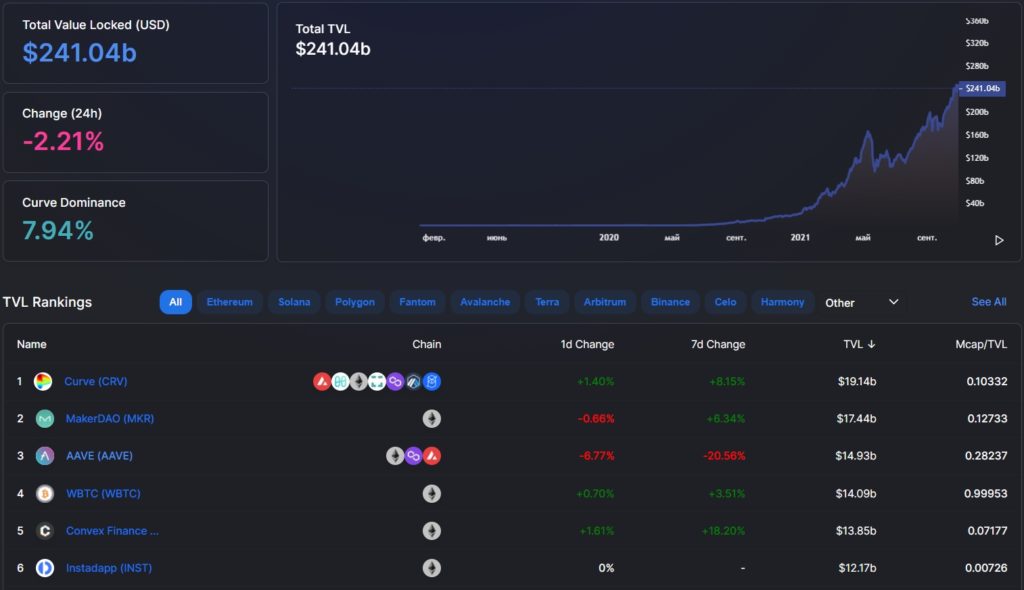
DeFi Llama includes in the final figure the group of tokenised Bitcoins. WBTC with a value of $14.09 billion ranked fourth. The aggregate value of “Bitcoin on Ethereum” stood at $18.22 billion.
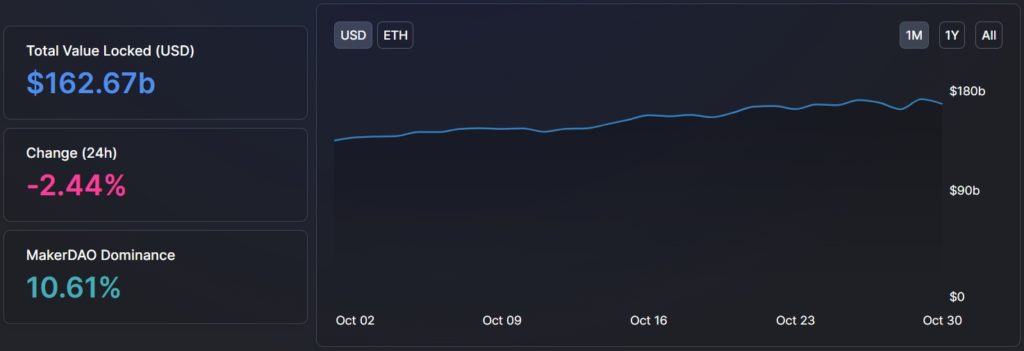
TVL in Ethereum applications rose to $162.67 billion. Over the last 30 days the metric rose 31% (as of 30 September it stood at $123.92 billion).


Trading volume on decentralised exchanges (DEX) over the last 30 days stood at $88.8 billion.
Uniswap continues to dominate the non-custodial exchange market — accounting for more than 66% of total turnover. The second DEX by trading volume is SushiSwap (15.9%), the third Curve (6.5%).
Justin Sun withdrew billions of dollars worth of liquidity from Aave pools
Tron founder Justin Sun withdrew a significant portion of liquidity from Aave’s DeFi pools. His actions led to higher interest rates. Sun may have taken this step amid a Twitter debate about a vulnerability in Aave.
According to the developer going by the pseudonym banteg, the vulnerability in Aave could have resulted in “an 11-digit loss.” He later clarified that the exploit was possible “for 160 days in the past, but not now.”
No evidence of the vulnerability has been published by any of the developers. After the discussion, the project’s founder Stani Kulechov urged the crypto community to stick together and support one another.
Gary Gensler reiterates the need for DeFi regulation
Head of the SEC stated that the innovativeness of the DeFi sector does not exempt it from regulation. He compared decentralised finance with P2P lending and stressed that financial stability and public safety are priorities.
Swiss crypto bank SEBA opens institutional access to DeFi and staking
The regulated FINMA cryptocurrency bank SEBA announced the launch of SEBA Earn. The service will allow institutional clients to earn yields from crypto lending, DeFi and staking of cryptocurrencies, including Cardano, Polkadot and Tezos.
Experts flag DeFi risks in FATF final guidance
On 28 October FATF published a revised and refined version of the guidance for the cryptocurrency industry. The organisation set standards for DeFi sectors and NFT.
In the view of experts, the document does not contain clear and narrow restrictions on supervisory functions. They also noted that developers may face challenges deploying DeFi protocols and noted that, in light of the recommendations, even an infrastructure plan looks better.
Investments in DeFi
The Chinese venture firm Sino Global Capital announced the launch of a $200 million fund. The capital will support startups in Solana and Ethereum ecosystems, including those related to DeFi— and NFT infrastructure.
The cryptocurrency trading bank Galaxy Digital and venture firms Multicoin Capital and Variant said they planned investments in crypto startups totaling $325 million, $250 million and $110 million respectively.
The France-based licensed prime broker SheeldMarket secured $10 million following an Series A round. The funds will be used to develop derivative financial instruments and to expand institutional-focused DeFi services akin to Aave Arc.
The multi-chain liquidity protocol Symbiosis Finance completed a seed round of $2 million, led by Blockchain.com Ventures.
The project will enable token swaps across major native DeFi networks, such as Ethereum, Binance Smart Chain, Polygon, Avalanche, as well as EVM-compatible networks and L2 solutions.
Hacks and scams
The decentralized protocol Cream Finance was hacked again. The damage from the attack was estimated at $130 million.
Analytical firm PeckShield said the attack was made possible by a bug that ‘allows borrowing all funds in the current lending pools.’ In collaboration with the developers of yearn.finance, the governance team identified and closed the vulnerability.
The attack vector involved the use of flash loans in complex transactions. Most of the stolen assets were liquidity provider tokens from Cream Finance and other ERC-20 coins.
The DeFi protocol PancakeHunny was also attacked using a flash loan. The project lost 388 BNB and 1.7 million TUSD (about $1.9 million at the time).
The developers reassured that all user funds are safe, and the exploit affected only the price of the HUNNY token. They noted that the hacker created a smart contract for the HUNNY TUSD storage exploit, which was subsequently executed 26 times.
Unknown withdrew from liquidity pools assets worth about $16 million from Indexed Finance. The developers said the hacker exploited a vulnerability in the rebalancing mechanism.
The administration called the incident ‘devastating’ for the project and said it knows how to close the vulnerability. It was also offered help by ‘esteemed Ethereum developers’.
The day after the incident, the Indexed Finance team said it had managed to identify the attacker. They issued an ultimatum — to return the assets within 24 hours or, they said, they would involve law enforcement.
The hacker did not return the funds in time, but the Indexed Finance team did not follow through on their threats. The developers explained that changes they made to the attacker’s account indicated that he was much younger than they had thought.
Also on ForkLog:
- Financial Hardcore: what is the future of decentralised options.
- A Safe Harbour in the Turbulent Seas of DeFi: how fixed-rate lending protocols are evolving.
- Analyst at Divergence Ventures earned $2.4 million through Ribbon airdrop exploit.
Read ForkLog’s Bitcoin news on our Telegram — cryptocurrency news, prices and analytics.