




The decentralised finance (DeFi) sector continues to attract heightened attention from cryptocurrency investors. ForkLog has compiled the most important events and news of the past weeks into this digest.
Key metrics for the DeFi segment
Total value locked (TVL) across DeFi protocols remained unchanged at $198 billion. Curve Finance remains the leader with $17.68 billion. MakerDAO ($15.07 billion) ranked second, Lido ($13.7 billion) third.


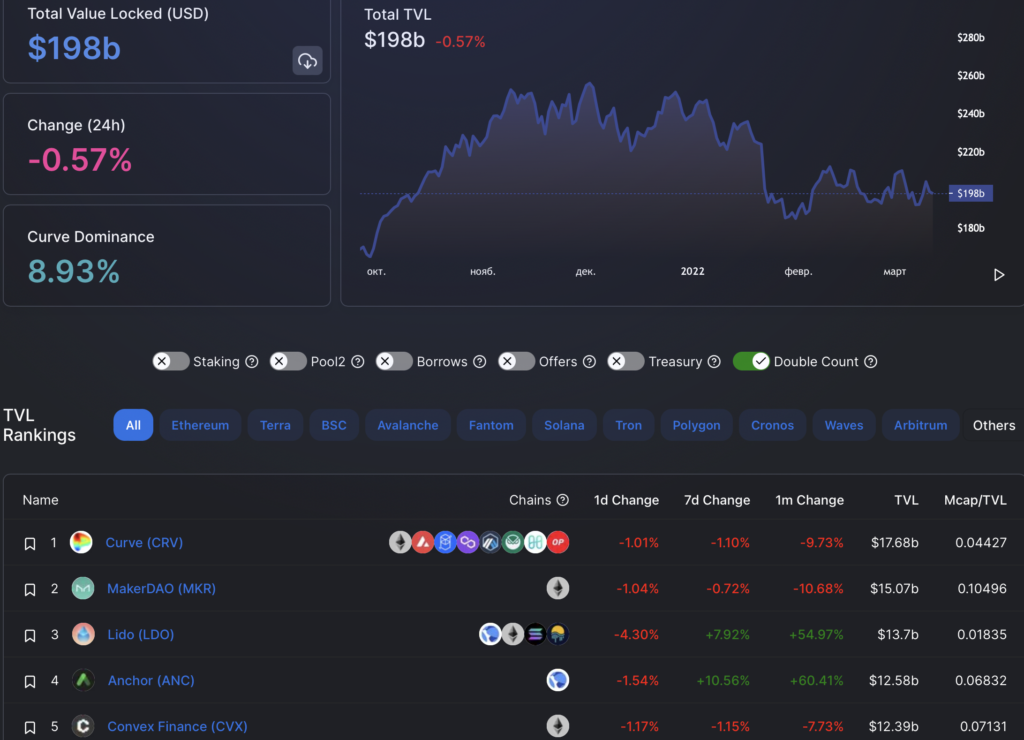
DeFi Llama includes in its aggregate figure a group of tokenised bitcoins. WBTC at $10.61 billion ranked seventh. hBTC at $1.55 billion placed twentieth. The aggregate value of “Bitcoin on Ethereum” stood at $13.29 billion.
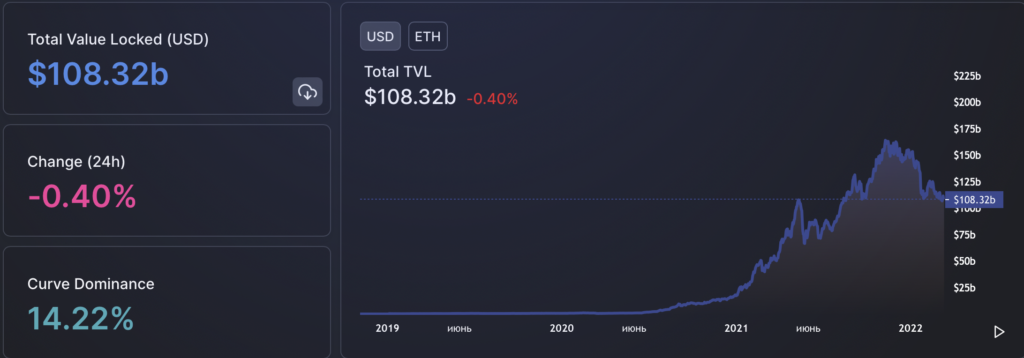
TVL in Ethereum applications declined to $108.32 billion. Over the last 30 days the figure fell by 7% (19 February the value was $116.41 billion).


Trading volume on decentralised exchanges (DEX) over the last 30 days amounted to $72.7 billion.
Uniswap continues to dominate the non-custodial exchanges market — it accounts for 76.5% of total turnover. The second DEX by trading volume is Curve (7.2%).
1inch Network introduced the P2P orders feature
The DeFi project 1inch Network introduced the P2P orders feature, which enables direct peer-to-peer exchange of digital assets between users.
“The P2P order will be useful in situations where liquidity for a given token is insufficient for a large off-exchange trade, and a swap on the market would entail significant slippage. The same applies to tokens that are not yet trading on the market, for example, those in the presale stage,” the statement said.
The P2P order system is based on the 1inch Limit Order Protocol. The feature is available across all networks supported by the project.
The team noted that the main advantages of this method of exchange are complete decentralisation and a guarantee of execution by the smart contract. 1inch does not store trade data on servers—everything remains in users’ web browsers. Data is transmitted only as links.
Uniswap community proposes to deploy the protocol on the Celo network
Uniswap community proposed launching Uniswap v3 on the Celo network.
The proposal was created by the student group Blockchain at Michigan in collaboration with the Celo Climate initiative and the non-profit Celo Foundation.
As part of the partnership, the latter intends to launch a $10 million-user incentive program for Uniswap, as well as provide the exchange with additional financial support in the future.
Deploying Uniswap V3 on the network would involve creating liquidity pools for “green assets” from Celo, such as tokenised carbon credits.
The collaboration is intended to spur future eco-friendly use cases for the exchange, the proposal authors noted.
At the time of writing, support for the proposal had been voiced by holders of nearly 9 million UNI governance tokens, with almost no objections. The vote is due to close on March 13.
RUNE price rises 50% on THORChain synthetic assets launch
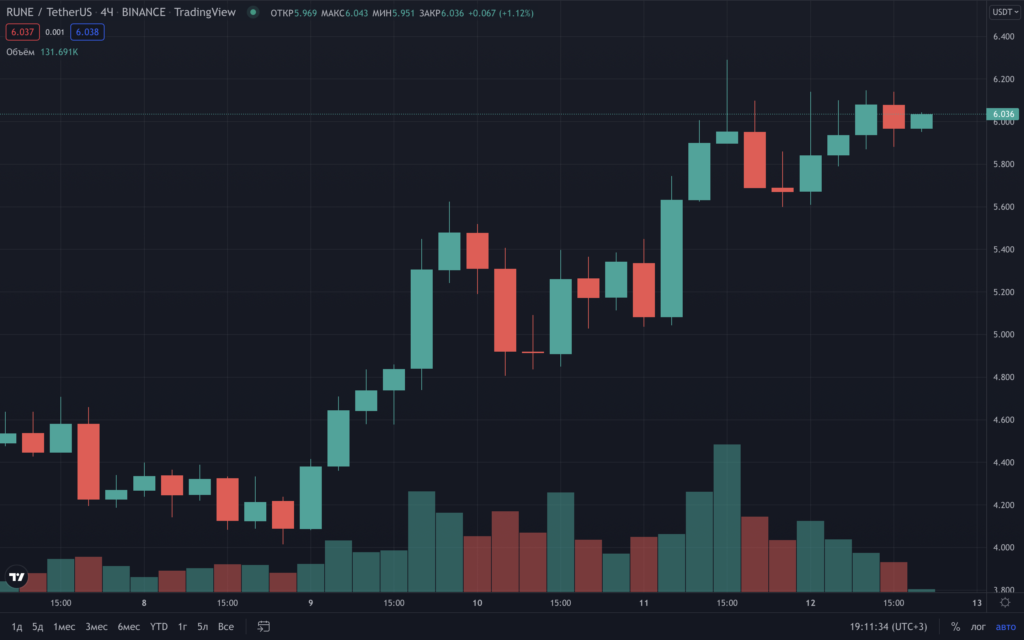
In the wake of the activation of synthetic-asset pools, the native token price of cross-chain protocol THORChain (RUNE) rose by 50%.
As of writing, it was trading at around $6.


Synthetic assets — ‘synths’ — are tokens backed by collateral, whose price is derived from the value of other tokens. In THORChain, collateral pools are maintained in equal parts of base cryptocurrencies and RUNE.
THORChain lead developer Chad Barraford explained that this approach improves network security and resilience.
According to him, synths halve the trading fees and enable ‘almost instant trades’ at lower gas costs. He also noted that by using such assets liquidity providers can earn revenue on a larger amount than they contributed to the pool.
DeFi investments
The Zebec team, a real-time settlement protocol built on Solana closed a $15 million Series A round.
It was led by Solana Ventures and Distributed Global with participation from Coinbase Ventures, Alameda Research, Circle and Lightspeed.
The funds will be used to further scale the protocol. Its aim is to simplify sending and receiving payments on a continuous basis.
Zebec Payroll enables employees to automatically convert portions of their earnings into digital currencies, allocate to crypto pension schemes, invest in DeFi protocols, and withdraw to fiat on bank accounts with no fees.
The team behind the DeFi social trading platform Nested closed a $7.5 million Series A round.
It was led by Brevan Howard founder Alan Howard with participation from CMT Digital, Kenetic Capital, Republic Capital and others.
The funding will be used to expand the number of supported blockchains and the platform’s functionality.
Nested enables users to showcase investment portfolios via social networks as NFTs or send them as gifts or rewards.
The Singapore-based crypto fintech platform Cake DeFi created a venture arm with $100 million in capital.
Cake DeFi Ventures (CDV) will focus on investments in Web 3.0, metaverses, NFT, gaming and fintech startups.
They will be led by Cake DeFi CEO Julian Hosf and CTO Yu Jin Chua.
The firm positions itself as a provider of a decentralised financial platform where users can buy and sell cryptocurrencies, participate in staking and lending, among other services.
Read ForkLog’s Bitcoin news in our Telegram — cryptocurrency news, rates and analytics.