



The decentralized finance (DeFi) sector continues its rapid growth. We have gathered the most important news from the past three weeks into one piece.
Value of Locked Assets, Market Capitalization and DEX Volumes
In recent months, the value of tokens locked in DeFi protocols has surged. On September 2 the figure reached $9.6 billion.
A subsequent correction in the crypto market dragged DeFi project tokens lower. The average price drawdown for most of such coins stood at 46%.
DeFi tokens averaged 50% drawdown to start September. Have now rebounded 35% since but still down ~30% from Sept 1.$LRC up, $YFI & $LEND down <10% since Sept 1.$CRV, $MTA, $SUSHI down >50% since Sept 1. pic.twitter.com/IkML1ZZuZo
— Ceteris Paribus (@ceterispar1bus) September 11, 2020
After the correction, the market recovered somewhat, but the total value of locked tokens remains far below peak levels — $7.84 billion at the time of writing.


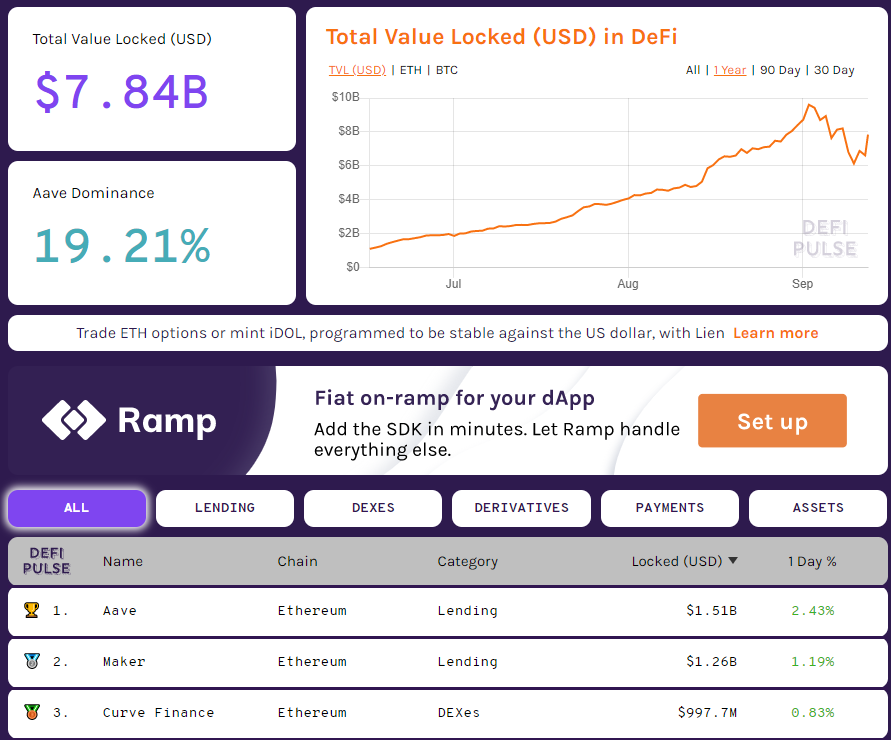
Data from DeFi Pulse is unlikely to be 100% objective, as SushiSwap is not listed in the rating. According to Zippo.io, the total value locked in this application amounts to $1.3 billion.
The aggregate market capitalization of DeFi tokens stands at $16.4 billion.


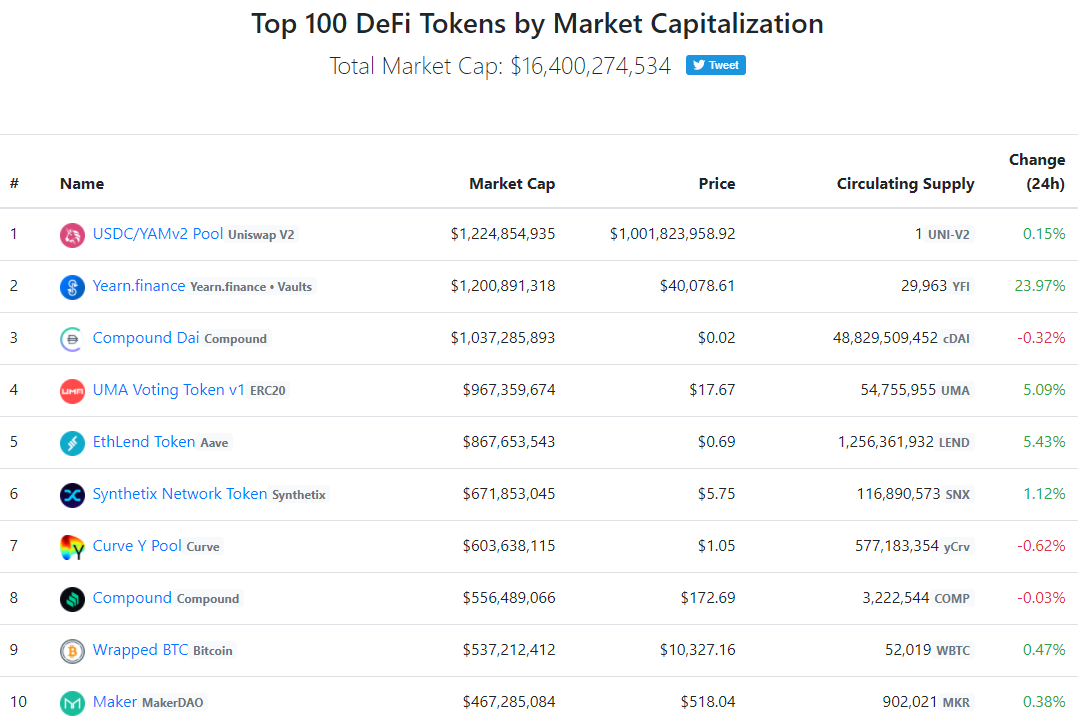
According to CoinGecko, which uses a different methodology, the total market capitalization of DeFi tokens stands at $15.6 billion.
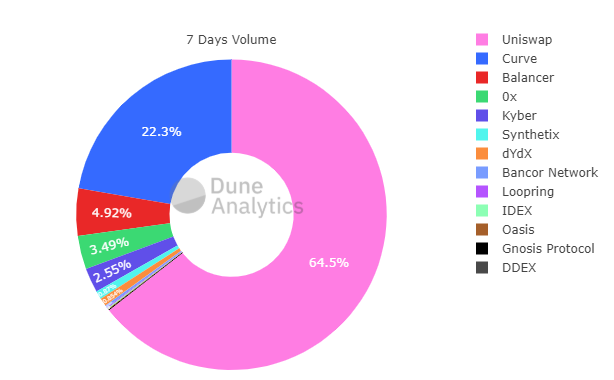
Total daily trading volume on decentralized exchanges (DEX) reached $532 million, according to Dune Analytics. Uniswap leads this segment with a market share of 64.5%.


Activity in the DeFi and DEX segments pushed transaction fees to new highs.


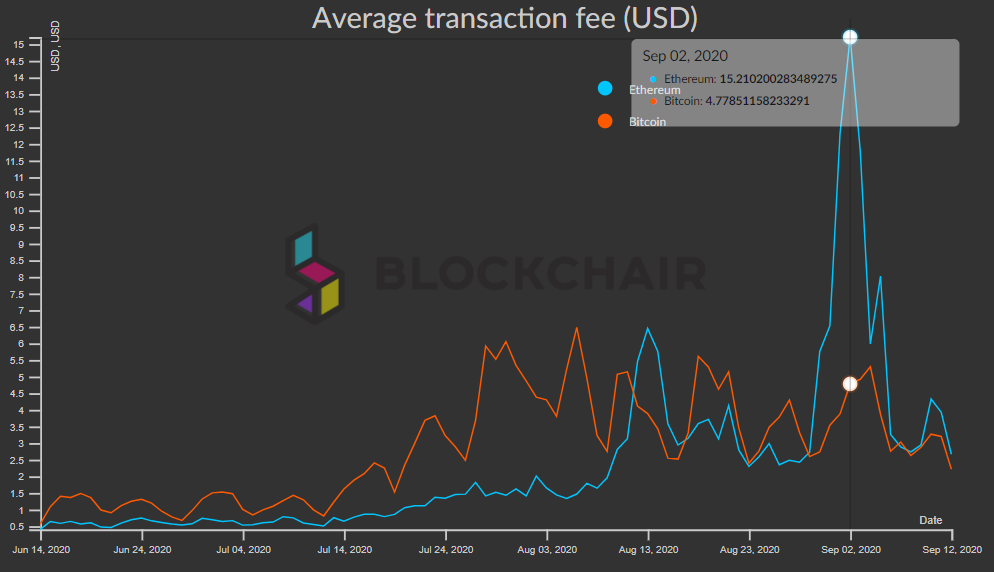
On September 2 the average Ethereum transaction fee exceeded $15. However, following the market correction, the figure fell almost sixfold to $2.66.
Latest News
The SushiSwap project has drawn the crypto community’s attention
Three days after SushiSwap launched, the amount of funds locked in the protocol surpassed $800 million. The project bills itself as the “evolution of Uniswap,” distributing the SUSHI token to liquidity providers.
Driven by the SushiSwap hype and profitable farming in general, the non-custodial exchange Uniswap rose to the top of the DeFi Pulse rankings. The platform did not rest on its laurels for long — after assets migrated to SushiSwap, the volume of frozen funds fell by 75.8% in a single day.
On September 6, the SushiSwap administrator “Chef Nomi” transferred control of SushiSwap to the exchange founder Sam Bankman-Fried. The day before, the administrator sold half of the developers’ fund assets worth $27 million in SUSHI tokens and drove the coin price down.
Thereafter several investors of SushiSwap threatened a class-action lawsuit against “Chef Nomi.” Yet after a few days the latter returned to the developers’ fund 38,000 ETH (about $14 million at the time), apologising for his decision.
Analysts at the Quantstamp startup, following the SushiSwap audit, identified ten non-critical vulnerabilities in the code. Later, developer Chong Sok Park discovered a bug that preserves voting rights for token holders even after transfer.
Several projects attempted to replicate SushiSwap’s success, but their token prices soon collapsed to near zero.
The yEarn token price surges to $40,000 amid Coinbase listing announcement
The market cap of the DeFi platform yEarn Finance (YFI) accelerated its rise after the announcement of its listing on Coinbase, the largest U.S. exchange.
Today, September 12, the price touched $41,000. At the time of writing the asset was trading around $39,100.


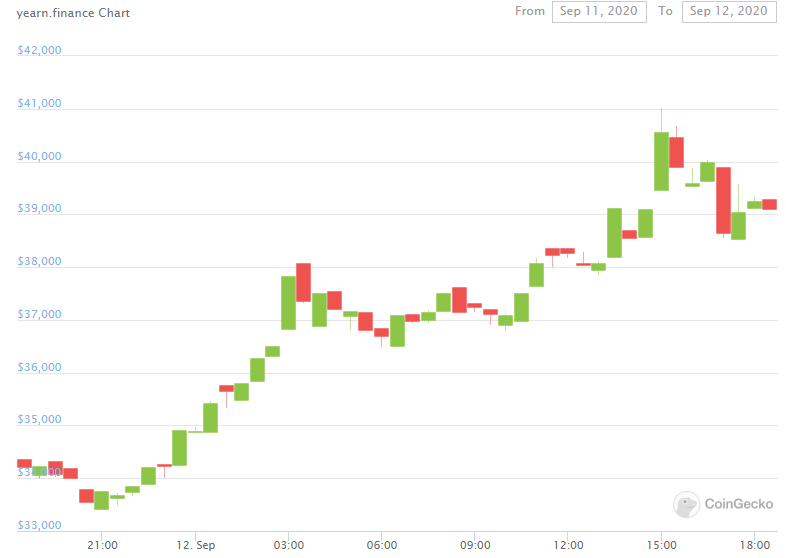
Trading in the YFI/USD pair is planned to commence on September 15, subject to sufficient liquidity.
The yEarn Finance developers are not stopping there and will launch a lending protocol called StableCredit, using stablecoins and an automated market maker mechanism.
How to turn $200 into $250,000? Use a bug in a DeFi protocol
Thanks to a bug in the Soft Yearn DeFi protocol, an anonymous user turned 0.5 ETH into 740 ETH.
User going by the handle Amplify said he exploited a data-synchronisation bug between Soft Yearn and Uniswap. The trader sold two SYFI tokens at the old price, exhausting all available liquidity in the pool.
Amplify stressed that there was no ill intent or desire to harm anyone.
Within 24 hours, the SYFI price collapsed from $150 to near-zero levels.
In the DeFi segment, scams have grown more frequent
The organizers of the liquidity mining pool Yfdexf.Finance disappeared with $20 million of user funds.
Yfdexf ran an active two-day campaign across platforms, including Twitter and Telegram, promising prize draws for retweets and hashtags. After the exit-scam, the project’s website stopped operating, social-media accounts used to lure investors were deleted. Yfdexf did not fulfil promises to pay for promotional campaigns.
Shortly before this, news emerged of a suspected DeFi scam EMD based on EOS.
According to available information, from the contract “emeraldmine1” $780,000 USDT, 490,000 EOS and 56,000 DFS were withdrawn. Funds totaling $2.5 million were deposited to the account “sji111111111”. Subsequently, 121,000 EOS were moved to the ChangeNOW exchange.
Whales have taken to DeFi tokens
Some DeFi tokens have become popular among OTC participants and centralized exchanges.
A head of a centralized platform reported a twofold rise in DeFi token trading volumes in July–August.
Among traders, the most popular tokens are Synthetix (SNX), Compound (COMP) and yEarn Finance (YFI). Since the start of the year, trading volumes of these coins have risen eightfold.
Tron enters strategic partnership with 1inch
The Tron blockchain entered into a strategic partnership with 1inch, a liquidity aggregator from decentralized exchanges (DEX).
JustSwap DEX, launched on the Tron blockchain, will be integrated with 1inch. Mooniswap, the AMM developed by the aggregator, will add Tron support.
Mooniswap integration on the Tron blockchain will allow users to swap a range of tokens at precise prices with a wide range of options, and liquidity providers will earn profits otherwise captured by arbitrageurs, the statement said.
Tron plans to reward liquidity providers on Mooniswap with the network’s native tokens as an additional incentive.
Acala and Perpetual Protocol DeFi projects attracted nearly $9 million
The DeFi protocol Acala on Polkadot raised $7 million through SAFT sales in a Series A round. Investors include Pantera Capital, Digital Currency Group, 1confirmation, Arrington XRP Capital and Polychain Capital.
The Acala team has focused on developing various DeFi products, including the decentralized stablecoin aUSD, a non-custodial exchange and a staking derivative contract. The project also issued the Acala Network Token (ACA). The Acala model bears similarities to MakerDAO.
The Acala creators say their Polkadot-based parachain will remove the need to choose between staking yield and DeFi lock-up rewards.
Recently raised $1.8 million for the DeFi protocol Perpetual Protocol. The funding round was led by Multicoin Capital.
The project positions itself as a “combination of Uniswap and BitMEX”. At the core of Perpetual Protocol lies a virtual automated market maker (vAMM).
As the name suggests, Perpetual Protocol focuses on perpetual contracts. Its differentiation lies in the vAMM.
“vAMM implies that there is no real asset inside the protocol. The real asset is stored in a custody of smart contracts that manages all collateral backing the vAMM. This helps support trading with borrowed funds”, said Perpetual Protocol founder Enyen Feng.
Also read:
- Crypto.com launched a fork of the Uniswap DeFi protocol.
- Binance announced plans to connect CeFi and DeFi ecosystems.
- Huobi Global launched a DeFi Liquidity Mining staking program.
- A new alliance plans to unite eastern and western DeFi markets.
- OKEx CEO: many people will lose money in DeFi.
- Chainlink to expand oracle capabilities for DeFi.
- Ethereum founder compared DeFi project activity to the Fed’s printing press.
Sign up for ForkLog news on Telegram: ForkLog FEED — full feed, ForkLog — the most important news and polls.