




The explosive growth of the decentralized-finance (DeFi) sector is drawing heightened attention. Read about the most important events of the past few weeks in ForkLog’s special report.
Capitalisation, DEX volumes and the value of locked assets
According to DeFiMarketCap, at the time of writing the market capitalisation of DeFi tokens stood at $7.288 billion.


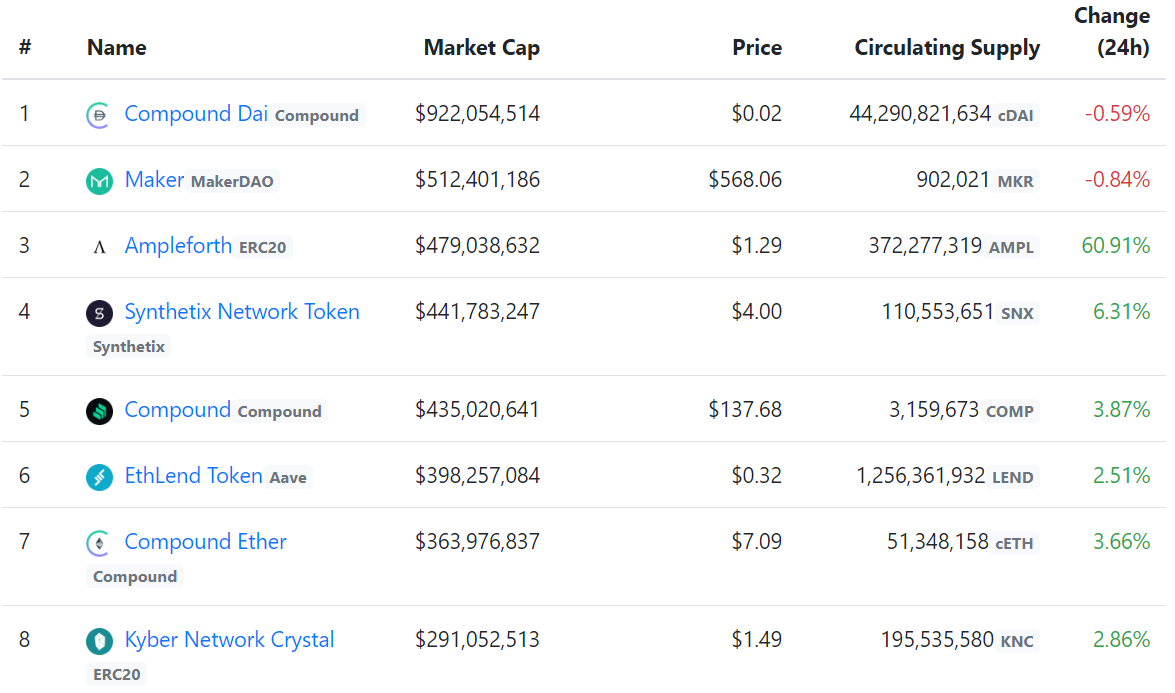
According to CoinGecko, the aggregate market capitalisation of the 100 largest DeFi tokens has already surpassed $8 billion. The discrepancy arises because each service applies its own rules for including a token among DeFi assets.
CoinGecko’s figure includes Chainlink, whose market capitalisation is just under $3 billion. DeFiMarketCap does not include Chainlink but accounts for many other tokens, resulting in an overall market capitalisation of 1,111 assets of about $7.3 billion.
Total value locked in DeFi services has surpassed $4 billion. The most popular asset remains Maker, whose dominance index is over 30%.

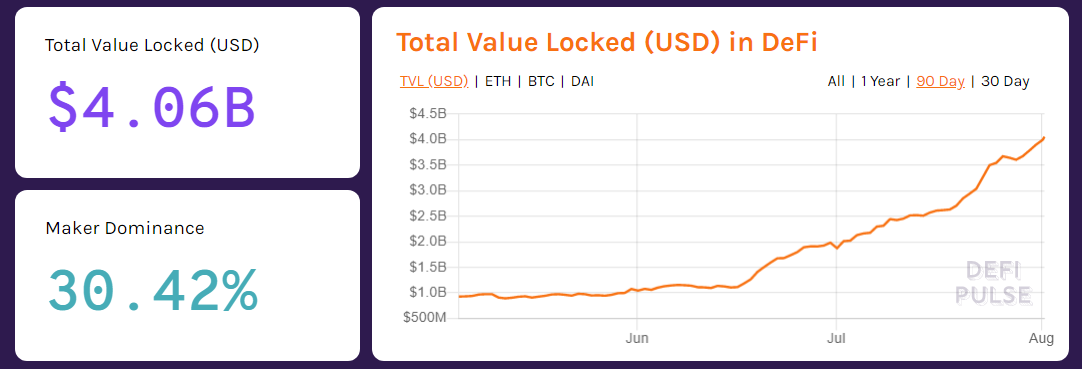

Source: DeFiPulse
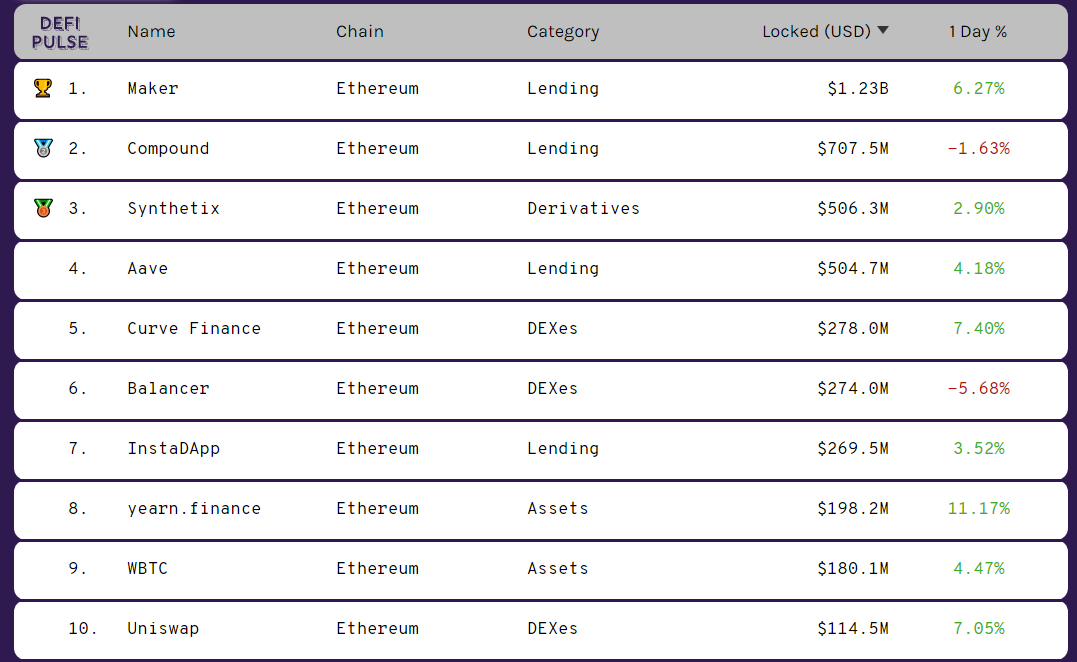
According to the latest data, Maker accounts for $1.23 billion of all funds held in Ethereum-based smart contracts, protocols and decentralised applications.


ETH price: $356.95 (+5.84% in 7 days).
Gas crisis in DeFi
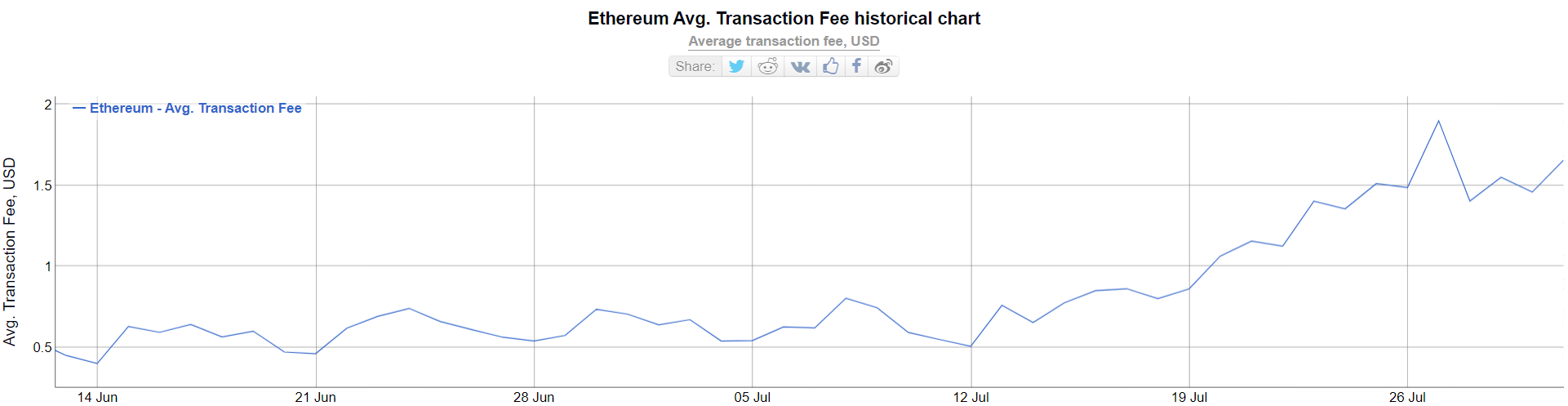
In recent weeks, using the Ethereum network for small transactions has become noticeably problematical. The average transaction fee rose from 8 Gwei in May to 66 Gwei by the end of July. As a result of the ETH price rally, the average size of last month’s fees rose by 280% — from $0.50 to $1.90.
GasToken price has surged by 4,000% as it enables discounts on certain on-chain transactions. The gas-cost situation is likely to worsen further ahead of EIP-1559, which changes how transaction fees are calculated.


Latest news
Celsius Network raised $18.8 million
The Celsius Network lending platform closed a financing round of $18.8 million. Accredited and retail U.S. investors could participate in the round. The minimum investment for purchasing shares was $1,000.
The Celsius stock offering was conducted via the online fundraising platform BnkToTheFuture. The round’s initial goal was to raise $17 million.
In an interview with ForkLog, Celsius Network founder and CEO Alex Mashinsky said that at this stage the DeFi sector needs help from traditional systems. He also notes that Celsius Network uses the “secrets of the rich” to generate profits, but 80-90% of these profits are returned to depositors.
Compound added WBTC support
Token holders of the Compound protocol approved using Wrapped Bitcoin (WBTC) as collateral. The initiative to add WBTC came from Alameda Research, the crypto-derivatives exchange affiliate. It was supported by Compound founder Robert Leshner and Gauntlet Network. As a result, their COMP tokens outnumbered those of opponents such as Polychain Capital, Dharma and others.
As a result, users can borrow up to 40% of the value of the pledged WBTC. By comparison, the analogous figure for DAI, USDC and ETH stands at 75%. Alameda is pushing to further raise the parameter to 65%. The value of BTC locked in WBTC stands at $180 million today.
Also read:
- Loan volume issued through Compound surpassed $1 billion.
- Study: Compound tokens are mainly used for speculation.
- Aave displaced Compound from the No. 2 spot in the DeFi rankings.
Aave developers raised $3 million
Aave’s lending protocol raised $3 million through the sale of LEND tokens to Framework Ventures and Three Arrows Capital. Investors bought about 30 million LEND tokens at $0.10 each. The funds will be used to further develop global decentralised money markets.
Both investors backed the drive to increase decentralisation. As part of a change in the economic model, there was a move from LEND to AAVE tokens with a 25% increase in the supply. This is intended to bolster the protocol’s security and the liquidity-mining program planned to launch with Balancer.
Investors will also participate in creating an insurance fund to be used in potential liquidity shortfalls. It will be based on the Balancer protocol and will be 80% represented by AAVE and 20% – ETH.
Circle and Genesis to develop DeFi products based on USDC
Genesis Global Capital, the lending arm of Digital Currency Group, and Circle will join forces to create DeFi protocols built on the USD Coin (USDC). Digital Currency Group will commit $25 million as strategic investments in Circle to accelerate USDC adoption.
The collaboration aims to deliver solutions for businesses and developers. It will be based on both earning interest on USDC provided as collateral and lending in USDC to businesses and merchants. The latter use the stablecoin for treasury operations and business payments.
Synthetix moved to a decentralised governance model
The leading platform for decentralized derivatives, Synthetix has transitioned to a decentralised governance model. The project’s foundation will be dissolved. Governance will instead pass to three decentralised autonomous organisations (DAOs):
- ProtocolDAO — oversees updates and configuration of the protocol;
- grantsDAO — responsible for funding various initiatives;
- synthetixDAO — oversees settlements with platform participants.
Launch of the yEarn Finance project
yEarn Finance has attracted considerable attention, issuing the YFI token. Unlike MakerDAO and Compound, yEarn Finance does not have a foundation or venture capital backing its development. The project did not conduct a presale, and governance is by YFI holders who receive the token in exchange for providing liquidity.
In just a few days the project raised several hundred million dollars in liquidity, and its capped supply (30,000 YFI) and its community-only distribution drove demand. As a result, the price of YFI surged from $34 to well over $4,500 by the end of July.


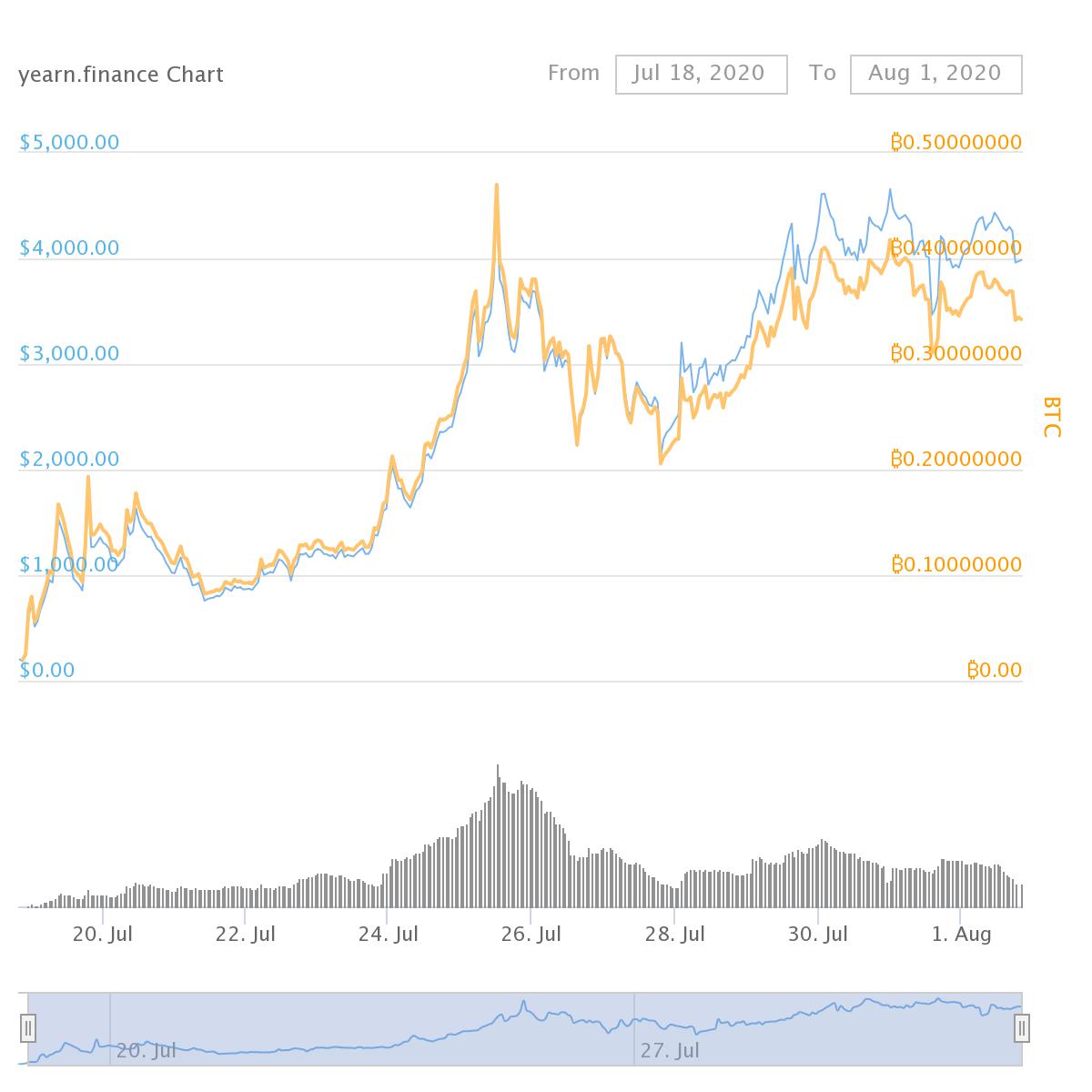
yEarn Finance is a lending aggregator, offering its depositors a search for the best rates on the market. The project’s data are used by Curve.fi to optimise the yields for its liquidity providers.
In the near term a new version of the product aimed at aggregating the best liquidity-mining offers is planned. Other assets besides stablecoins will also be usable as collateral.
Conclusion
In ForkLog’s commentary, Zerion co-founder Vadim Koleoshkin noted that over the last 30 days most DeFi assets have posted double-digit returns. One reason he cites is that many tokens have entered the market via Uniswap or Balancer listings, where liquidity constraints push prices higher.
He believes that if market sentiment remains positive and BTC and ETH continue to rise, DeFi projects will scale their volumes. He also expects several leveraged-futures trading projects to launch, which could spur volatility across the market.
“In the coming months there will be a further influx of DeFi tokens, and existing projects will begin to pivot toward this sector. And, apart from the current cost of transactions, DeFi already offers more convenient trading opportunities than centralised exchanges,” said Vadim Koleoshkin.
He notes that price rallies in DeFi could prove even riskier than ICOs, but as long as new projects enter the market there are no clear reasons to slow trading activity. In terms of volumes, DeFi remains far behind centralised exchanges.
Follow ForkLog news on Telegram: ForkLog FEED — all the latest news, ForkLog — the most important news and polls.