




The decentralized finance (DeFi) sector continues to attract heightened attention from cryptocurrency investors. ForkLog has compiled the most important events and news of recent weeks into this digest.
Key metrics of the DeFi segment
The total value locked (TVL) in DeFi protocols has reached nearly $92 billion. The first, third and fourth places are held by lending protocols Compound ($9.49 billion), MakerDAO ($8.04 billion) and Aave ($6.23 billion).


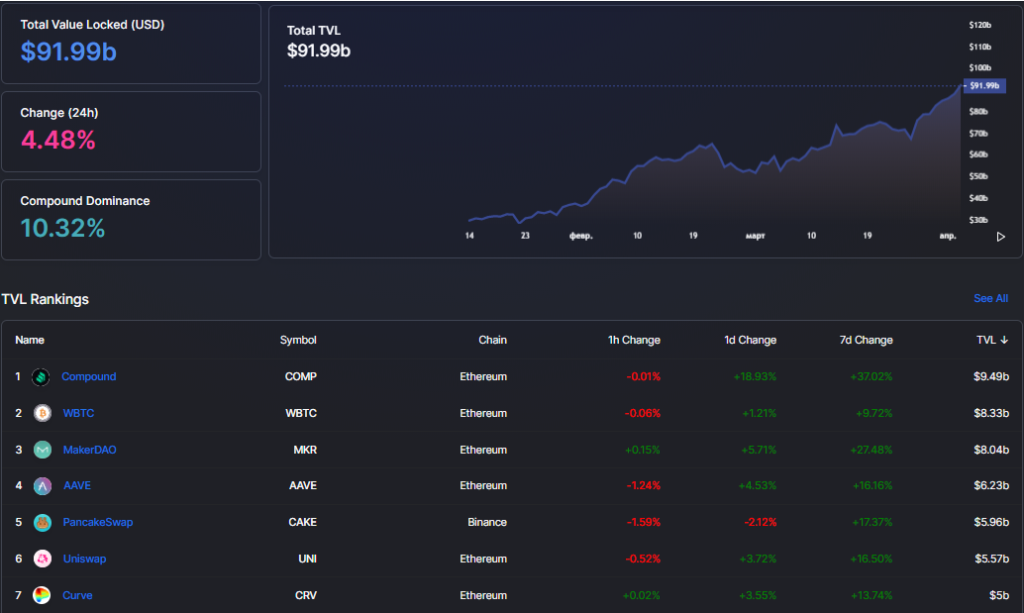
Defi Llama includes in the final value a group of tokenized bitcoins. WBTC with a value of $8.33 billion ranked second. hBTC with $1.65 billion placed 17th, renBTC with $925.3 million — 23rd.
Rounds out the top five is the PancakeSwap platform on Binance Smart Chain (BSC) with a TVL of $5.96 billion.
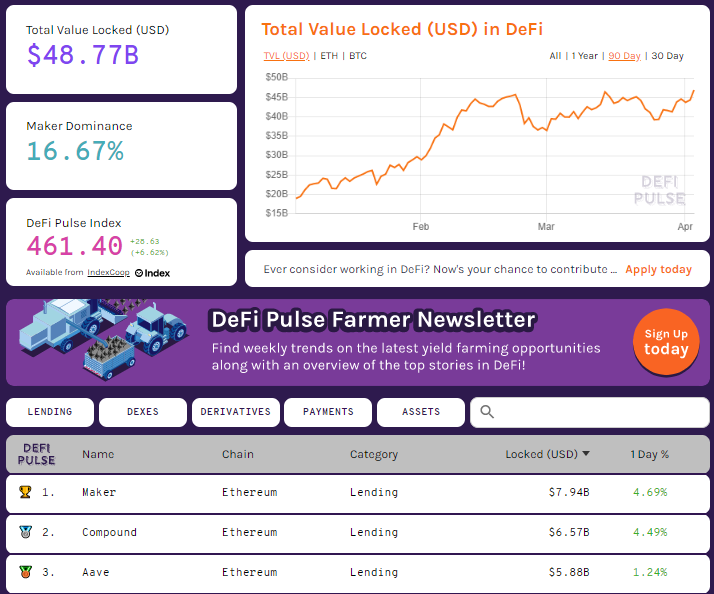
The total value locked in Ethereum-based applications reached $48.77 billion. Over the last 30 days, the figure rose by 22%.


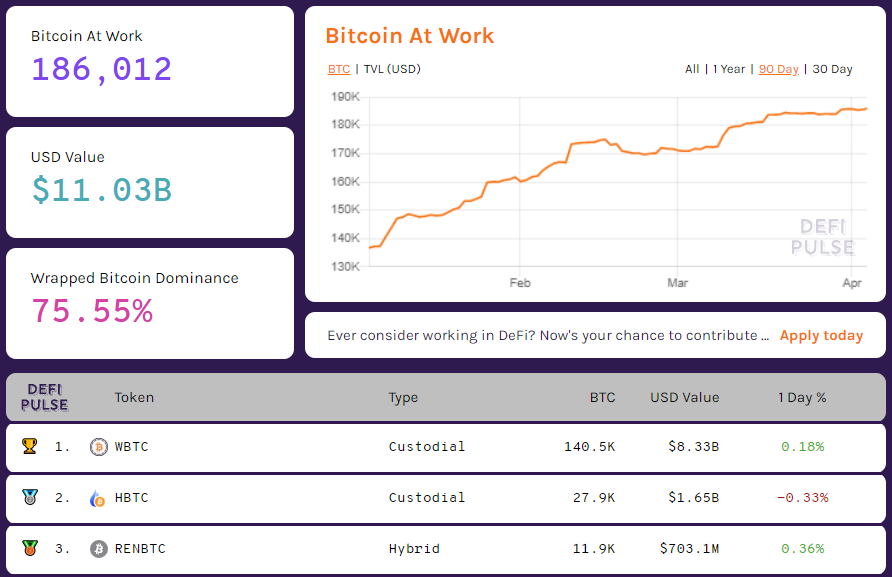
The tokenized-Bitcoin segment slowed its growth. The total market value of WBTC, HBTC, renBTC and other Bitcoins on Ethereum reached $11.03 billion. Three weeks ago the figure was $10.81 billion.


Trading volume on decentralized exchanges (DEX) over the last 30 days amounted to $59.2 billion.
61.4% of the total turnover of non-custodial exchanges is accounted for by Uniswap. The second DEX by trading volume is SushiSwap (14.1%), the third is Curve (9.2%).
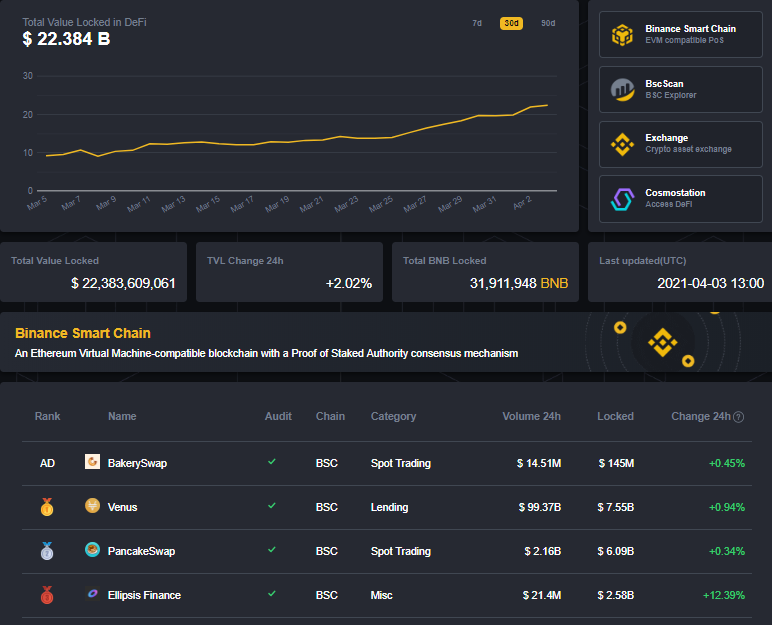
TVL of projects on BSC is rising confidently. The aggregate figure reached $22.38 billion, a 143% increase over the last 30 days.


On March 28, Uniswap surpassed Bitcoin’s daily fees by $1.7 million. For the seven-day metric, the non-custodial trading platform trailed the Bitcoin blockchain — averaging $3.49 million versus $4.15 million.
Uniswap announces launch date for Version 3
The leading non-custodial exchange Uniswap will launch the third version of the protocol on May 5. One of the main innovations of the new protocol is the Concentrated Liquidity positions.
Developers are convinced that, thanks to the new approach, liquidity providers’ (LP) activity could become more capital-efficient. This could also help reduce slippage in trading, according to Uniswap representatives.
Another novelty of Uniswap v3 is the three-tier structure of liquidity provider fees (0.05%, 0.30% and 1%). It is expected that LPs will generate more fees from pools with high-volatility coins.
SushiSwap launches first BentoBox-based app
The SushiSwap team announced the launch of BentoBox app store and the first lending and margin trading solution on its basis — Kashi.
BentoBox is a vault that allows assets to be deposited to be used in other decentralized applications built on its platform.
Kashi enables the creation of lending pairs of tokens and to conduct margin trading operations.
BentoBox acts as a wallet for assets, allowing gas costs to be reduced and additional income through maximizing token usage, said SushiSwap.
Launch of QuipuSwap DEX on Tezos
The MadFish.solutions launched the decentralized exchange QuipuSwap, enabling adding and exchanging any tokens on the Tezos blockchain.
The exchange uses an open-source automated market maker. QuipuSwap users will have the opportunity to:
- create liquidity pools in pairs with other tokens and Tezos (XTZ);
- instant trading launches after creating a liquidity pool;
- earn income from mining XTZ rewards and fees;
- vote for a delegate or its ban in the chosen liquidity pool;
- use the infrastructure to create new DeFi solutions on the Tezos blockchain and more.
On the first day the volume of assets locked on QuipuSwap rose to $434,000.
TurtleDex on BSC performed an exit-scam for $3 million
The TurtleDex organizers vanished, pulling 9000 BNB (over $3 million at the rate at the time of writing) from liquidity pools on PancakeSwap and ApeSwap on the BSC network.
The funds were converted to Ethereum, split among nine wallets and sent to the Binance exchange, according to a Twitter user named DeFi Stalker.
All TurtleDex social media accounts have been deleted. The platform JetfuelFinance, which worked with the project, confirmed the fraud.
Investments in DeFi
OKEx and MXC will direct $40 million as strategic investments in the Solana blockchain ecosystem.
The funds will go to projects and developers through the Solana Foundation grants program. Besides financing it also provides technical support and help in recruitment. OKEx and MXC will receive tokens in exchange for the investments.
The developers imToken, a non-custodial wallet and DApps browser with asset-management capabilities, raised $30 million in a Series B financing round from Qiming, Xiaomi, Meitu, Megvi and IDG Capital.
The funds will be used to create a safe and convenient gateway to DeFi services in the next version of the app.
In imToken they plan to launch a research division to pursue further expansion of product functionality.
The project Reef Finance raised $20 million from venture firm Alameda Research. The funds will go to expand the team, further development and launch of the mainnet.
Reef Finance also intends to implement cross-chain integration with the Solana-based Serum DEX, supported by FTX and Alameda Research.
The project provides cross-chain solutions and yield farming opportunities on the Polkadot platform, supporting non-custodial and centralized exchanges.
After the investment, Alameda’s Sam Trabucco tweeted that the venture firm is “not affiliated” and “not supporting” REEF. According to him, the parties agreed only on an off-exchange deal, which Reef Finance allegedly subsequently declined.
The parties exchanged mutual accusations and differing views on the dispute, and questioned the possibility of a partnership.
The Vega project, a protocol for creating derivatives and trading them in a decentralized network, closed a funding round of $5 million. Major investors were Arrington Capital and Cumberland DRW.
The project’s founder Barney Mannering said that later cash-settled futures and perpetual contracts trading would begin. In 2022 Vega will launch a system of “smart products” allowing traders to create their own instruments.
The lending platform Liquity Protocol raised $6 million in a Series A funding round led by Pantera Capital.
The funds will be used to expand staff, improve access to on-chain loans, reduce interest rates and minimise governance of the protocol.
Launch of Liquity on the Ethereum mainnet is planned for April 5. Before that, the team has been modelling and auditing for a year and a half.
Saturday long read
We explored why the hype around the new DeFi ecosystem emerged, its pros and cons, and, most importantly, whether BSC has prospects after Ethereum’s scaling.
Read ForkLog Bitcoin News in our Telegram — cryptocurrency news, rates and analysis.