




The internal clocks of the Solana blockchain lag real time by about 30 minutes. Developers stressed that the issue does not affect the network’s performance.


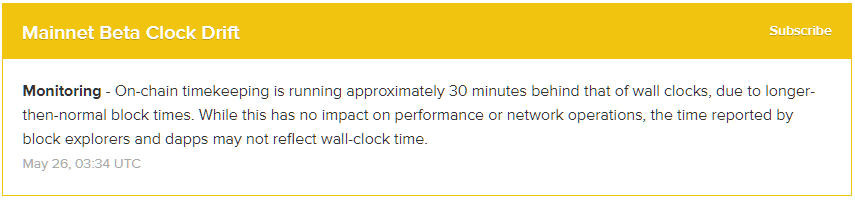
“On-chain timing lags behind ‘wall clocks’ by about 30 minutes due to longer-than-usual block times. While this does not affect network performance or operation, the time reported to observers and dapps may appear incorrect,” — the developers wrote.
For consensus, the Solana blockchain uses Proof-of-Stake, but the network’s timing is governed by the Proof-of-History (PoH) mechanism.
The issue is triggered by an increase in the time a validator needs to submit a block to the network (slot time). The canonical slot time in the Solana network is 400 ms. At the time of writing, the average stood at 756 ms, according to the Solana Explorer.
Validators in the Solana network are organized into clusters, which are responsible for processing transactions in the blockchain. The PoH algorithm enables all cluster nodes to track time synchronously and in a decentralized manner.
When the slot time value exceeds the standard, the cluster’s internal clocks become skewed, causing the network to lose synchronization with real time. This has economic consequences for ecosystem participants.
A timing disruption leads to longer epochs (epoch), since each epoch comprises 432,000 slots. At the canonical slot time, about 182 epochs occur per year — each lasting 2-3 days. An increase in the metric results in fewer epochs.
Staking rewards in Solana are paid once per epoch. A lower number of epochs directly affects the income earned by validators and delegators.
During the night of May 1, 2020, the Solana blockchain paused operations due to a surge in incoming transactions and heavy traffic.
Follow ForkLog’s Bitcoin news on our Telegram — news, prices and analytics.