



Gaspar König — a French writer and philosopher, founder of the Simple movement, which advocates a radical “simplification” of the state’s bureaucratic apparatus. While working on the book “The End of the Individual”, he spoke with dozens of AI experts to learn what real possibilities and challenges revolutionary technologies pose, how they will change the familiar economy, politics, and our daily lives. With the publisher Individuum’s permission, we publish an excerpt from the chapter “In Defence of the Right to Personal Data Ownership”.


In New York I met with Alex Elias, founder of the startup Qloo. He sets himself the task of merging individual preferences across different domains: if you like a certain kind of music or a certain film, you should try a certain restaurant or go on a date with a certain person… Qloo could become the Netflix for life, immersing its users in total recommendations from which nothing escapes. In this sense, the pursuit of “cultural personalization” is precisely what scares me about AI. But Alex is an East Coast intellectual, a jazz aficionado, who understands the merits of improvisation. He knows that a trip to a record shop opens up unexpected vistas, while Spotify offers only a limited experience. After analysing the search on Qloo, he notes that most Americans describe the Bible as their favourite book, and the latest blockbuster as their favourite film… Left to an optimizing algorithm’s mercy, they are likely to take the most traditional path. That is why Alex included in Qloo’s program what he calls the “diversification factor.” On the one hand, a touch of randomness is introduced into the recommendation system to create surprises and raise questions. On the other — the user controls a number of criteria: this is the “first directive” in action! To wake a sleeping consciousness you need randomness, and to reorient the algorithm — the presence of a clearly expressed choice.
Alex acknowledges that giving individuals control over their own preferences, oddly enough, makes Qloo less efficient and thus less profitable. After all, as he succinctly notes, “most people want to disappear into the crowd.” But he at least offers them an alternative, reassured by the thought that new generations will be more sensitive to diversity. Moreover, we should rely on a free market for algorithms to bring to life projects more attentive to the free-willer, and hope they gradually win over users drawn by the prospect of liberation. For now, everyone can try to outwit the machine. For example, using Google Maps, I always switch off geolocation: extracting benefit from distance calculations, I want to determine the streets myself, to understand where I am going, rather than blindly following the blue dot. On Deezer I try to select tracks from a list whose criteria I set myself (for example, “sonatas”), not relying on recommendations. I personally note my real friends’ birthdays in a diary and do not wait for LinkedIn to remind me. And I also leave YouTube when the video I chose ends, though it is not easy — for it is so easy and pleasant to surrender to the stream of images…
But all these tricks are laughable because the market is rigged. Because platforms have almost unfettered access to our personal data, we spend our digital lives feeding various AIs that in turn manipulate us. Nudge everywhere, it leaves no room for weighed and autonomous decision-making, appearing as ads, notifications, recommendations, social-media messages, or mailbox spam. Our brains are constantly subject to hacking, made possible by the fact that we scatter our data everywhere. Opening the Internet is like being naked in public, as the king in Andersen’s fairy tale believed he wore a garment of precious fabric, when in fact he was entirely naked. Anyone can see this in practice. A browser developed by the startup myCo, for example, allows visualising all strangers present on a site, collects cookies and more. Having tried it myself, I found more than a hundred programs that sent my browsing history, clicks and search results around the world to better interpret and steer my behaviour. This plunder is perfectly legal: during the day, several times, we tick “I agree” in user agreements, voluntarily submitting to the platforms’ gaze. The tricks sites and apps use to harvest our data are countless. Thus, a flashlight app on your smartphone, in exchange for this tiny service, takes all your geolocation data. I remember sitting in a restaurant in Paris opposite an entrepreneur who proudly announced his new “innovative project” — to track mouse movements across the screen to fine-tune user profiling. When I asked whether the technology was too intrusive, he shrugged and said it would serve us all well, then turned to discuss charity with his tablemate. Tartuffes 2.0 clearly deserve a new play…
And how then can “digital” citizens carefully curate algorithms if with every click, with every app opening, they give AI the weapon against themselves? If we cannot keep our data to ourselves, we will fall under the power of mighty AIs that will make any free choice impossible, and thus no room for any alternatives. The European General Data Protection Regulation (GDPR) attempted to introduce something like control by requiring greater transparency from Internet companies. Yet as a result we end up clicking “I agree” even more often, and still we have no real ability to challenge the terms or negotiate.
[…]
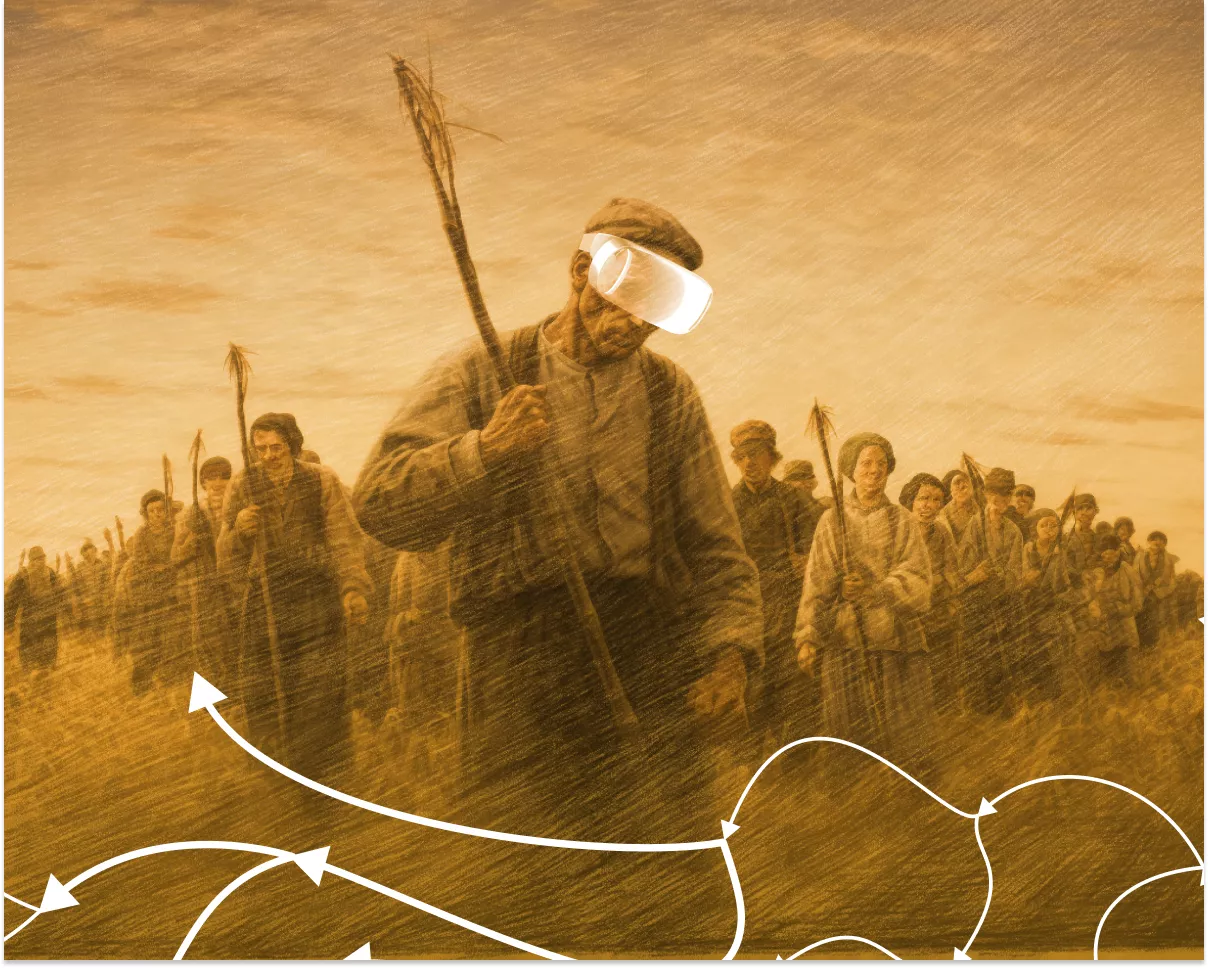
To understand how digital plunder operates, of which we have become victims today, one only needs to read Georges Duby’s works on medieval economics. At the dawn of the preceding millennium, serf peasants bound to the land yielded to the lord a substantial portion of the fruits of their labour in exchange for “free services,” more or less real: protection in war, or the use of village infrastructure owned by the lord (the bakehouse, the mill, the press…). It took a long time for peasants to gradually gain the right to pass property by inheritance, freely trade the fruits of their labour, and, finally, alienate them with documents of ownership that can be transferred. The Great French Revolution ended feudal serfdom and broadened the right to own land: the serf became a free man. With every technical innovation, similar debates flare up. Several centuries after the invention of printing, Beaumarchais led the writers’ fight for copyright recognition. During the Industrial Revolution, inventors secured a true patent regime. Man must always fight for the right to freely dispose of his property and the fruits of his creativity, whether tangible or intellectual.
Today we have become digital serfs, surrendering the right to collect all our data in exchange for free services (the value of which is not always clear), provided by our new feudal lords. We post a billion photographs on Facebook every day. Yes, a billion. After processing by algorithms that include facial recognition, this data trove yields quarterly profits of several billions of dollars. What share of that goes to the original producer? None. Well, perhaps tips in the form of a network of friends… We not only cannot negotiate with our feudal lords about data, we are even forbidden to sell it on the market: in May 2018, Oli Frost, a proactive British millennial who posted his Facebook updates on eBay for ten years, was forced to remove his offer as a violation of the social network’s terms. Yet Frost’s line of reasoning seemed highly persuasive: “Since everyone makes money from my personal data, why shouldn’t I make money from it myself?” Bids in the auction reached $400, but the feudal lord clearly could not tolerate such a breach of his prerogatives. This is understandable: according to the European Commission, the value of personal data in 2020 approached one trillion euros, i.e., 8% of the EU’s GDP. Who would want to share this manna with the rabble that produces it?
Remarkably, we accept this digital feudalism with such passivity… Probably, the twelfth-century serfs did not dream of challenging the lord’s rights, reclining under his canopy — a figure as sacred as today’s tech entrepreneur on the TED Talk stage. But as everything accelerates, the revolution could come faster too. Property rights in personal data — not yet existent anywhere in the world — would put an end to this plunder. They would include the data producer in the value-creation chain in the digital economy, allowing them to monetise (or not monetise) their data according to terms they choose, and which intermediaries would negotiate with platforms on their behalf. The question of remuneration is secondary to me. More important: by reclaiming ownership of their data, a person would feel they exist with renewed force — like a peasant enjoying cultivating their own land. They would be entitled to grow nothing but blackberries, thistles and brambles, or, in the case of data, to refuse to disclose it, without handing it to AI processing. Everyone could decide what they reveal and for how long, what they give away without duplicates and to whom, what they sell and at what price. Creating such a space of individual sovereignty, we would become ourselves again.
[…]
The modern sharing ideology, no matter how attractive, masks mass plunder in the interests of data aggregators. Regulation — as envisaged by the Data Protection Regulation — has opened a door in this house, but not a lock: it merely makes us click “I agree” more often. Henceforth, all these strangers ask us: “I’ll drop by for a minute, if you don’t mind?” — having already crossed the threshold. They find it hard to refuse. Data ownership will finally put locks on the door, reversing power relations and creating the calm zone necessary for the development of an autonomous personality. The owner will pre-emptively draft a guest list, setting contractual terms under which they are willing to disclose their data. Hobbes in “Leviathan” asked: who, going to sleep, would not lock the door with a key? “Yet none of us blames human nature itself. Desire and other human passions in themselves are not sins.” No one will blame platforms for collecting data that we gift to them willingly. But the time has come to act pragmatically and put a lock on the door if we wish to preserve ourselves as individuals in the AI era.
In particular, one can imagine data for each person gathered in a personal digital wallet. We would pre-enter in a smart contract our own terms of use, the product of personal deliberation. How, with whom and in exchange for what are we prepared to share our personal data, and which exactly? Various sites, apps and platforms, connecting with us, would be informed of our terms immediately. It will be they, not us, who must accept them. For example, I might decide to provide data about my health for research purposes for free, but hold back all geolocation data, even if I must pay for services like Waze that currently use them. As for data about my online purchases, I would agree to share them without particular problems to receive recommendations tailored to me (and in the process receive monetary compensation for doing so). Something like a blockchain could provide a way to track my data, to preserve a “memory” of the original conditions of my contract: such a procedure already used in the music industry to protect the intellectual property of musical compositions. Endless streams of micro-transactions would continuously create debit and credit in our digital wallet, and there would inevitably be intermediaries negotiating data prices, modeled on copyright-protection societies. In place of digital feudalism would come an entire economy of infinitesimally small markets, self-administered by AI.
Financially, the property-rights aspect raises expected questions. On one hand, why should we pay, even a very modest amount, for services that have hitherto been free? Isn’t it sufficient to ban the use of personal data for commercial purposes, in the logic of the Data Protection Regulation? But then the digital economy would collapse, depriving us of numerous services that AI could deliver. If we believe that value is produced, then this logic of exchange should apply equally to the data-producer and the platform-aggregator. If Waze selects the best route for me, but I refuse ads for restaurants along that route, other ways of compensating platforms must be found. Otherwise I become a “fare-dodger,” using others’ data without sharing in return. Anonymity has its price.
[…]
On the AI side, ownership of personal data would lead to a loss of efficiency, with which society at large would have to live. Anyone would welcome Facebook’s profits shrinking due to less precise targeting, yet the same inefficiency would affect other public services as well. It is conceivable that certain categories of data especially important to society could be “nationalised,” in the same way as land can be expropriated from private owners to build vital infrastructure. But such a procedure can only be extraordinary, and a court would decide to what extent expropriation reflects the public-interest motive. In other cases one must acknowledge that a smart city or smart meters would not be so smart, and autonomous vehicles not as autonomous. Allowing room for individual deviation, data-property would cause accidents, carbon emissions and ruptures in relationships. It will prevent society from becoming perfect, thus returning evolution as a regression. Enduring such contingencies, immediate and concrete, for the sake of a vague promise of progress is a heavy burden for legislators. But it is on this fault line that the debate between nudge and autonomy, blissful slavery and the return of the Enlightenment, is fought.
There are already many startups eager to take part in this war to restore autonomy to individuals. These ecosystems are particularly dynamic in France — the country that gave us copyright. In Paris, Lyon, Montpellier, entrepreneurs strive to breathe life into this property right, where the regulator presently refuses. Some are developing data wallet: using the GDPR mobility right, it allows individuals to extract their own data and control its provision. Others seek to assign monetary value to personal data, exploiting legal “grey areas.” A third group organises “digital cooperatives,” jointly using the data of their members and paying them dividends. As has happened before, technology will compel the law to adapt to it. Perhaps, after travelling the world, I will find a solution very close to home, like Captain Haddock, who found the Lycorne treasure at Moulinsart?
Translated from French by Inna Kushnareva. Published to: Gaspar König, The End of the Individual: Adventures of the Philosopher in a World of Artificial Intelligence. Moscow: Individuum, 2023.