



A regular ForkLog reader and seasoned participant in the crypto market on how he lost funds—and with them the hope of getting them back.
We often repeat as a mantra: “Even the most experienced crypto investors are not immune to mistakes.” That is, of course, true. But is this acceptable for an industry that seeks mass adoption as an alternative to traditional finance?
A long-time ForkLog reader and contributor, who today asked to remain anonymous, says no.
“Sorry, we can’t help”
A substantial sum in stablecoins was stolen from my wallets after the Aperture Finance hack. Through that service I provided liquidity on PancakeSwap, which required approving unlimited USDT spend. A hacker found a vulnerability in the contracts and, via that approval, drained all tokens from users’ wallets. Here and here are technical analyses of the incident.
Trying to find help recovering at least something, I realised the industry still cannot deal with hackers. So long after the creation of bitcoin, Ethereum, 20,000 L2 solutions and 30,000 smart-contract platforms, developers have yet to master the most important thing: protecting their users.
Right after the theft I contacted Tether for help, since they are the issuer of USDT. We see daily news about freezing tokens linked to thefts, hacks and illegal activity—apparently not in standard cases like mine. I received this reply:
“Sorry, we can’t help. We do not issue USDT on BNB Chain.”
Fine, I know who does. I turned to the exchange. Surely they have transaction-tracking software, I thought. Surely they use every tool available. You can cluster related addresses, trace where the stolen tokens went, and find a path to a centralised venue with KYC. The hacker will have to cash out at some point, right? Then you send the platform a request to freeze the account. I have all the evidence of the theft.
“Sorry, we can’t help. According to our data, the tokens did not reach us,” came the reply.
Of course they didn’t. They are still sitting in the hacker’s wallet. I did not ask them to block USDT at that address—the answer would have been obvious.
“The best solution will be to contact law enforcement. They have the resources and legal authority to investigate such complex cases and find those responsible. Provide them with the link to the request page for law enforcement,” the exchange’s representatives wrote, sending a URL to the official request form.
I turned to the authorities, having heard about a cyber-police trained by leading blockchain-security firms to track transactions. They first wrote the hacker’s addresses on a sheet of paper (for some reason they skipped transaction hashes). Then I had to explain to three different people what had happened. In the end they said:
“You understand these issues better. Do it yourself, and we are ready to help if anything. We can put some stamp.”
The Aperture Finance developers have been silent for two weeks. They said they were hacked—and then nothing. I assume they lack the funds to compensate victims.
As a result, after the Aperture Finance hack (if it was a hack, and not a backdoor left by the team followed by theft) and two weeks of silence, everything points to the project having halted its development and existence, several million stolen from various people, and the hacker pleased with himself and untouched.
Everyone can see the addresses holding the tokens, and no one can do anything. There is no body that would help—and no one is interested.
Not your keys—not your coins
We crypto users tout as our biggest advantage the full control over our funds. But it is also the industry’s biggest scourge. How is mass adoption possible if anyone can find a vulnerability in three lines of code, steal funds straight from wallets and face no consequences?
This is worse than phone scammers. There, victims have to act—sell a flat, send funds, hand over a CVV code. In crypto, tokens can vanish while you sleep because of three-year-old approvals, as a new vulnerability is found in old contracts.
Yes, I understand each of us is responsible for our own security. We all know the rules we must follow:
- Regularly revoke approvals.
- Rotate wallets.
- Do not use unvetted services.
- Do not click links from Google.
- Do not copy an address from transaction history.
- Do not fall for X scams like “Elon Musk is giving away 1 BTC, just send 0.1 BTC to this wallet”.
And so on, and so on. Isn’t that too many? The industry promises decentralised finance in which “you own your assets”. But does it offer adequate protection?
Why not build tools to return funds after a theft? Or to prevent it? Submitted a fraud report to nodes —> provided proofs —> they voted to freeze —> then, by the decision of a decentralised court, the money was returned.
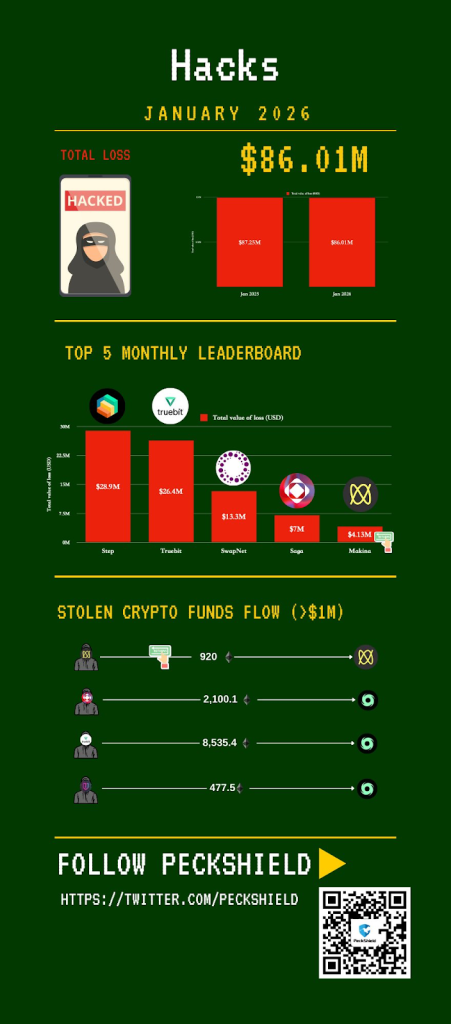
In January 2026 alone, hackers hacked 16 projects and stole $86.01m.


Who will find cryptocurrencies appealing with so many unknowns? Try suggesting your friend park USDT on Aave instead of dollars in a bank, and list all the risks:
- USDT can be frozen (just not when yours were stolen);
- Aave can be hacked and everything taken;
- you can click the wrong link and get drained entirely;
- USDT can depeg.
Sandwich attacks, scam tokens, wash-traded volumes to manufacture token allure—these are our realities, which we live with while pretending all is fine.
There are also counterfeit USDT. You might sell, say, a Telegram channel and be sent not real stablecoins but fraudulent ones. You have to know how to check them by contract address.
Who would want to use digital assets after learning all this?
When friends ask me to teach them to make money on yield farming (because they see someone press three buttons on a laptop and earn money while playing FIFA), I am always tempted to give only one piece of advice: don’t get in—it will eat you alive.
The DeFi industry remains, as five or six years ago, complex, inconvenient, unsafe and unappealing to the mass market. A seasoned crypto user might find market inefficiencies and ways to profit, but for the vast majority this is far from “a bank in every pocket”.
The safest use of cryptocurrencies was and remains a single option: buy bitcoin, put it on a hardware wallet and don’t touch anything. The moment you start thinking “they’re just sitting idle; I should pledge/move them and earn,” a time bomb starts ticking. Sooner or later, a mistake will catch up with you.