



ForkLog is not responsible for readers’ investment decisions.
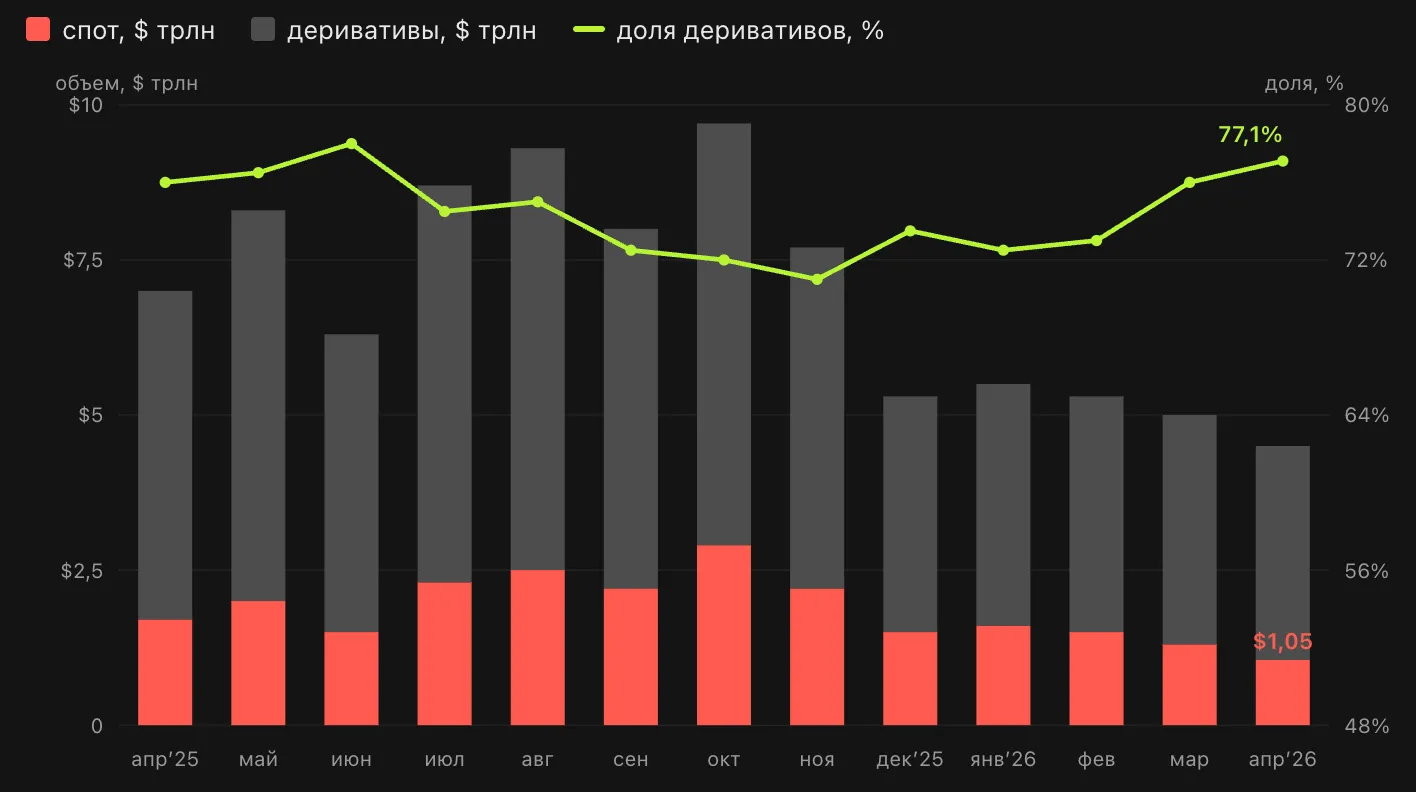
In April 2026, spot trading volumes on crypto exchanges fell to their lowest since November 2023, while derivatives reached 77.1% of turnover. It looks almost paradoxical: actual asset trading is shrinking, but appetite for leveraged bets remains high.
The shift isn’t driven by market conditions alone. As noted by crypto journalist Colin Wu, perpetual contracts have become embedded in the industry partly because they tap a quirk of the human brain — the same one slot machines have exploited for generations.
Here’s how rational trading morphs into gambling — and why it’s harder to step away than it seems.
Spot deflates as bets rise
A perpetual contract (perpetual, “perp”) is a futures contract with no expiry date. As far back as 1992, economist Robert Shiller floated the idea of a “perpetual” derivative for assets that are hard to price directly, such as real estate. The concept never caught on in traditional finance, but it proved a natural fit for crypto.
BitMEX launched a bitcoin perpetual (XBTUSD) on May 13, 2016, and the product quickly became an industry standard. That was the mass-market rollout. The “perp” itself was pioneered earlier — the first inverse perpetual was implemented by ICBIT in 2011.
Why crypto specifically? A few reasons:
- The market runs 24/7 with no weekends or trading sessions, making expiring futures less convenient here;
- digital assets have no single authoritative price — quotes are scattered across dozens of venues. The funding rate keeps the contract near a spot index, replacing expiry-based settlement;
- speculation is baked into the culture, and perps offer leveraged access and a way to profit in both directions with a relatively low barrier to entry.
According to CoinGlass, bitcoin perpetual volumes steadily exceed spot by 5–10 times. Real asset trades are increasingly giving way to directional wagers.
The paradox: a tool designed for hedging and price anchoring has, for the mass user, become a mechanism for rapid-fire betting.


The brain craves uncertainty, not winnings
Gambling hooks people not with winnings but with unpredictability. In the mid-20th century, psychologist B. F. Skinner showed that behavior is reinforced most strongly by random rewards — the so‑called variable reinforcement schedule.
In his experiments, pigeons that received food after a random number of lever presses pecked more often and persistently than those rewarded on a fixed schedule. What drove them was anticipation born of uncertainty.


The same mechanism drives humans, and dopamine is central to it — a neurotransmitter of anticipation, not pleasure per se. These neurons respond less to the reward itself than to the error in predicting it: the more surprising the outcome, the stronger the spike. When a win is guaranteed and predictable, the response is muted. When the result is unknown, the brain fires at full tilt.
It’s no accident slot machines long ago overtook card tables and roulette as casinos’ top earners. Anthropologist Natasha Dow Schull, in her study of Las Vegas gambling industry, showed how solitary, continuous, rapid play induces a trance‑like state regulars call the “machine zone.”
A slot doesn’t pay on schedule but unpredictably, and that very uncertainty becomes pleasurable. Losses barely sober a player up: the next spin could hit the jackpot.
The “near-miss” is especially insidious — when a combination almost lines up. The brain reacts much like it would to a real win, and the hand reaches for the lever again.
Neurobiology backs this up: the dopaminergic system is highly sensitive to unpredictable rewards, while it habituates to what’s expected and routine. That helps explain why players fixate on risky, low‑probability bets: the thrill comes from uncertainty itself, not the odds. The win is almost secondary — the brain wants not to know the outcome in advance.
Pleasure tied to the unknown can thus sustain itself even without regular rewards. For dependency to form, winnings needn’t be frequent or large — it’s enough that outcomes stay unpredictable.
A slot machine in your pocket
Perp trading reproduces this variable‑reward loop. Traders place frequent bets with immediate but unpredictable outcomes — essentially spin after spin on price direction.
Researchers compare intraday trading with gambling disorder: in both, people repeatedly stake money on unknown outcomes and receive irregular rewards.
Each app open and chart refresh works like a slot pull: a position either ticks into profit — even a small one — or bleeds, sometimes all the way to liquidation.
Modern trading apps supercharge the effect. Price alerts, flashing P&L badges, flickering candles — they fragment trading into a nonstop stream of micro‑wins and micro‑losses. Social feeds use the same trick: at any moment the timeline might surface a like, a repost or a riveting post — that very unpredictability keeps many from closing the app.
An extra layer comes from the funding rate. Every eight hours, longs and shorts pay each other: when the rate is positive, longs pay shorts; when negative — the reverse.
Formally it anchors the contract to spot. Psychologically it’s a small win or loss inside an open position, arriving with the regularity of a machine that dispenses a token payout every few spins. The reward cycle shortens further.
Behavioral finance calls the state that follows an “illusion of control” — the belief that constant monitoring and tinkering can steer a fundamentally random process.
A trader can’t leave the screen for fear of missing a move — a fixation barely distinguishable from a gambler hovering over the roulette wheel.
A casino that never closes
Perps trade 24/7 — pushing the thrill to a new level. Traditional exchanges shut overnight and on weekends, offering natural breaks to cool off.
Crypto never closes. The casino literally sits in your pocket, its doors unlocked: no breaks, no forced time‑outs to slow the spiral.
Leverage turns up the heat. Many venues allow multiples in the dozens and, in places, up to 100x and beyond. That’s akin to raising the slot stake: risk and potential reward soar — as does the urge to go all‑in. Combined with round‑the‑clock access, it becomes an endless high‑speed game where balances swing in seconds and traders’ brains stay on high alert.
Researchers note that a 24/7 schedule materially amplifies compulsive trading — people simply don’t get a natural signal to step away.
Bets placed in such a mode can prove costly. Analysts warn that if traditional markets move to 24/7, investors will face the same psychological risks as online‑casino users.
When the market resembles a round‑the‑clock slot hall, some participants become so dependent they may need medical help.
And this isn’t a side effect — it’s the business model. Economically, casinos thrive on nonstop play and high unpredictability — and crypto exchanges mirror those principles.
High‑frequency interfaces, leverage tools and 24/7 access ensure there’s always a reason — and a way — to place one more bet. Trading itself gets gamified: the “trade — settle — instant feedback” loop is as gripping as a video game.
Why traders lose to themselves
It’s not just dopamine. Cognitive biases push retail traders into decisions against their interests.
Three core mechanisms:
Loss aversion
The pain of loss outweighs the joy of a comparable gain. Instead of realizing a loss, people average down, deny reality or simply close the app to avoid looking. Small cuts turn into a deep hole.
Many take profits too early — afraid gains will vanish. Professionals do the opposite: they treat losses as a planned expense, not a personal defeat.
Illusion of control
This is the conviction that the market can be outplayed. It motivates hyperactivity that only entangles traders deeper in noise.
Experienced players, by contrast, accept that uncertainty can’t be tamed — and rely on risk‑management tools instead of fighting it.
Peer pressure
Screenshots of others’ profits and overnight‑riches stories set a “success at any cost” template, while FOMO whispers that the “next 10x” is about to slip away.
In such groups, blowing up an account is hardly shameful — a gripping liquidation tale draws sympathy. Emotional, even reckless trading becomes a badge of belonging.
A vivid example: in spring 2025, trader James Winn opened a 10,200 BTC long ($1.14 billion at the time) with 40x leverage on Hyperliquid. At the peak, the “paper” profit reached $87 million on roughly $3–4 million of initial capital.
Then the very biases above kicked in. After bitcoin fell below $105,000, Winn faced liquidation: the drawdown from the peak totaled $99.3 million — in a single week.
He conceded it would have been wiser to keep bitcoin in cold storage. Yet days later he resumed trading, building a new position up to $140 million.
Winn blamed his setbacks on a conspiracy — the machinations of market makers and a supposed “deep state” steering prices. He repeatedly announced he was quitting the “Hyperliquid casino,” only to return soon after — pure loss aversion and illusion of control.
How the house stays ahead
If retail mostly gambles, professionals take the casino’s side. Their strategies rely on positive expected value — a statistical edge that compounds over long series of trades.
Common approaches include:
1. Statistical arbitrage. Quant models capture short‑term dislocations in related assets. Market‑neutral positions isolate profits from market direction. High trade frequency and tight risk controls turn many small wins into steady results.
2. Trend following. Entries by strict rules when momentum appears, and decisive stop‑loss exits on reversals. Big wins in strong trends offset small losses — producing a positive expectation.
3. Market making. Continuous two‑sided quotes earn the spread regardless of direction. A very high share of winning trades with minimal margin on each.
4. Non‑directional option strategies. Delta‑ and gamma‑neutral portfolios earn from time decay and risk premia.
What unites these strategies isn’t foresight but discipline. Pros cap per‑trade risk at a small slice of equity (typically 0.5%–2%), use stop‑losses and position limits. After losses, they follow the rules and review mistakes instead of trying to “win it back.”
That composure — not entry precision — explains the long‑run gap between the groups. The seasoned participant aims to be the house with a statistical edge, not the player at the machine.
Math also matters. Fees, spreads and funding steadily leak from traders’ pockets, turning trading into a negative‑expectation game. Those who collect these costs — exchanges and market makers — reliably stay ahead. Just like in a casino.
The price of lax discipline shows up at the macro level. In October 2025, the market saw the largest liquidation cascade on record: more than $19 billion in positions were force‑closed in a day. The trigger was a macro shock — the announcement of 100% US tariffs on imports from China — and the fall was amplified by the large stock of leverage in the system.
Up to 90% of closures hit longs, with Hyperliquid the epicenter — $10.3 billion. Each downtick triggered new liquidations, which pushed prices lower — a self‑reinforcing spiral. Mass all‑in bets became a systemic risk not just for individual accounts but for the entire market.
Is the casino moving on‑chain?
Barriers keep falling. Perpetuals are migrating to decentralized venues with no KYC and no intermediaries — everything is non‑custodial, fast and nearly seamless.
The segment’s new center of gravity is the Hyperliquid exchange. The leading platform accounts for more than 30% of volume across perp DEXs.

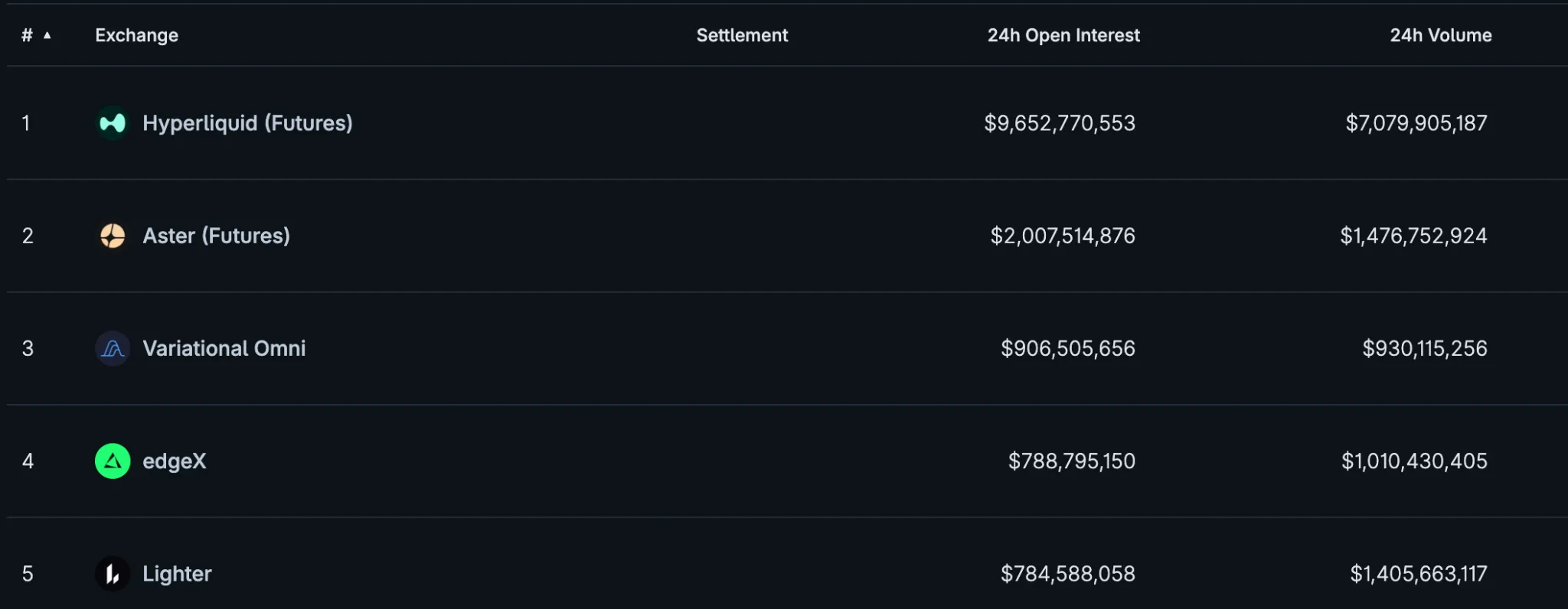
The “casino in your pocket” is getting more accessible, but it’s still niche — perhaps the only good news in this story of removing the last brakes.
For years, trading has seemed to many the most direct and thrilling path to wealth. You can enter and exit positions anonymously, without trading hours or TradFi intermediaries. Leverage, instant execution and the ability to play both ways complete the picture — making the market look like a perfect arena for endless play.
But that very freedom, paired with the siren song of fast riches, quietly blurs trading into gambling. A newcomer believes they’re mastering cutting‑edge finance. In reality, they’re slipping deeper into the psychological trap of speculative dependence.
Web3 and the on‑chain world aren’t just a “casino for screen‑glued traders,” but a space to rebuild trust mechanisms, cooperation models and data ownership. DeFi, DAOs, RWA, digital identity, confidential computing and transactions — these are all evolving frontiers.
Perp trading is only one lane, not the essence of Web3 or a mandatory route. While retail migrates to derivatives and thrills, the other pole is increasingly visible: institutions and holders who long ago moved coins to cold storage.
What makes this world complex and compelling is precisely the lack of one right answer. Speculation and creation coexist, narratives and technologies matter equally, and whales and regulars share the same liquidity pool.
Some earn on perpetuals, some exit after their first liquidation. Some build protocols and reshape industries, others find a home in community life. There is no single correct script here.
Before visiting the “casino” again, it’s worth asking a simple question: does the silent whale‑hodler who parked bitcoin in cold storage long ago really need to become a trader glued to charts day and night?