



ENS Labs, the company behind the Ethereum Name Service, has announced the cessation of its own L2 solution, Namechain.
ENSv2 will be deployed exclusively on Ethereum.https://t.co/lCUmvhcRmH
— ens.eth (@ensdomains) February 6, 2026
In 2024, the project team announced the creation of a second-layer network for the planned ENSv2 upgrade.
At the time, this solution seemed inevitable due to the high cost of gas on the Ethereum mainnet, noted ENS lead developer Nick Johnson. Even basic transactions like domain registration and renewal cost tens of dollars, he added.
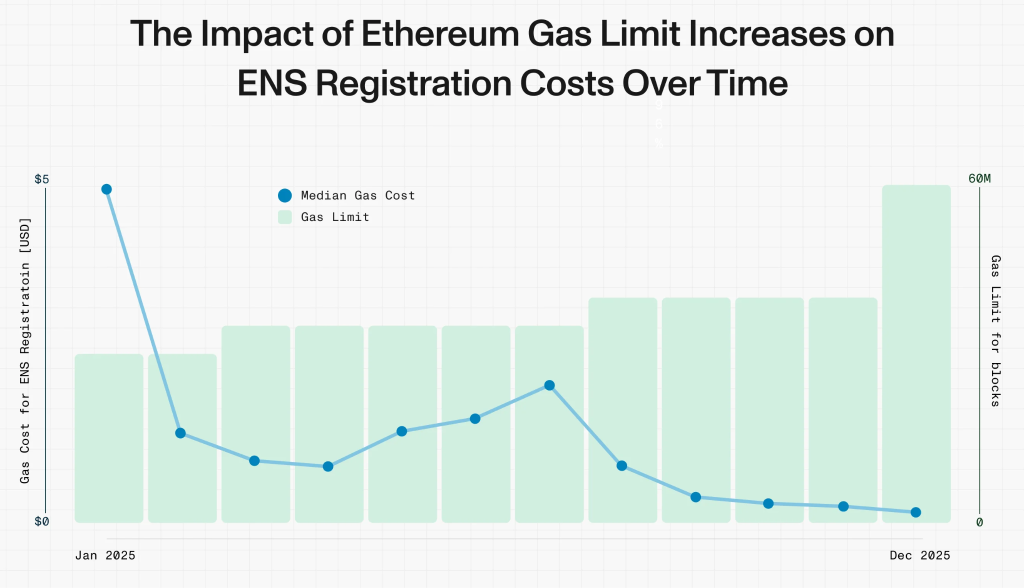
“Ethereum is scaling faster than almost anyone predicted a couple of years ago. Over the past year, we have seen a 99% reduction in the cost of ENS registration, coinciding with an increase in the gas limit from 30 million to 60 million,” Johnson acknowledged.
According to him, the decision to forgo deploying the upgrade on its own L2 network will not affect its implementation timeline, and the system will continue to rely on the robust infrastructural guarantees of the first layer.
The developer explained from an economic perspective that after the Fusaka hard fork, registering an ENS domain on Ethereum now costs approximately $0.05 compared to about $5 a year ago.


“For example, if we were to subsidise every ENS transaction in 2025, at current gas prices we would spend about $10,000. Even at peak levels, this amount only rises to $250,000, which is significantly less than the cost of launching a second layer,” he emphasised.
This cost-saving allows for the consideration of subsidising transaction fees for domain holders after the release of ENSv2, Johnson added.
In early February, Ethereum co-founder Vitalik Buterin stated that the original L2 concept has become outdated as the first-layer blockchain scales. He welcomed ENS Labs’ decision to abandon its own network development:
“This is the right decision!”
Earlier, several L2 project representatives challenged the paths for further ecosystem development presented by Buterin.