


Gnosis and Zisk, with support from the Ethereum Foundation (EF), have developed a framework to unify the fragmented ecosystem of layer two networks. The initiative is named the Ethereum Economic Zone (EEZ).
Welcome to the Ethereum Economic Zone (EEZ), a framework for synchronously composable rollups.
What does that mean?
One deployment. Shared liquidity. Single transactions across L1 & L2. Identity verified anywhere. Smart wallets connected everywhere. No additional trust… https://t.co/Fuf8G0xwA4 pic.twitter.com/KeMLIisN8S
— The Ethereum Economic Zone (@etheconomiczone) March 29, 2026
The project will allow applications to share infrastructure between rollups while maintaining settlements on the Ethereum base layer. This will reduce service duplication and the need for cross-chain transfers, simplifying interactions between ecosystems. EEZ will use ETH as the default gas payment.
The proposal aims to address a key dilemma in the scaling strategy of the second-largest cryptocurrency network. While dozens of L2 solutions have increased throughput, they have also fragmented liquidity, infrastructure, and user activity across isolated environments.
Alongside EEZ, an informal EEZ Alliance will be established to coordinate standards and support adoption. Founding members include Aave, block builders Titan and Beaver Build, the RWA platform Centrifuge, and the tokenized stock project xStocks.
The “economic zone” will be registered as a Swiss non-profit organization. All software will be released as open source. Technical specifications and performance metrics are expected in the coming weeks.
Part of the Strategy
The Ethereum Foundation has agreed to co-finance EEZ—a notable decision amidst its shift to a frugal model. The foundation suspended its grant program in mid-2025, aiming to keep annual spending at 5%.
Soon after, the organization shared an updated plan with a “proactive approach.” The leadership identified scaling the main network and L2 interoperability as priority areas—EEZ aligns with this focus.
In February 2026, Ethereum co-founder Vitalik Buterin stated that the original concept of layer two solutions had become outdated. The programmer proposed a new model for ecosystem development.
Later, the EF presented its vision of the roles of the base layer and rollups. Developers also emphasized differentiation, suggesting that L2 solutions should offer unique features.
Active Staking
Meanwhile, the Ethereum Foundation continues to stake more ETH. On March 30, the organization locked 22,517 coins worth $46.2 million, noted Arkham specialists.
THE ETHEREUM FOUNDATION IS STAKING ETH
The Ethereum Foundation just staked $46.2M of ETH. This is more ETH than they have EVER staked before. pic.twitter.com/gCCc0qK6VN
— Arkham (@arkham) March 30, 2026
Reports of the organization’s plans in this direction emerged in late February. At that time, the EF emphasized that they would initially lock a total of 70,000 ETH. All proceeds will support the ecosystem.
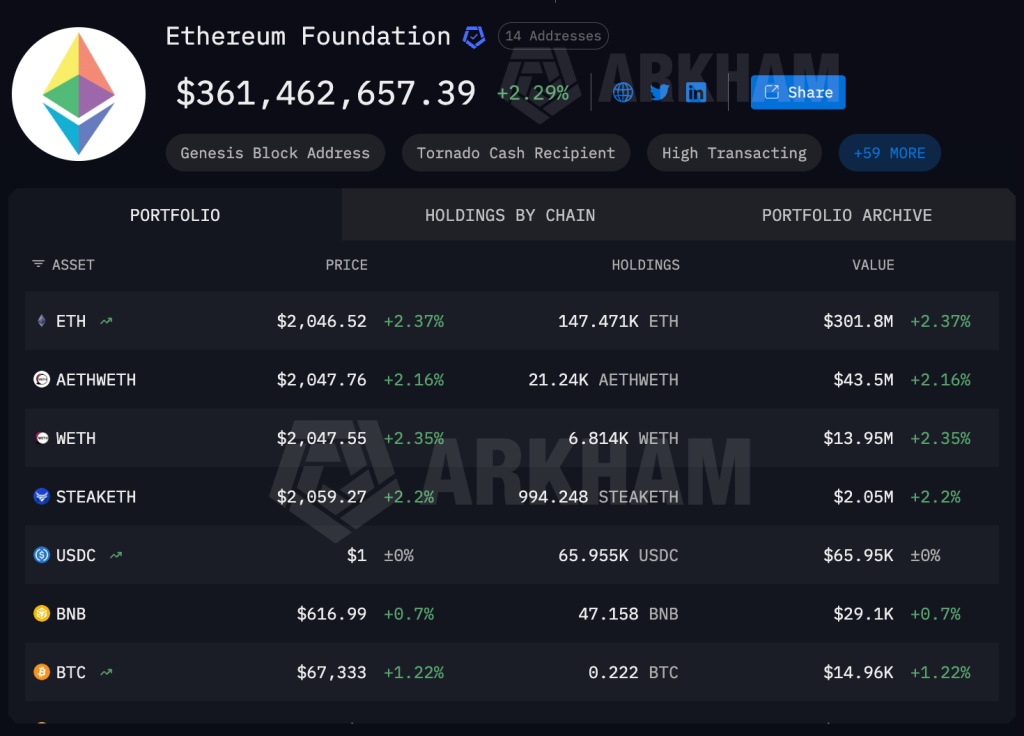
At the time of writing, the foundation manages 147,471 ETH worth $301 million.


In March, the Ethereum Foundation introduced a roadmap to protect the network from quantum computers.