



The second‑largest cryptocurrency is showing stronger momentum than the flagship, MN Trading founder Michaël van de Poppe observed.
The markets are waking up, and $ETH is outperforming #Bitcoin.
That’s a good sign.
However, for clear momentum, just break through 0.03250 $BTC and I’d be very happy as then I think we’ll start to see strong continuation taking place. pic.twitter.com/BwYjp5rUTB
— Michaël van de Poppe (@CryptoMichNL) March 30, 2026
He said the set‑up points to a revival in digital assets. However, to cement momentum, Ethereum must break above 0.03250 in the BTC pair.
A break of that level, he added, could usher in a sustained upswing.
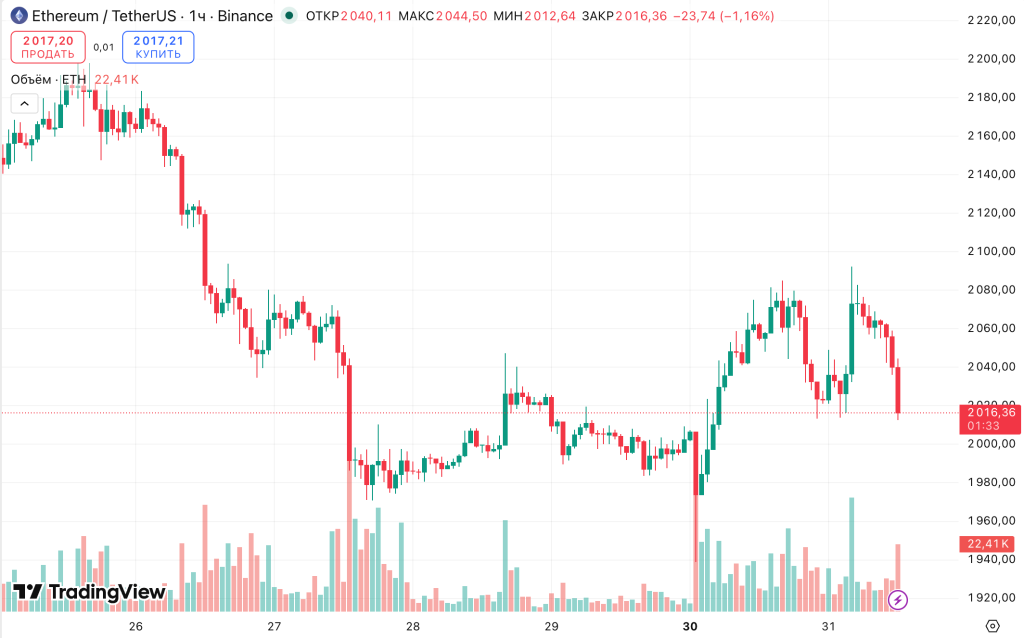
At the time of writing, the leading altcoin trades around $2,000. Over the past 24 hours its price is down 1.9%, and 6.4% over the week.


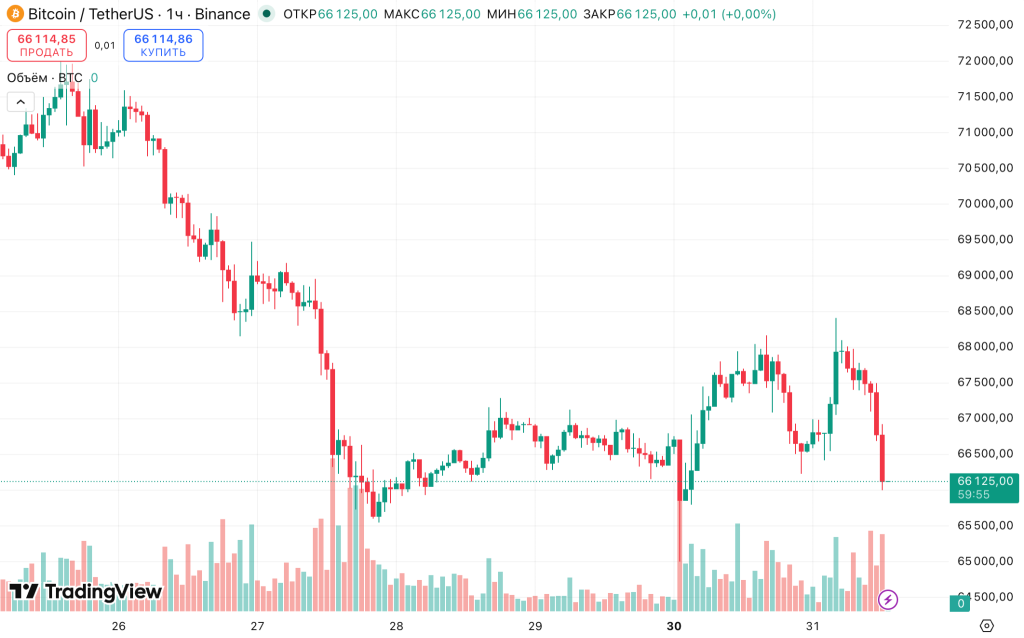
Bitcoin is trading near $66,100. Over the past 24 hours it fell 2.1%, and 6.8% over seven days.
Van de Poppe described bitcoin’s overall trend as weak. He allowed that in the coming weeks the coin could take out the lows. At the same time, he said the current market phase can be viewed as the final stage of the bear trend.
Slight bounce earlier today, but clearly, direction is downwards instead of upwards.
I wouldn’t be surprised if we take out the lows in the coming weeks on #Bitcoin.
Ideal moment to accumulate larger positions on your holdings as it might be the final stage of the bear. pic.twitter.com/0gDEJMQSut
— Michaël van de Poppe (@CryptoMichNL) March 30, 2026
Bitcoin could find a floor at $54,000
The realized price, which reflects the average acquisition cost of coins on‑chain, points to a bottom for the current market phase.
The DeFi Report founder Michael Nadeau noted that in bear phases bitcoin has traditionally traded below this level.
BTC historically trades *below* its Realized Price (a proxy for the cost basis of onchain coins) during bear markets.
Furthermore, the Realized Price typically *declines* as time does its thing in a bear market (as older coins purchased at a higher price are sold at lower… pic.twitter.com/rlFGmYONAg
— Michael Nadeau | The DeFi Report (@JustDeauIt) March 30, 2026
The realized price itself declines over time as earlier purchases are sold at lower prices. This makes the metric useful for estimating potential downside levels within the current cycle.
According to CryptoQuant analyst Axel Adler Jr., the indicator is now at $54,000. Hitting that mark would signal extreme oversold conditions that in past cycles often preceded a reversal.
Sales pressure is rising. If Bitcoin drops to $54K Realized Price — it goes abnormal. pic.twitter.com/xjOiEgZ9AA
— Axel 💎🙌 Adler Jr (@AxelAdlerJr) March 31, 2026
Macro headwinds intensify
Amid record pressure on traditional markets linked to the conflict in the Middle East, bitcoin and other digital assets are showing resilience. The S&P 500 has posted its longest streak of daily declines since 2022, losing more than 7% over the past ten sessions. Over the same period, Nasdaq 100 fell by 5%.
Total crypto market capitalisation ($2.32 trillion) has been largely unchanged. Since the start of US and Israeli strikes on Iran, digital gold has traded in a $65,000–$73,000 range, sold on each escalation but not breaking structurally lower. Equities, by contrast, are forming a persistent downtrend.
However, Adler Jr. warned that bitcoin’s relative resilience does not mean it has fully decoupled from risk assets. Although the short‑term link between the coin and the S&P 500 has weakened, its performance relative to the index continues to deteriorate.
Bitcoin is not decoupling from equities. It’s just getting weaker.
New ☕️ Adler AM 👇https://t.co/ME15XFsg8j pic.twitter.com/XIjiU25oof
— Axel 💎🙌 Adler Jr (@AxelAdlerJr) March 31, 2026
“The formal correlation between bitcoin and the S&P has now become a less reliable guide, but relative performance still indicates that the market views bitcoin as a higher‑risk asset with greater drawdown amplitude than the S&P 500,” he said.
The analyst believes it is too early to call a trend change until bitcoin’s ratio to the index stabilises and begins to recover. That means the coin’s current resilience may be temporary. Without an improvement in relative performance, a durable reversal higher is unlikely.
On March 30, digital gold fell to $65,112, setting a new low since late February.