



The supply of Ethereum has risen to 120,521,725 ETH, a level last seen in September 2022 before the Merge update.


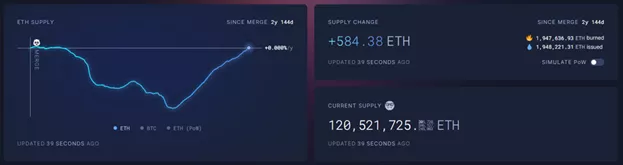
The metric has surpassed pre-Merge PoS and PoW levels by 584 ETH.
In the two years and 144 days since the update, 1,948,221 ETH have been issued, while 1,947,636 ETH have been removed from circulation.
Following the Merge, Ethereum’s supply hit a low in April 2024 at 120,064,500 ETH, after which the trend reversed.
Jaehyun Ha from Presto Research reminded The Block that inflation began to rise again a month after the Dencun hard fork.
The current dynamics of ETH supply cast doubt on the narrative of Ethereum as a deflationary asset, which is considered a better store of value than Bitcoin.
Before Dencun, users paid fees as the price of gas multiplied by its quantity, with a significant portion of fees being burned.
“With Dencun, Ethereum added support for BLOB transactions for L2. These use a separate unit of ‘blob gas’, which differs from the standard ‘gas’ applied to regular operations,” explained Ha.
According to the expert, the change led to a decrease in the share of burned fees, as a significant portion of on-chain data moved to BLOB objects.
“As a result, even if overall network activity remains high or increases, the balancing effect that previously limited net ETH issuance is now less pronounced,” he added.
Ha emphasized that the current situation is not a cause for concern, as Ethereum has not yet seen a decline in transaction numbers despite the sharp increase in asset supply.
“The upcoming March hard fork Pectra with an EIP that will increase both the target volume of BLOB objects and the maximum limit will boost inflation,” the specialist predicted.
Benjun Kim from DeSpread Research noted the migration of users and liquidity to Solana amid the rise of L2 and the hype around meme coins.
The expert noted that the continuous growth of supply could negatively impact blockchain security in the long term, as the parameter and asset price are interconnected within PoS.
On February 4, the majority of Ethereum validators supported raising the gas limit—the maximum that can be used for transactions in a single block. The initiative was implemented to enhance network scalability.
In September, Web3 researcher Cygaar called for an increase in fees for BLOB objects to restore the ETH burn rate.
Later, Ethereum co-founder Vitalik Buterin confirmed the course towards scaling the network through L2.