



The Ethereum mainnet is set to add ERC‑8004, a standard that will let AI agents interact across organisations.
ERC-8004 is going live on mainnet soon.
By enabling discovery and portable reputation, ERC-8004 allows AI agents to interact across organizations ensuring credibility travels everywhere.
This unlocks a global market where AI services can interoperate without gatekeepers. https://t.co/Yrl0rvnSxj
— Ethereum (@ethereum) January 27, 2026
The new standard enables discovery of digital assistants and their services without a central gatekeeper. It also gives them reputations that are not tied to a single platform.
ERC‑8004 lets users verify:
- who an AI agent is;
- what it has done previously;
- whether it can be trusted.
The changes aim to unlock a global market for AI services, where assistants can interoperate without intermediaries.
Under the ERC-8004 proposal published in August 2025, each agent receives an identifier in a dedicated registry contract. This ensures compatibility with existing infrastructure and allows assets to be transferred between owners.
Trust models for AI agents are tiered by security levels, spanning low‑risk tasks such as ordering pizza to high‑risk ones like medical diagnostics.
No activation date has been officially announced. However, co‑author of the standard and MetaMask’s head of AI Marco De Rossi pointed to 29 January 2026.
“Ethereum occupies a unique position as a platform that provides security and settlement for interactions between artificial intelligences,” — noted Davide Crapis, head of the AI division at the Ethereum Foundation.
Identity, reputation, validation
ERC-8004 introduces a system of three registries for verification and strengthening trust in AI agents. The solution is compatible with both the mainnet and L2 protocols.
The identity registry assigns each agent a portable, censorship‑resistant identifier. Compatibility with NFT standards allows an assistant’s profile to be moved easily across applications.
The reputation registry provides an interface for signed client feedback, creating a kind of rating for digital assistants.
The validation registry handles audits: agents request verification of their actions, and validators record the results on‑chain.
The future of payments
The crypto community is increasingly debating a future in which AI agents manage finances: making transactions, purchasing goods and operating without human involvement.
Ethereum co‑founder Vitalik Buterin noted that over the next 5–10 years AI will process “many micropayments”. Full automation remains too risky for large sums.
“AI is easy to attack. But it will do for small payments. Artificial intelligence can also serve as a risk‑management tool for large transfers — checking whether a $100,000 transaction looks suspicious or not. I think we will gradually find the right ways to combine AI with payments. There will be successes, but also mistakes,” he explained.
Paxos called AI agents a potential driver of the stablecoins sector. According to company co‑founder Bhavu Kotecha, market fragmentation across jurisdictions and multiple models of “pegged” tokens can be solved with digital assistants.
Algorithms can switch instantly among platforms and assets, selecting the most favourable terms for operations.
“This means fragmentation is not necessarily a constraint — it can become a market‑level optimiser, where artificial intelligence directs liquidity flows to the most efficient issuers. Over time this could reduce fees and force providers to compete on fundamentals,” Kotecha said.
Galaxy Digital CEO Mike Novogratz expects that “in the not‑too‑distant future the biggest users of stablecoins will be neural networks”. Users will be able to offload everyday purchases and bill payments to AI agents, with software executing the transactions.
Investor and Shark Tank star Kevin O’Leary noted that artificial intelligence and blockchain will launch “the next revolution in business”. AI will be able to make retail purchases on its own, while distributed‑ledger technology handles settlement.
Solutions for the AI economy of the future are already being built.
America’s largest crypto exchange, Coinbase, launched the Payments MCP system, which lets language models such as Anthropic’s Claude and Google’s Gemini access a crypto wallet, fiat gateway and payments.
PayPal will implement the Agentic Commerce Protocol (ACP) and OpenAI’s Instant Checkout so that users can pay for purchases via ChatGPT.
ACP is an open standard that allows merchants to list their goods in AI applications, and users to shop via agents.
Instant Checkout, launched in September, lets users confirm order, delivery and payment without leaving ChatGPT.
In late October, the Quack AI team unveiled x402 BNB — “a unified layer for signatures, payments and administration in the agentic economy on BNB Chain”. The tool allows several steps to be replaced with one signature: confirmation → transfer → payment.
x402 BNB “solves the problem at the protocol level”, providing “one‑click, gasless transactions that can be verified, checked and controlled”.
Ethereum isn’t earning
Fees on the Ethereum network have fallen to their lowest level since May 2017.


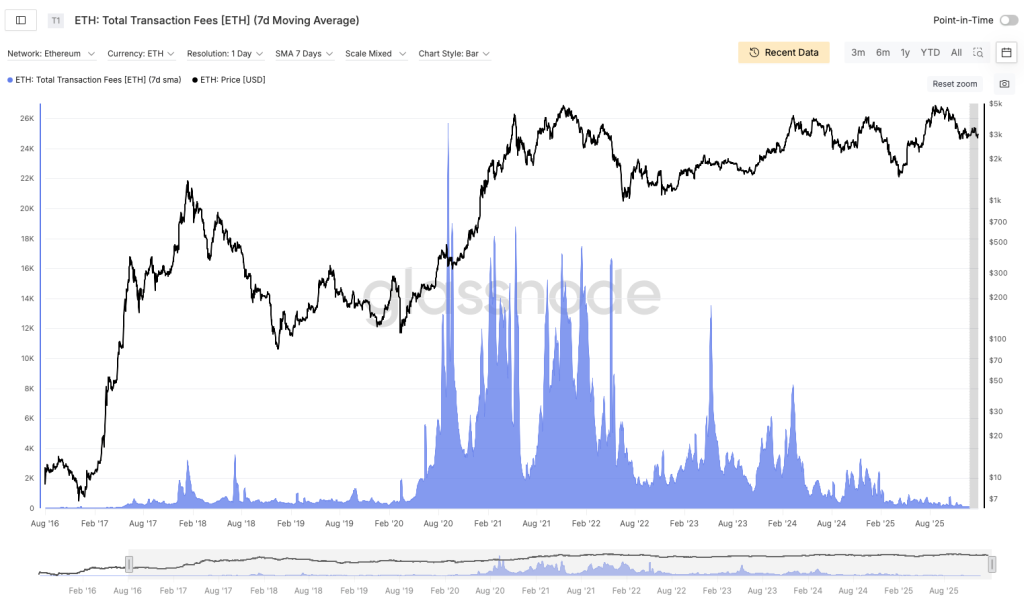
That is not due to falling activity. In January the network of the second‑largest cryptocurrency by market capitalisation set a new all‑time high for transfers. The seven‑day average neared 2.5m — twice last year’s level.
On‑chain activity began to surge in mid‑December after a long slump. Scalability has been supported by recent upgrades.
- activation of the Fusaka upgrade at the start of winter;
- fork Blob Parameter-Only (January 7), which raised the per‑block blob limit from 15 to 21.
In January, Glassnode recorded a doubling in Ethereum’s activity‑retention metric.